.svg)
ReinstateIQ had sellers paying $3,500 and waiting a week for a lawyer to draft an appeal. We built a RAG-powered platform that generates a submission-ready Plan of Action in under 3 minutes, with an 87% reinstatement rate.
.png)
See how Amplence builds AI systems that replace expensive manual processes with speed and precision.
We built an AI-powered Amazon appeal generation system using Retrieval-Augmented Generation (RAG) trained on 46 real, successful appeal templates. The system reads the suspension reason, matches it against winning precedents, and writes a tailored Plan of Action in minutes. Not days. Deployed across 2,000+ appeals with an 87% reinstatement rate.
We indexed 46 real successful Amazon appeals into a vector database, building a proprietary precedent library that no off-the-shelf tool could replicate. When a seller submits their case details, Gemini semantically searches this database and retrieves the most relevant successful precedents. These are injected directly into the generation prompt, grounding every appeal in proven, real-world language that Amazon's review teams have already accepted. This single layer is the primary driver behind the platform's 87% success rate.
.png)
The generation layer runs on GPT-4o-mini with a custom legal prompt system built specifically around Amazon's reinstatement framework. It structures every appeal according to Amazon's own preferred format, Plan of Action, Root Cause, Corrective Steps, and dynamically adapts tone and emphasis based on the specific violation type, whether that's an inauthentic complaint, a policy breach, or a performance-related suspension. The result is a fully formatted, professional appeal document delivered in under 3 minutes.
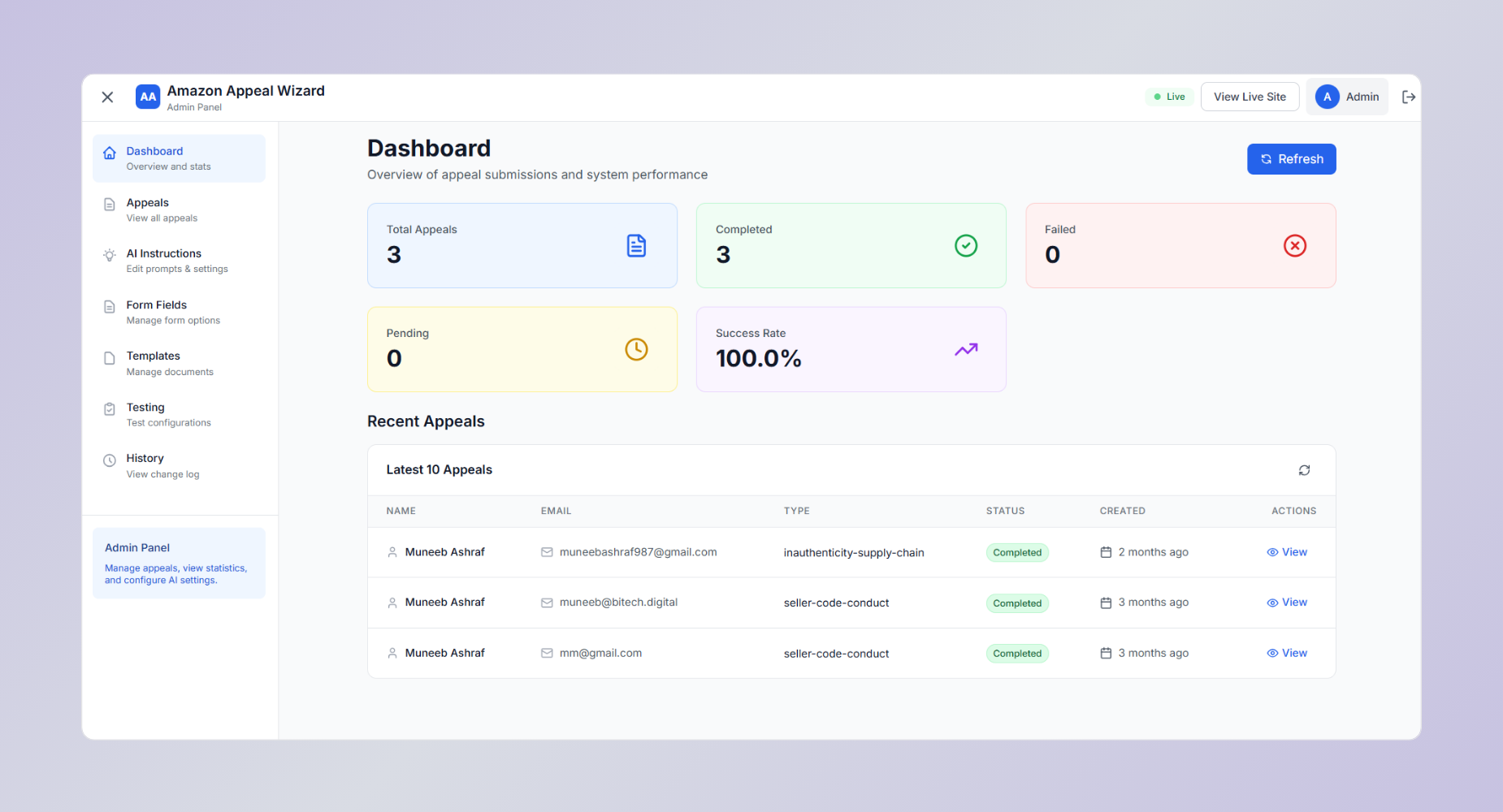
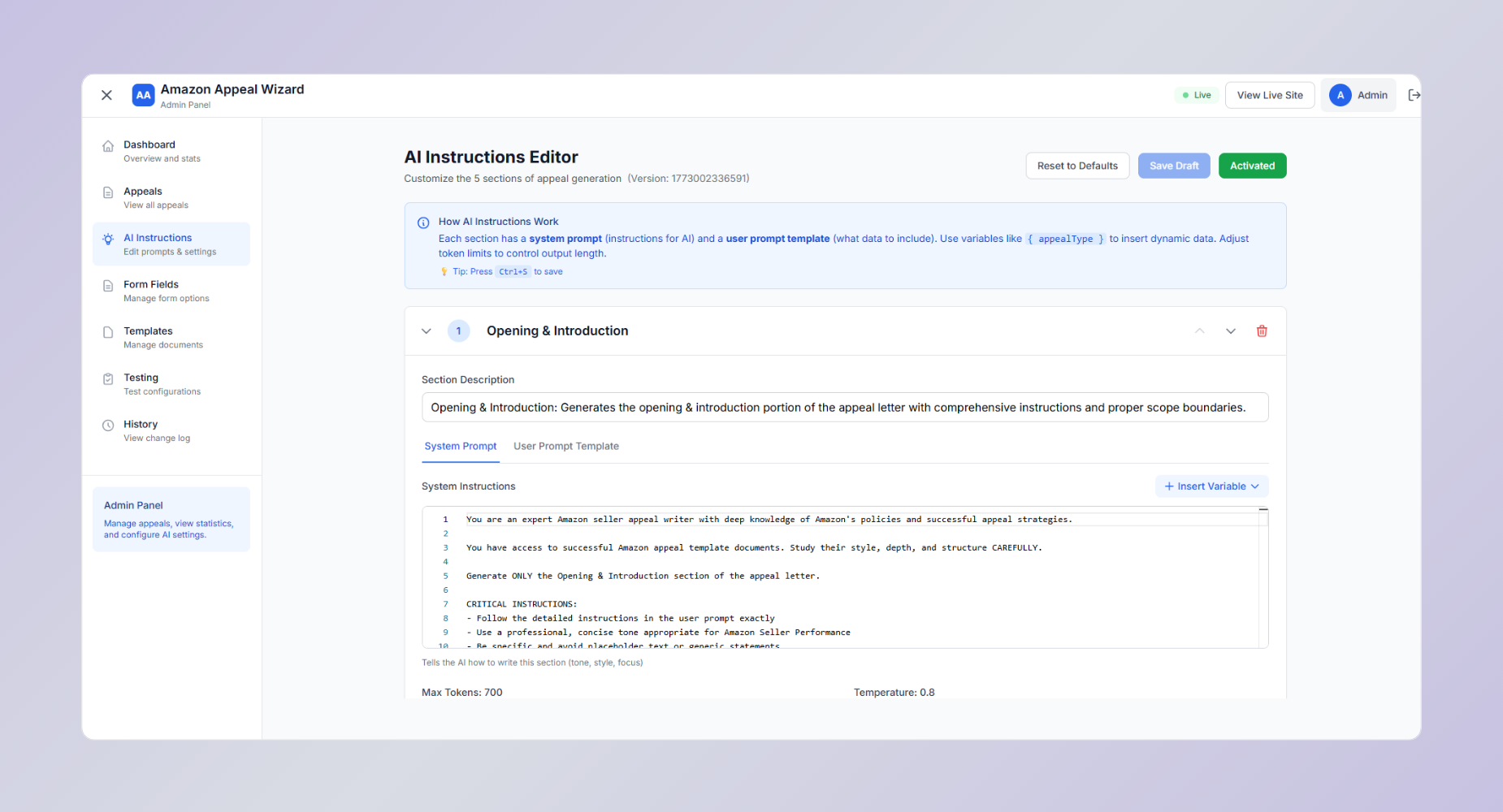
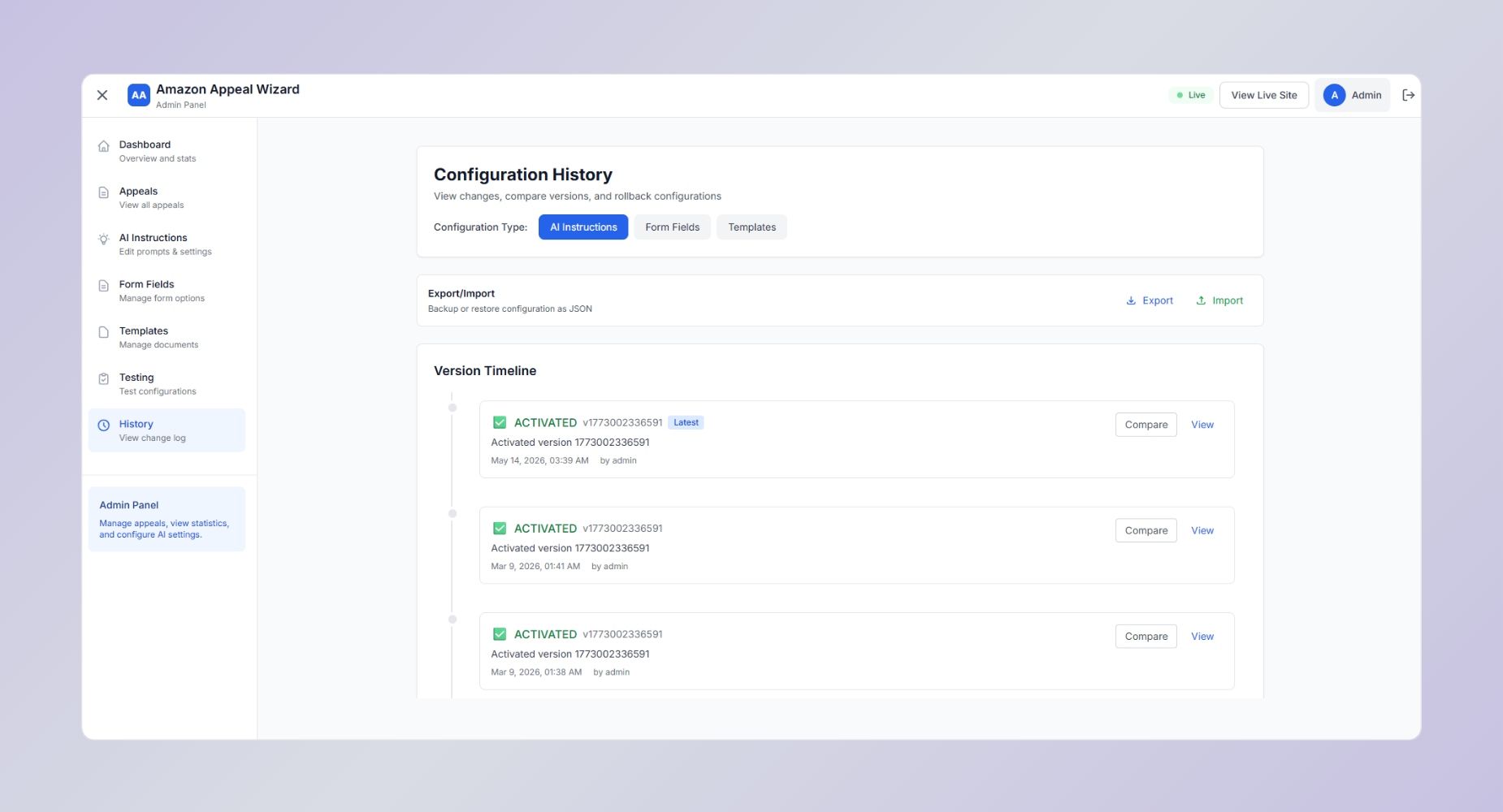
Behind the seller-facing product sits a full internal admin dashboard that gives the team complete control over the AI's behavior. Prompts can be iterated and versioned, legal templates managed and updated, and A/B tests run between document variants to compare approval rates across different writing approaches. Every change is tracked and logged, turning what usually runs on gut feeling into something measurable and repeatable.
Sellers come in through a clean, guided onboarding flow that walks them through their case details one step at a time. Stripe handles all the payment and subscription logic, and the portal gives them a full dashboard to track every appeal they have ever generated, including status, submission history, and outcome records. Nothing slips through the cracks and sellers always know exactly where their case stands.
?


The platform runs on a serverless Next.js 14 architecture, with API routes handling all AI orchestration between the RAG pipeline and the generation engine. The two AI layers, Gemini for retrieval and GPT-4o-mini for generation, are fully decoupled, meaning each can be scaled, swapped, or improved independently without touching the other. Supabase handles all persistent data: user accounts, appeal records, prompt versions, and A/B test results. The entire system is designed to deliver a complete, submission-ready appeal document in under 3 minutes at any volume.
Retrieval-Augmented Generation sits at the core of what makes the output legally credible rather than generically plausible. Gemini doesn't just assist the prompt, it anchors every generated appeal in the language and structure of real decisions that have already worked.
The version-controlled prompt system ensures that improvements compound over time. Every prompt iteration is stored, compared against historical approval rate data, and only promoted to production when it demonstrably outperforms its predecessor. The platform gets sharper with every case that runs through it.

The AI doesn't write from scratch, it retrieves from a library of 46 real successful appeals and grounds every generated document in language and structure that Amazon's review teams have already accepted. The attorney or ops lead still reviews and approves every appeal before it's submitted. The AI handles the pattern, your team handles the judgment.
Every appeal is generated using Retrieval-Augmented Generation, meaning the system searches real successful precedents before writing anything. It's not asking GPT to "write an Amazon appeal," it's anchoring the output in proven cases that match the specific suspension reason. That's the difference between an 87% success rate and a generic AI wrapper.
Yes. The admin panel includes full prompt version control and A/B testing. Every prompt iteration is stored and compared against historical approval rates, and only promoted to production when it demonstrably outperforms the previous version. The system gets sharper with every case.
Yes. Sellers get a Stripe-gated portal with a full dashboard showing every appeal they've generated, current status, submission history, and outcomes. Nothing requires a support ticket to check.
This platform took 4 months from scoping to production deployment on Next.js 14 and Supabase, and it's been running across 2,000+ appeals since. The timeline depends on how much the RAG pipeline needs to be trained on your specific precedent library, but a focused first version can move faster.
Practical systems that reduce manual work, lower costs, and help teams scale.


