.svg)
CollageDepot's support team was drowning, 48+ hour response times and a 22% rise in refund requests. We built an n8n pipeline that classifies, enriches with live Shopify data, and replies in four languages, resolving 65% of tickets in under 60 seconds.

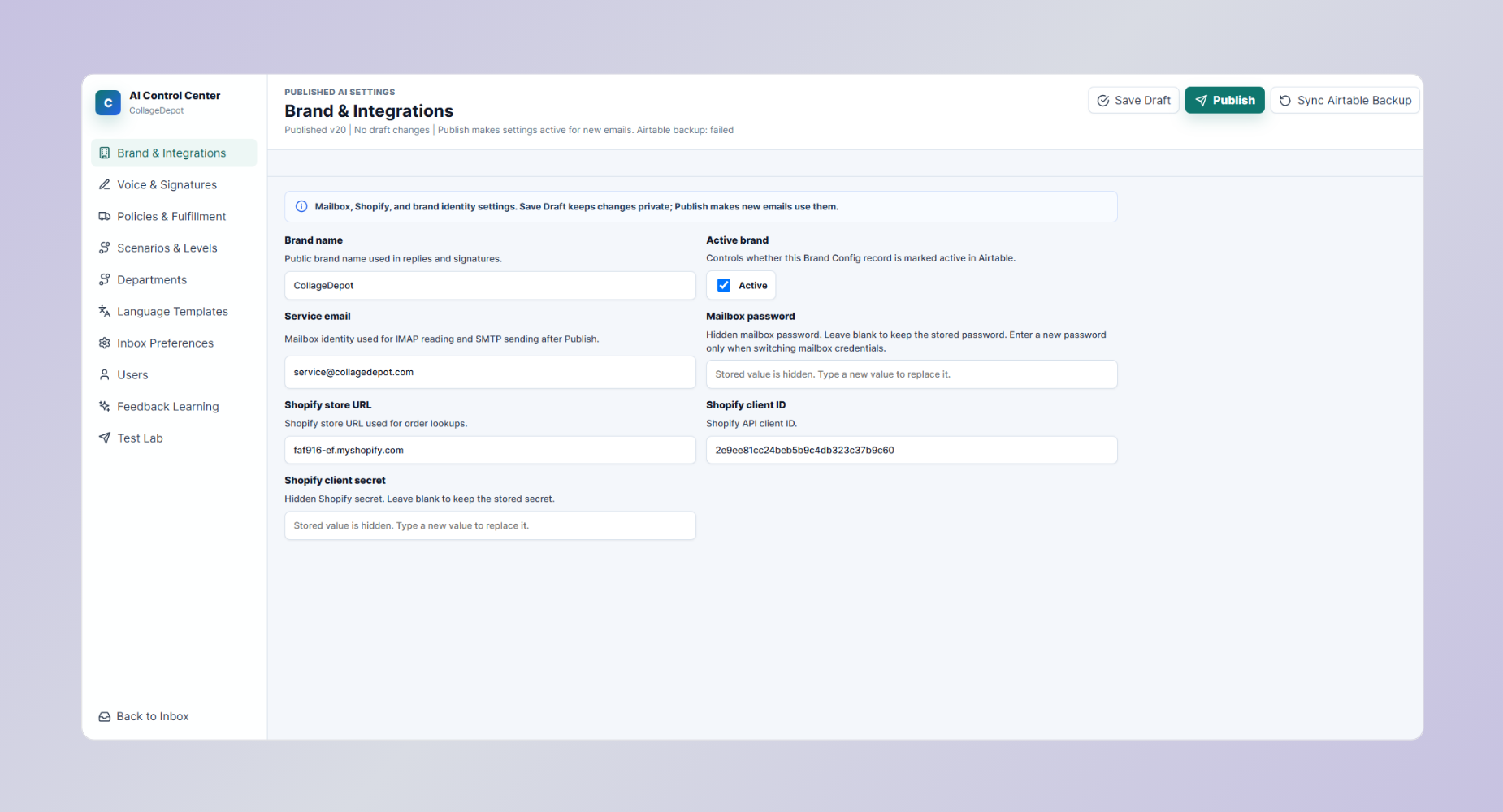
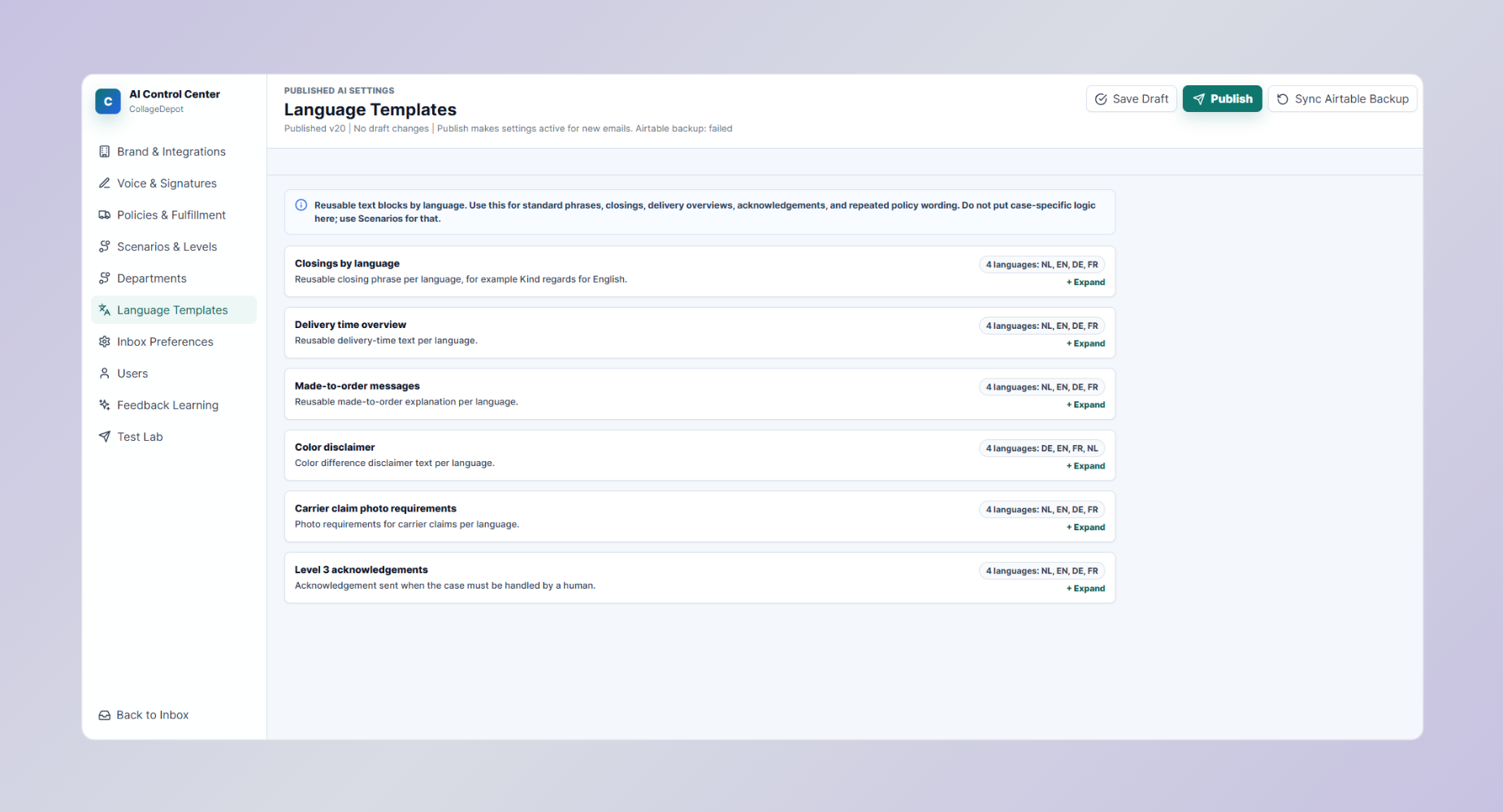
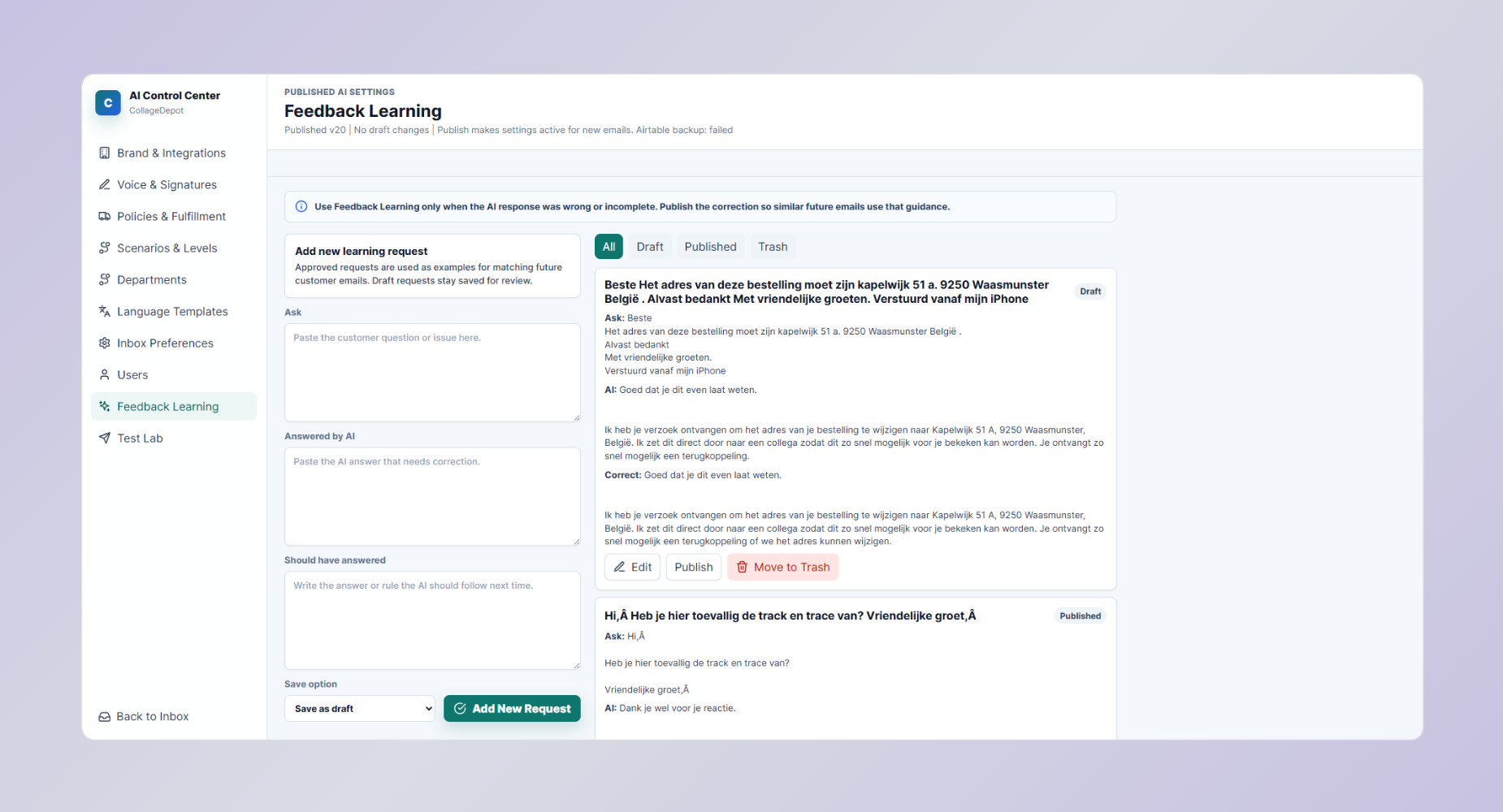
Amplence builds AI pipelines that handle customer service at scale, so your team only deals with the stuff that genuinely needs a person.
CollageDepot was fielding over 5,000 customer service emails a month across four languages, and the support team was underwater. Response times had crept past 48 hours, satisfaction scores were slipping, and 70% of the team's day was being eaten up by the same repetitive questions about order status, shipping, and return policies. On top of that, the business had zero visibility into ticket trends, resolution rates, or how customers were actually feeling. They needed an automated pipeline that could understand what a customer was asking, pull live Shopify data, reply in the right language, and only hand off the genuinely tricky ones to a real person.
Every email that lands in CollageDepot's inbox goes through a GPT-4o classification layer before anything else touches it. It picks out the important details like order IDs and product names, catches urgency signals and negative tone, and drops the email into a priority tier. The whole thing takes under two seconds and sets up every step that follows with the context it needs to work properly.
The moment an email comes in as order-related, the pipeline fires a Shopify API call using the order ID it just extracted. It pulls back real-time order status, fulfillment progress, tracking number, carrier, estimated delivery window, and product details. That data gets injected straight into the response prompt so every auto-reply is based on the customer's actual order, not a generic script. That's the main reason the platform hits a 65% auto-resolution rate without any human involvement.
GPT-4o writes fully personalized responses in the customer's own language, English, Spanish, French, or German. Each reply uses the customer's name, references their specific order, answers their actual question, and pulls in relevant policy details where needed. The tone is matched to CollageDepot's brand voice, so automated replies are practically indistinguishable from a well-written human response, except they land in under 60 seconds, any time of day.
The support team keeps full visibility through a live dashboard built on Supabase real-time subscriptions. Managers can watch incoming volume, track auto-resolution rates by category and language, check sentiment trends, and see the live escalation queue at any point. Any ticket can be overridden, reassigned, or flagged manually without touching the pipeline. Escalation thresholds are adjustable right from the dashboard, so the team can dial up or pull back the automation whenever the situation calls for it.


The whole thing runs through n8n, giving CollageDepot's operations team full visibility and control over the workflow without having to loop in a developer every time something needs to change. Email ingestion, AI classification, Shopify enrichment, response generation, multilingual delivery, and escalation routing all live as separate, independently logged nodes in the workflow. This means any stage can be paused, edited, or replaced without disrupting the rest of the pipeline, and the team can see exactly where any given email is in the process at any moment.
n8n visual workflow orchestration was a deliberate architectural choice over a custom-coded pipeline. It means the client owns the system fully, they can extend it, audit it, and adapt it to new business requirements without returning to a development team. The AI does the intelligent work; n8n provides the transparent, controllable infrastructure around it.
Sentiment-based escalation logic is what makes high automation rates trustworthy rather than risky. GPT-4o scores every inbound email for negative sentiment intensity, urgency language, and complexity signals. Emails that exceed defined thresholds, an angry customer threatening a chargeback, a multi-issue complaint with legal language, a VIP account with a high-value order problem, bypass the automation layer entirely and are flagged for immediate human review, with all classification data and order context pre-loaded so the agent can respond intelligently from the first second.

GPT-4o writes fully personalized responses in the customer's own language, English, Spanish, French, or German, matched to CollageDepot's brand voice. Each reply references the customer's name and actual order details, so it reads like a well-written human response, not a translated template.
Every email is scored for negative sentiment, urgency language, and complexity signals before anything else happens. Anything that crosses defined thresholds, an angry customer threatening a chargeback, a multi-issue complaint, a VIP account, gets routed straight to a human with full context pre-loaded, no automation attempted.
That was the point of building it on n8n rather than custom code. Email ingestion, classification, Shopify enrichment, response generation, and escalation all live as separate nodes you can pause, edit, or replace without touching the rest of the pipeline or looping in a developer.
Yes. The moment an email is identified as order-related, the pipeline calls the Shopify API directly using the extracted order ID and pulls real-time status, tracking, carrier, and delivery estimates. That live data gets built into the response, which is the main reason the system hits a 65% auto-resolution rate.
There's a real-time dashboard built on Supabase showing incoming volume, auto-resolution rates by category and language, sentiment trends, and the live escalation queue. Managers can override, reassign, or flag any ticket and adjust escalation thresholds directly from the dashboard.
Practical systems that reduce manual work, lower costs, and help teams scale.


.webp)