.svg)
We turned a complicated Medicare comparison journey into a clear, evidence-led prototype that helps people understand their options before speaking with a licensed advisor.
.png)
.png)
.png)
Our healthcare MVP development services help early-stage teams turn a promising idea into a focused, testable product.
Find The Plan helps people make sense of health insurance and Medicare with simple guidance and access to experienced advisors. The opportunity we saw was not to replace that human support. It was to make the conversation easier to start.
Choosing a plan can feel like reading several rulebooks at once. One person may care most about keeping a doctor. Another may travel often, take regular prescriptions, or want more predictable costs. Those priorities are hard to compare across long plan documents.
For this independent concept, we asked a practical question: what is the smallest useful AI product that could make this journey clearer? That question shaped the healthcare app MVP development process from the first screen to the advisor handoff.
?
We began with product discovery, not a long feature list. The goal was to find one journey that could prove the idea: choose a sample profile, describe a few priorities, compare plan evidence, and prepare for an advisor conversation.
That narrow scope made the concept useful as both an AI proof of concept and a custom healthcare software MVP. It showed the experience, the AI workflow, and the safety boundaries without pretending to be a finished insurance platform.
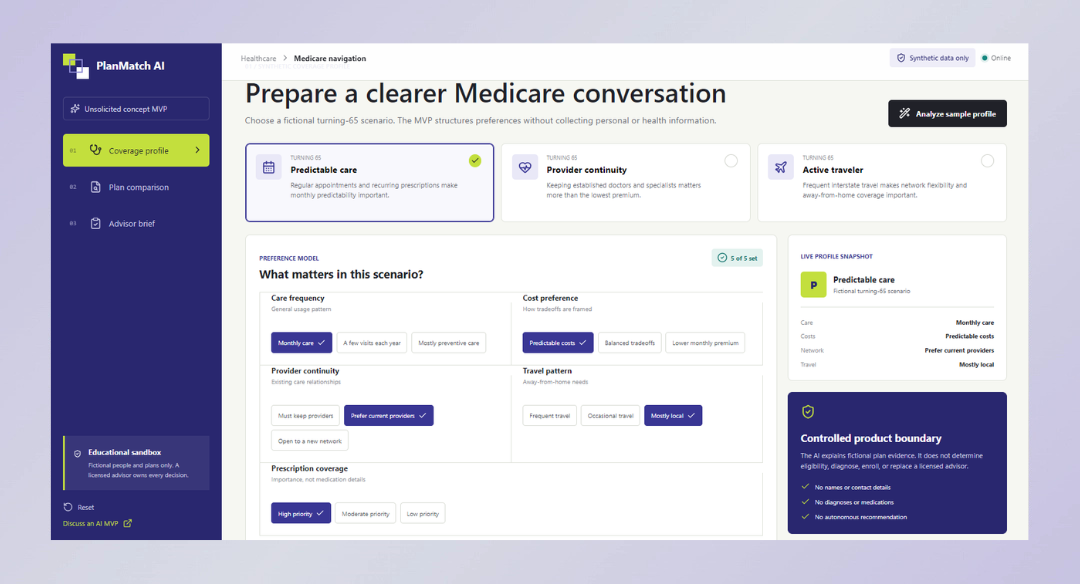
The prototype replaces an open-ended questionnaire with five guided choices. Users can describe care frequency, cost preferences, provider continuity, travel, and prescription priorities without entering a name, diagnosis, medication, or contact detail.
This is how we approach healthcare startup MVP development: reduce the first release to the decisions that need to be tested. Every screen should answer a product question instead of simply adding another feature.
The AI compares three fictional Medicare plan documents. Before generating an explanation, the system retrieves the clauses that match the user's priorities. Each plan summary then points back to those evidence IDs.
This retrieval-guided approach makes the recommendation engine easier to inspect. The user can see why a plan looks strong, where the tradeoffs sit, and which questions still need a human answer. Explainable AI, structured outputs, and model guardrails keep the experience grounded.
The product does not announce a winner. It creates an advisor-ready brief with the user's priorities, the plan comparison, unresolved questions, and verification checks. A clear review gate reminds everyone that the final conversation belongs with a licensed professional.
That human-in-the-loop design is important when building an AI health insurance platform. The AI does the organizing. The advisor brings judgment, current plan knowledge, and the responsibility to guide the customer.
The concept uses synthetic data and accepts no personal health information. There are no fields for names, contact details, diagnoses, or medications. This privacy-by-design choice kept the prototype focused while reducing unnecessary risk.
A production version would need a separate discovery phase for HIPAA considerations, data security, access controls, audit logging, encryption, consent, and vendor responsibilities. We would never describe a product as HIPAA-ready or HIPAA-compliant without validating the real data flows and technical controls.
The working flow moves from a synthetic profile to an AI comparison, an evidence inspector, and an advisor brief. That gave us a realistic way to test usability, retrieval quality, failure handling, and the handoff between automated guidance and human review.
MVP development services for early-stage healthcare apps should create this kind of learning. The first version does not need every planned feature. It needs to show whether the core experience is useful, trusted, and worth developing further.
The result is a focused concept for AI MVP development for healthcare startups. It demonstrates how rapid prototyping, product validation, and scalable architecture can come together around one clear customer problem.
It also creates a practical roadmap for the next phase: user testing, plan-data integrations, advisor workflow automation, secure APIs, role-based access, analytics, and a controlled pilot. Instead of debating an idea in the abstract, the team can react to a product they can see and use.
?


The user selects a fictional scenario and sets five practical preferences. This gives the AI enough structure to compare plans without collecting personal or medical details.
The system searches fictional Medicare plan clauses for details related to cost, providers, prescriptions, travel, and care frequency. Only the most relevant evidence moves into the analysis.
The AI creates a plain-language summary for each plan, highlights benefits and tradeoffs, and attaches citation IDs. The server checks the response structure and rejects unsupported citations.
The user can open the evidence inspector and read the exact clause behind each important statement. This turns the AI from a black box into a reviewable decision-support tool.
The final brief collects priorities, comparisons, open questions, and verification checks. It is marked for licensed-advisor review rather than presented as insurance advice.
This workflow shows how health insurance app development and Medicare app development can begin with a focused MVP before expanding into plan-data integrations, customer accounts, scheduling, CRM workflows, and production security controls.

Start with teams that can discuss the product problem before discussing features. Strong healthcare MVP developers should understand product discovery, user validation, privacy, AI safety, and the limits of automated healthcare guidance. Ask to see a working prototype plan, a clear scope, and how they will measure what the first release teaches you. That is a better way to hire AI MVP developers than comparing hourly rates alone.
Healthcare app development cost depends on the number of workflows, integrations, user roles, compliance needs, and the type of AI involved. A focused prototype with synthetic data costs less than a production product that handles personal health information or connects to live plan systems. The most reliable estimate comes after a short discovery phase defines the first testable journey.
A narrow AI proof of concept can be built in a few weeks, while a production-ready healthcare MVP usually takes longer. The schedule changes when the product needs live data, secure user accounts, external integrations, formal compliance work, or clinical and legal review. Good AI PoC and MVP development services separate rapid learning from production hardening instead of treating them as the same job.
It can be designed with HIPAA considerations in mind, but readiness depends on the real data, systems, vendors, contracts, and operating controls. This concept avoids personal health information and uses synthetic data. A production healthcare product would need a formal review of privacy, security, access, storage, logging, and data-sharing requirements before making any compliance claim.
The best healthcare MVP development companies for startups combine product thinking with practical engineering. Look for an AI MVP development agency that can narrow the scope, build a usable prototype, explain model risks, plan secure integrations, and keep a human review step where decisions carry real consequences. The right partner should help you learn quickly without creating a fragile foundation.
Practical systems that reduce manual work, lower costs, and help teams scale.