.svg)
Greenfield Systems works in a world where timing, calibration, signal quality, and engineering accuracy matter. We created an AI agent that shows how manufacturing and precision-instrumentation teams can intake technical requests, match them to the right product path, and prepare a clean handoff for engineers.
.png)
.png)
.png)
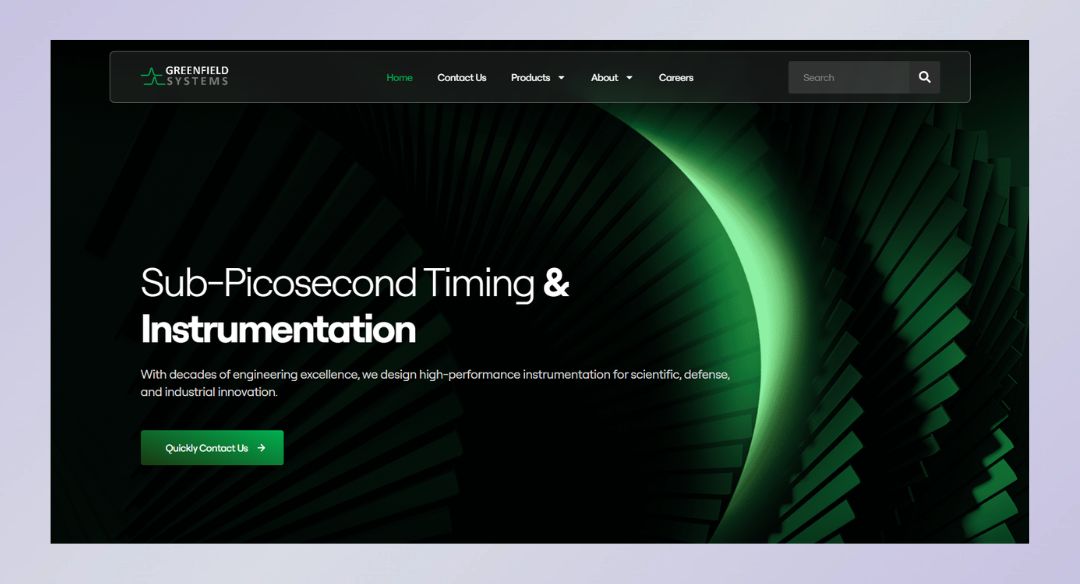
We can create an AI agent that fits your manufacturing workflow before you invest in a full platform.
Manufacturing companies often receive requests that are too technical for a simple contact form and too important to leave unstructured. A buyer may ask about timing systems, signal generators, high-speed data capture, calibration, on-site engineering, or a custom product path. If that request is not captured clearly, the sales team has to chase missing details and engineers lose time repeating the same discovery questions.
For Greenfield-style precision instrumentation, the challenge is even sharper. Their work involves sub-picosecond timing, trigger channels, pulse and delay systems, high-speed digitizers, custom solutions, and on-site calibration. A normal form cannot understand that context. This is where an AI agent for manufacturing business workflows can become useful.
We designed the agent around one practical question: how can an AI agent help a manufacturing team move faster without removing expert review?

The answer was not to create a chatbot that gives final answers on its own. Instead, the agent acts like an intake and routing assistant. It reads a technical request, identifies the key details, highlights what is missing, suggests the most relevant product path, and prepares a handoff for the right person.
This makes the page a strong example of how AI used in manufacturing industry workflows can support people who already know the product deeply. The agent does not replace sales engineers. It helps them start with cleaner information.
Many AI agents for manufacturing companies should begin with one high-value workflow: turning messy technical inputs into structured next steps. That is exactly what this agent shows.
A request may mention trigger channels, timing drift, signal stability, high-speed capture, or calibration. The agent separates those details into clear fields such as application, constraint, tolerance, service need, product family, and review priority.
From there, the team can quickly see whether the inquiry belongs with sales, product engineering, support, or an on-site service team.
This includes three AI agent for manufacturing use cases:
The agent reads a request for sub-picosecond synchronization across many trigger channels. It identifies the need for timing accuracy, product routing, and an engineering review before a quote is prepared.
The agent reviews a request around pulse generation, signal shaping, and high-speed capture. It maps the request to product categories like pulse shaping modules, signal generators, and high-speed digitizers.
The agent handles a service-style request where timing drift may affect a production test workflow. It routes the issue toward on-site engineering, calibration review, and support follow-up.
These AI agents in manufacturing examples keep the story grounded. They show what the agent does, what it does not do, and where a human engineer still needs to review the final recommendation.
It shows a simple AI agent for manufacturing business model. A company can start with one focused internal workflow instead of building a huge AI platform from day one.
For example, the business can use an agent to qualify inbound requests, reduce back-and-forth with prospects, prepare better discovery notes, and route opportunities to the right technical owner. This can support faster quoting, cleaner communication, and better use of engineering time.
For a company selling complex manufacturing tools, that kind of agent can become part of the sales process, support process, or customer portal experience.
The product-fit section shows how an AI agent for manufacturing building tools can guide users toward a likely product path. In this concept, the agent compares the request against Greenfield-style categories such as picosecond timing systems, pulse and delay generators, signal generators, pulse shaping modules, high-speed digitizers, time and frequency meters, custom solutions, and on-site engineering.
The important part is that the agent does not pretend every match is final. It shows confidence, explains why a product path may fit, and flags what an engineer should verify next.
An AI agent for manufacturing based startups can be especially useful when the team is small and every technical conversation matters. Startups often have expert founders, but not enough time to manually qualify every request, support question, and product-fit conversation.
This type of agent helps a startup test the workflow first. Before building a full SaaS product or internal portal, the team can see how the agent should read requests, what fields matter, what should be automated, and where human review is required.
Not every AI idea deserves a full build. The best AI agent for manufacturing business ideas are usually the ones tied to a repeated workflow.
For manufacturing teams, good starting points include RFQ intake, product selection, support triage, calibration request routing, spare-part matching, quality issue summaries, technical document search, and engineer handoff notes.
This agent focuses on the highest-friction part of the journey: turning a technical request into a clear next action.


Agent works in four simple steps.
The agent starts with the customer or internal team message. It looks for the real manufacturing context, not just the obvious keywords.
It pulls out the application, product need, technical constraint, tolerance, channel count, signal requirement, calibration issue, or on-site support need.
The agent compares the request with relevant manufacturing product categories and service options. It then shows why a product path may fit.
The final output is a clear review note for a sales engineer, support lead, or manufacturing specialist. This keeps the agent helpful without making risky final decisions on its own.

AI agents for manufacturing industry workflows are software assistants that help teams handle repeated technical tasks. They can read requests, extract important details, suggest product paths, create handoff notes, and support human decision-making.
AI agents for manufacturing companies can reduce manual intake work. They help sales and support teams understand what a customer needs, what information is missing, and which product or service path should be reviewed next.
A practical AI agent for manufacturing business usually starts with one workflow, such as RFQ intake, product matching, service routing, quality issue summaries, or engineering handoff notes.
Strong AI agent for manufacturing use cases include quote qualification, technical support triage, product selection, calibration request routing, field service preparation, inventory questions, quality documentation, and customer portal assistance.
An AI agent for manufacturing based startups should begin as a focused idea. The startup can test one useful workflow, learn what users need, and then decide whether to build a full platform, internal tool, or customer-facing portal.
Practical systems that reduce manual work, lower costs, and help teams scale.


.webp)