.svg)
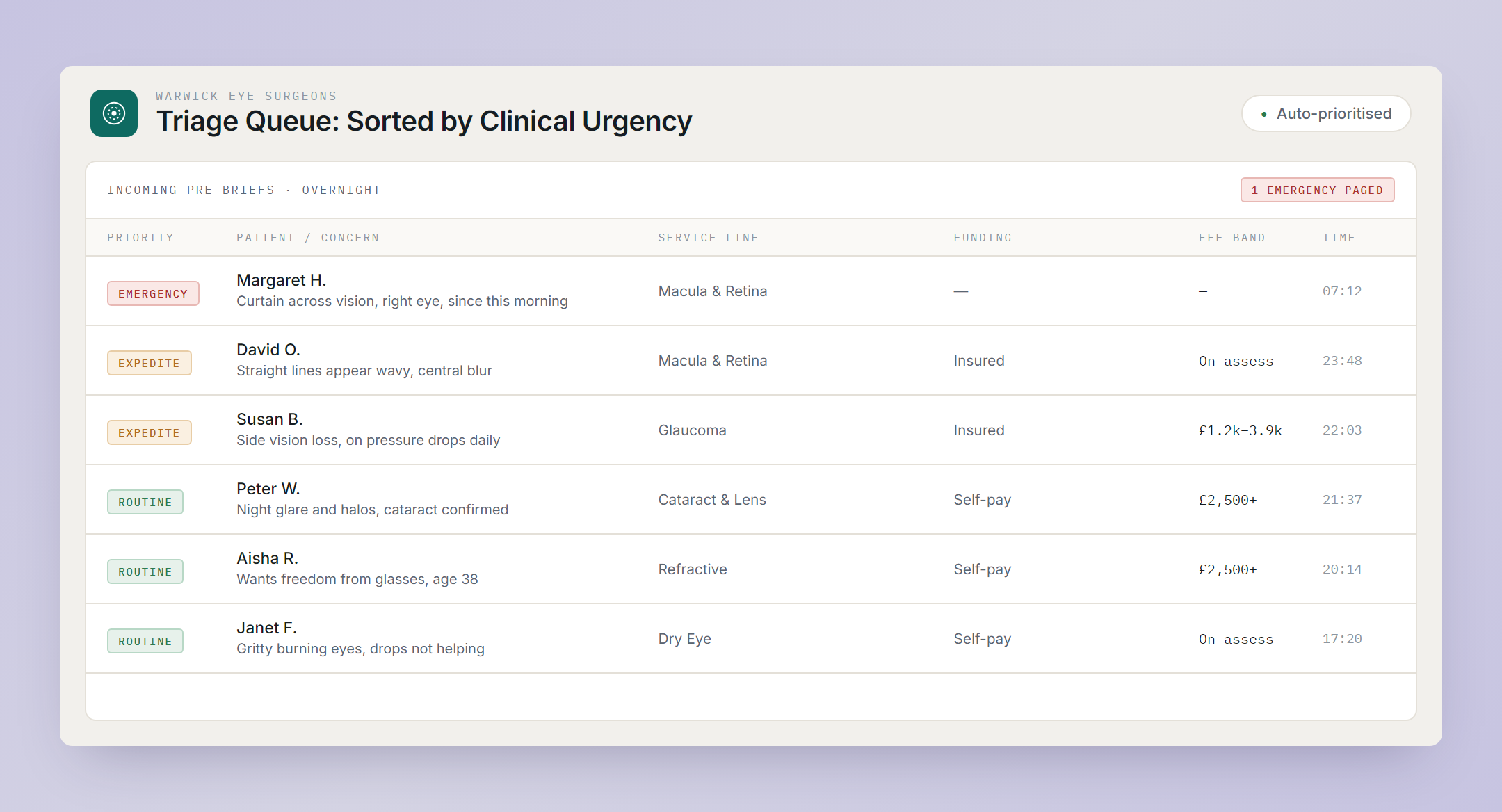
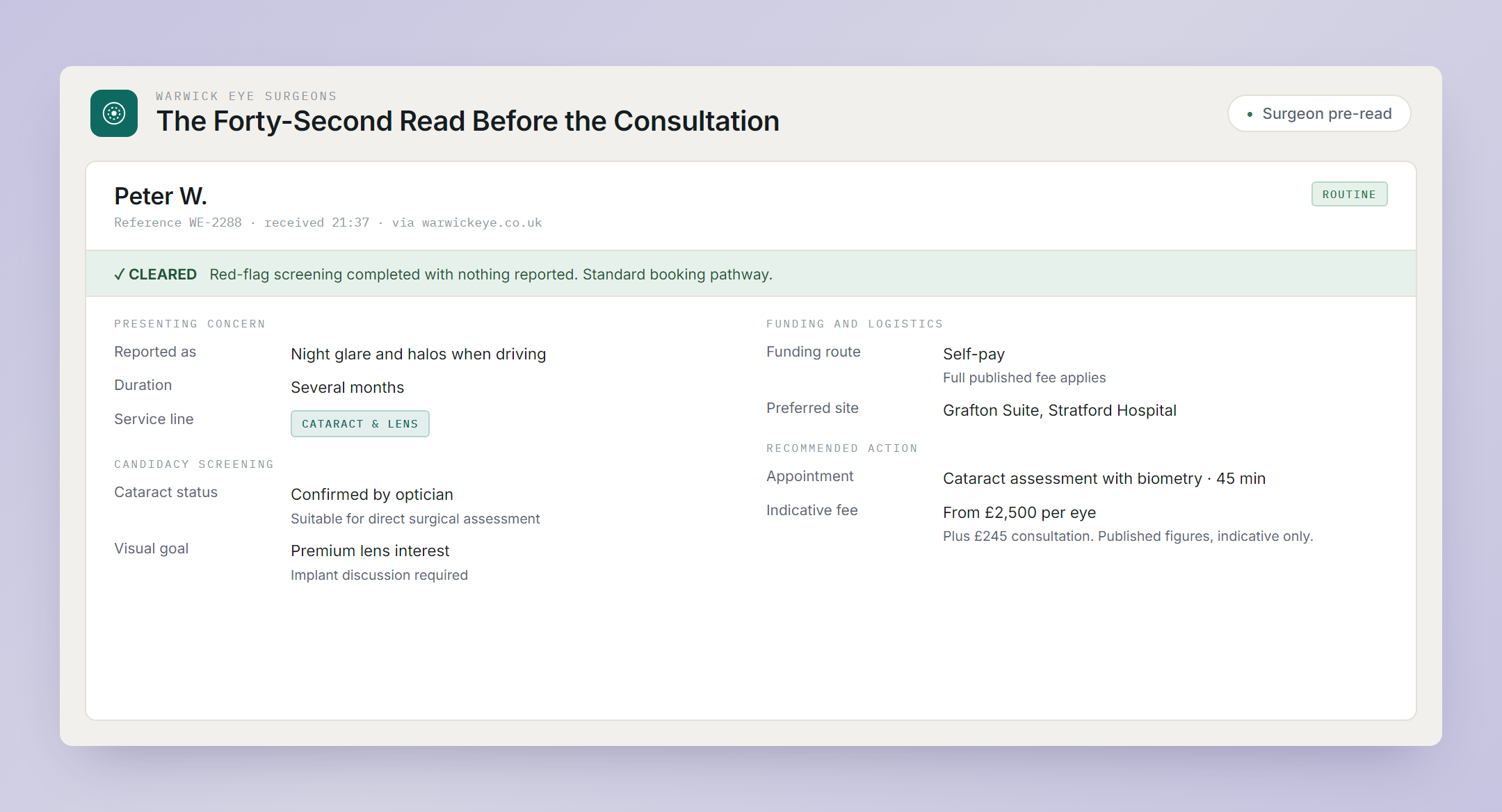
Warwick Eye Surgeons is a private ophthalmic surgery practice running seven surgical service lines across two hospitals, with fees published openly. We built a concept custom AI agent that screens every patient enquiry for sight-threatening symptoms, routes it to the right service line, and prepares a clinical brief the surgeon can read in forty seconds.
We can design and build a custom AI agent that fits your clinical workflow and your compliance obligations, before you commit to a full platform.
Private healthcare practices sit on a difficult gap. A patient researching cataract or glaucoma surgery is making a decision worth thousands of pounds, often anxiously, usually outside working hours. The practice has published fees, seven surgical service lines and two hospital sites. What it does not have is any way to turn an anonymous website visitor into a qualified, prioritised patient at two in the morning.
Warwick Eye Surgeons publishes its fees openly, which is a real differentiator in a market built on opacity. But a static price list cannot tell an individual patient what their case is likely to cost, and it cannot explain the insurance implant top-up before that becomes an unpleasant surprise. Meanwhile, the enquiries that genuinely need urgent attention look identical to the ones that do not.
This is the gap a custom AI agent for healthcare intake is well suited to close, provided it is built with the constraints of a clinical setting designed in from the start rather than bolted on afterwards.
We started from one question: how can an AI agent make a private practice faster without ever putting itself between a patient and urgent care? The answer was not a chatbot that answers clinical questions. It was a structured intake agent that gathers, screens, routes and hands off, with the clinical judgement left firmly with the surgeon.
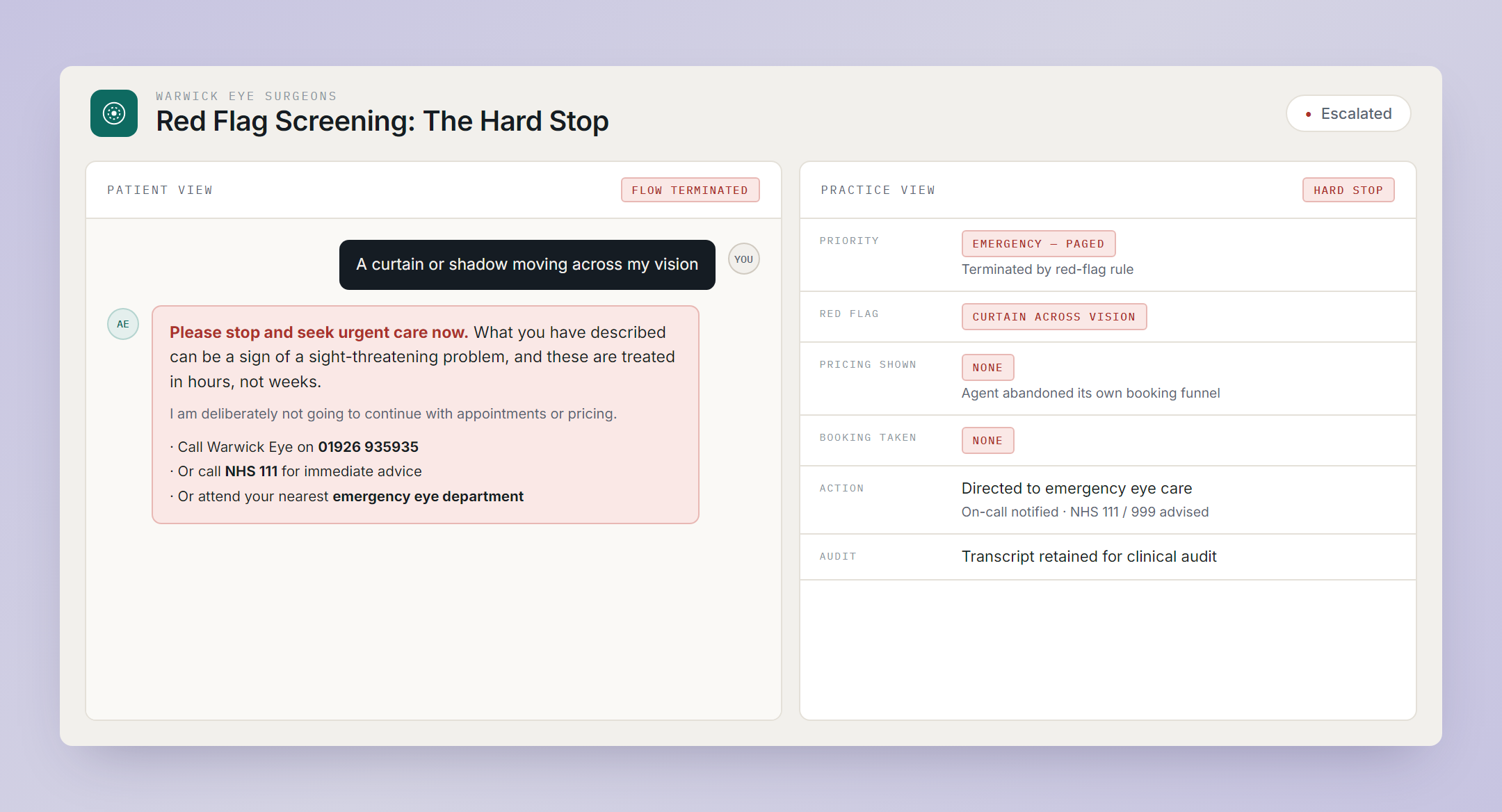
Before anything commercial happens, the agent screens for sight-threatening presentations: sudden vision loss, a curtain or shadow across the field, a new shower of floaters or flashes, severe pain with halos and nausea, and recent injury or chemical exposure. A positive hit terminates the session immediately. No booking, no pricing, no lead capture. The patient is directed to NHS 111, an emergency eye department or 999, and the practice is paged.
That behaviour is the point. An intake agent that would rather capture a lead than send a patient to A&E is not safe to deploy, so this rule sits in deterministic application code above the conversational layer where the language model cannot be talked out of it.
The distinction matters both clinically and legally. The agent performs administrative triage: it routes an enquiry to the correct service line and flags urgency. It never performs clinical triage, never names a condition as the patient’s, never interprets a result and never offers reassurance about a symptom. Every clinical statement is framed as something the surgeon will assess.
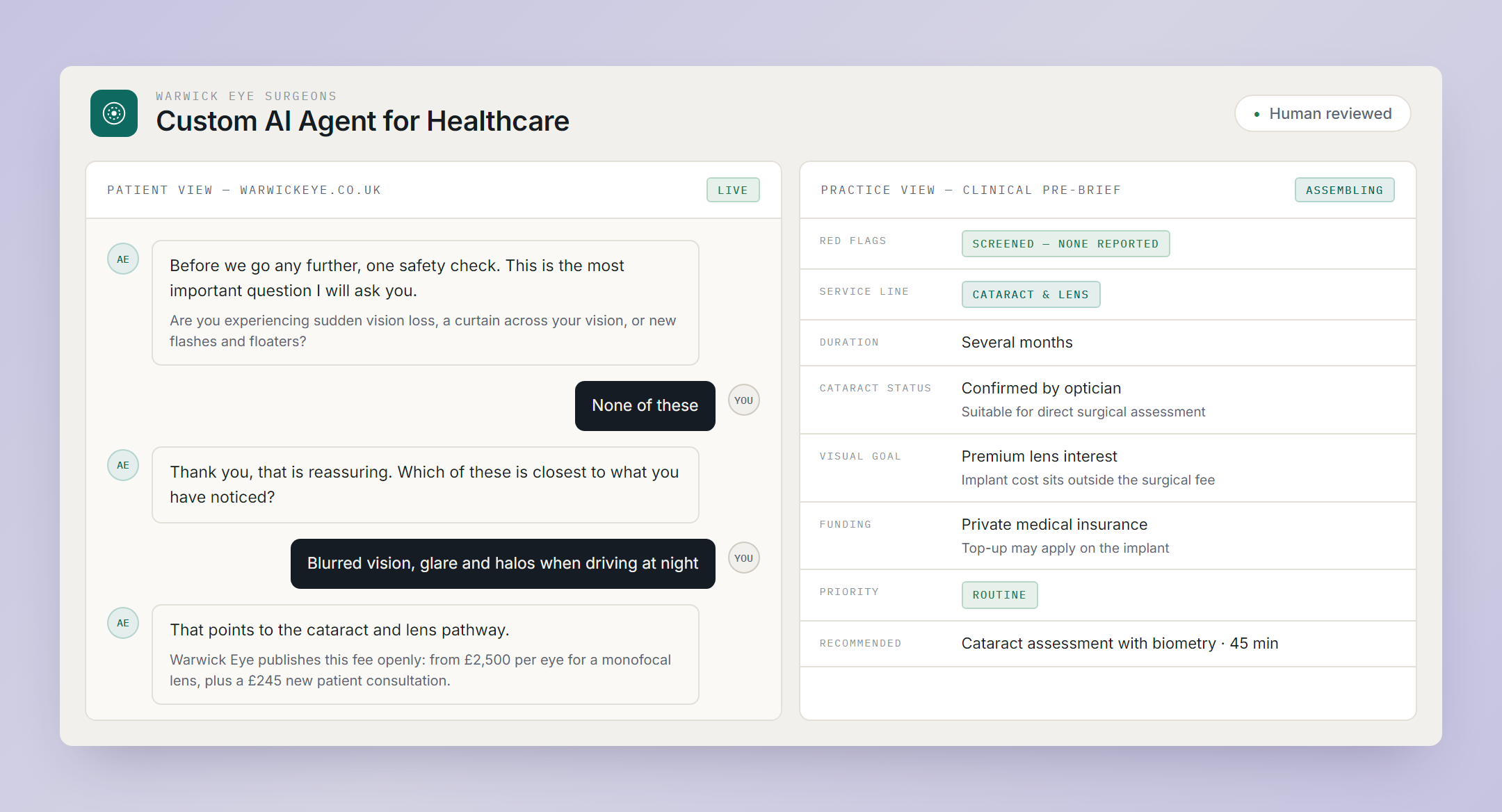
Each service line carries the questions a surgeon would otherwise ask in the first five minutes of a paid consultation. Age band against presbyopia to separate laser candidates from lens exchange candidates. Whether an optician has confirmed a cataract. Whether the patient is already on pressure-lowering drops. Distortion on an Amsler-style question for macula presentations.
The agent then quotes the practice’s own published figures against the pathway identified, and proactively surfaces the insurance implant top-up the practice already discloses in writing. Delivering that caveat before a patient commits turns honesty into trust rather than into a difficult conversation later.


The agent moves through six stages, and every output it produces is traceable to the answer that caused it.
Establishes why the visitor came: a symptom, a procedure they are researching, an optician or GP referral, or a pure cost enquiry. A cost-only enquiry is deliberately never treated as a clinical one.
The hard stop. Five sight-threatening presentations are screened before any commercial step. A positive result ends the session and routes the patient to emergency care.
Maps the presentation onto one of the seven lines the practice actually operates: cataract and lens, glaucoma, refractive, dry eye, retina, macula and oculoplastics. This is the step that removes the qualifying phone call.
Line-specific questions that establish suitability and surface contraindications, so the paid consultation is not spent gathering information a form could have captured.
Indicative published figures for the identified pathway, plus the self-pay or private medical insurance route and the implant top-up disclosure.
A single-screen clinical brief containing the presenting concern, duration, cleared red flags, service line, candidacy notes, funding route, site preference, and a recommended appointment type with the right diagnostic slots attached. Every brief is marked for human review before action.

A custom AI agent for healthcare is software built around one practice’s specific workflow rather than bought off the shelf. It can read patient enquiries, screen for urgent symptoms, route them to the right service line, gather the information a clinician needs, and prepare a structured handoff. It supports human decision-making and does not replace it.
No. The agent performs administrative triage, not clinical triage. It routes and describes, never names a condition as the patient’s, never interprets results, and never offers reassurance about a symptom. Clinical judgement stays entirely with the surgeon, and every brief is marked for human review.
Red flag detection sits in deterministic code above the conversational layer. If a patient reports a sight-threatening symptom, the session terminates immediately, no pricing or booking is presented, and the patient is directed to NHS 111, an emergency eye department or 999 while the practice is paged. The language model cannot override that rule.
Patient health information is special category data. The design collects only what changes a routing decision, stores no free-text medical history, processes in the UK region, retains transcripts for thirty days, and keeps the structured brief separated from identifying details until the practice claims it. For a US practice the equivalent requirement would be HIPAA, which changes the controls but not the principle.
This concept is scoped at six weeks across four phases: encoding the clinical rules with the lead clinician, building the agent and an adversarial guardrail test suite, integrating with the practice enquiry workflow, then a supervised live pilot on two service lines with every brief human-reviewed before wider rollout.
Practical systems that reduce manual work, lower costs, and help teams scale.