.svg)
Bella Luxe sells professional lash and brow products from Bergen into seven European markets, serving salons and private customers through the same storefront. We built a concept that replaces the whole manual order process, from an inbound message in Norwegian through to customs paperwork on an EU shipment, with a compliance gate that can stop the line.
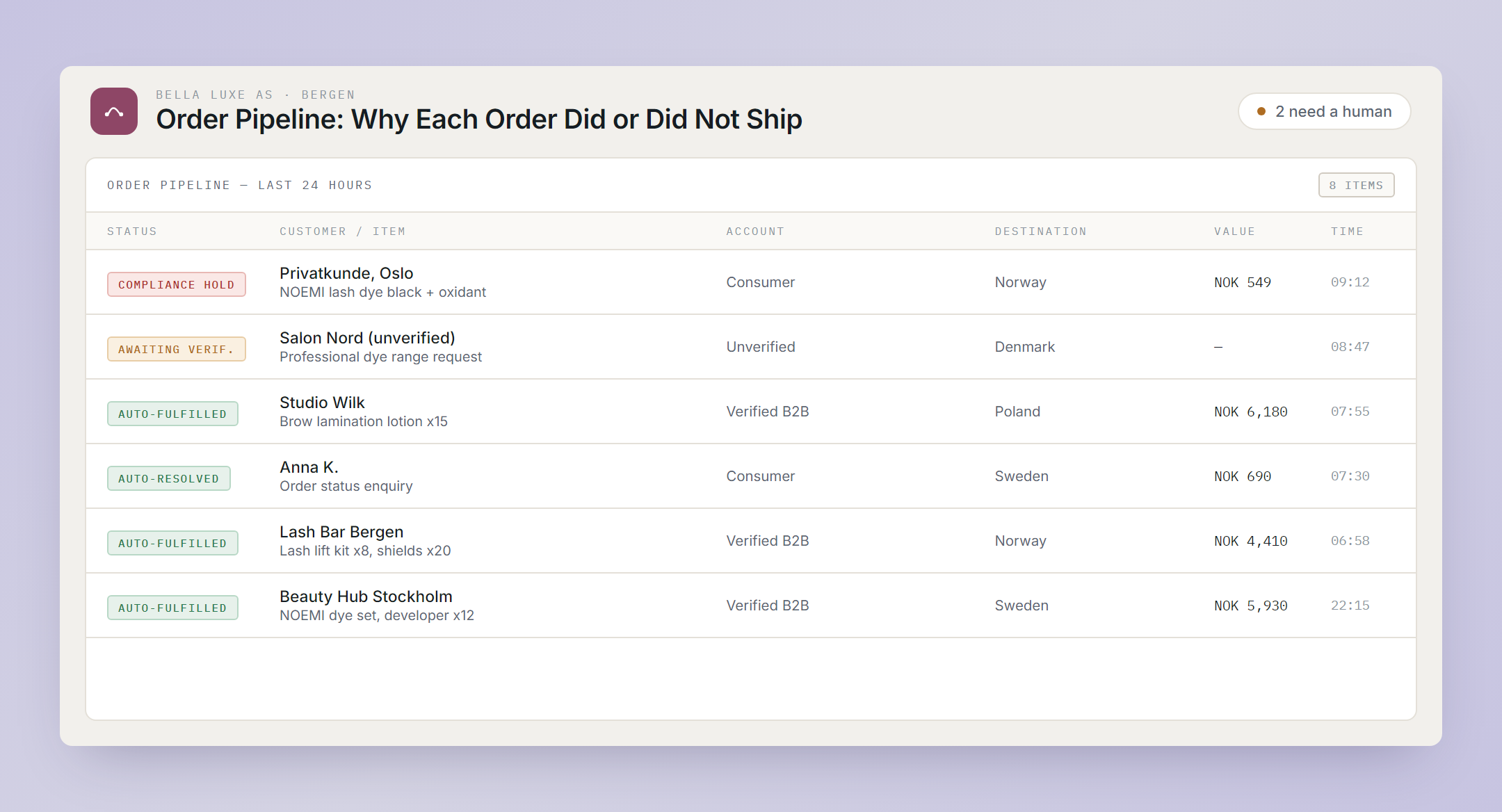
We map your real process first, including the rules that only live in people’s heads, then automate the decision points that actually cost you time.
Bella Luxe AS operates from Bergen and sells professional lash lift and brow lamination products, alongside training courses that certify the technicians who use them. Orders arrive in Norwegian, Swedish, Danish, English and Polish, through four different channels, from both trade buyers and private customers, bound for Norway and six EU destinations.
Individually, none of that is hard. Together it forms a process with more decision points than a person can apply consistently at volume. Which market is this? Is this buyer a salon or a consumer? Have they actually proved it? What price tier applies? Is everything in stock? And, most consequentially, is this order lawful to fulfil at all?
That last question is not a formality. Under EU cosmetics rules, eyelash dyes are restricted to professional products, and eyebrow products are treated differently. Supplying a restricted item to a private customer is not a service failure, it is a regulatory one. Any automation that speeds the process up without answering that question properly makes the problem worse, faster.
The distinction matters. Connecting Shopify to an inbox automates a task. What Bella Luxe needed was the whole process modelled end to end, with a single record travelling from first contact to dispatch, and AI confined to the points where a judgement is genuinely required.
We designed six stages. Language and market resolution, intent classification, account resolution, commerce enrichment, the compliance decision, and fulfilment routing. Each stage writes what it decided and why onto the order, so nothing downstream has to guess and no human ever lands on a blank screen.
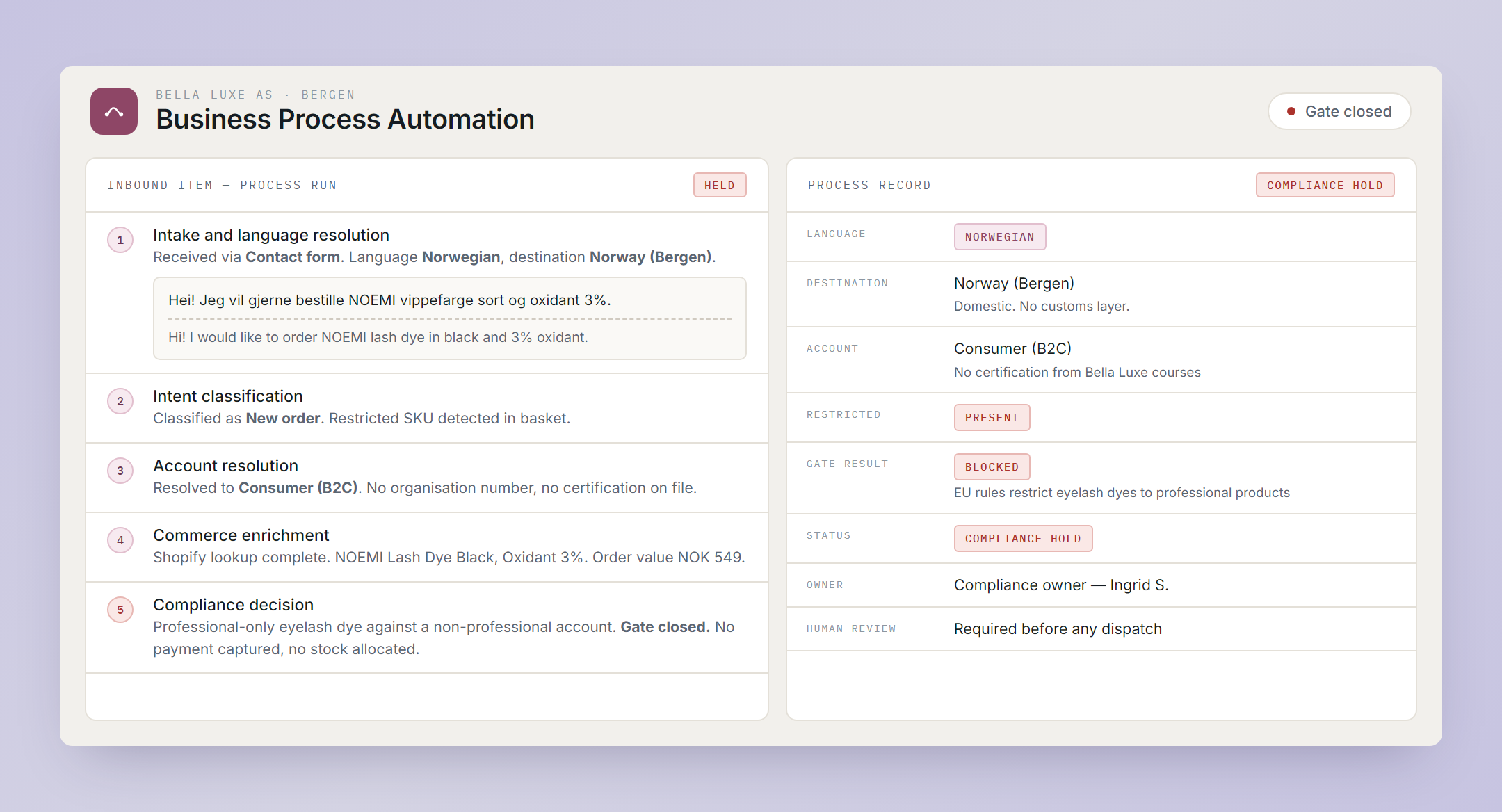
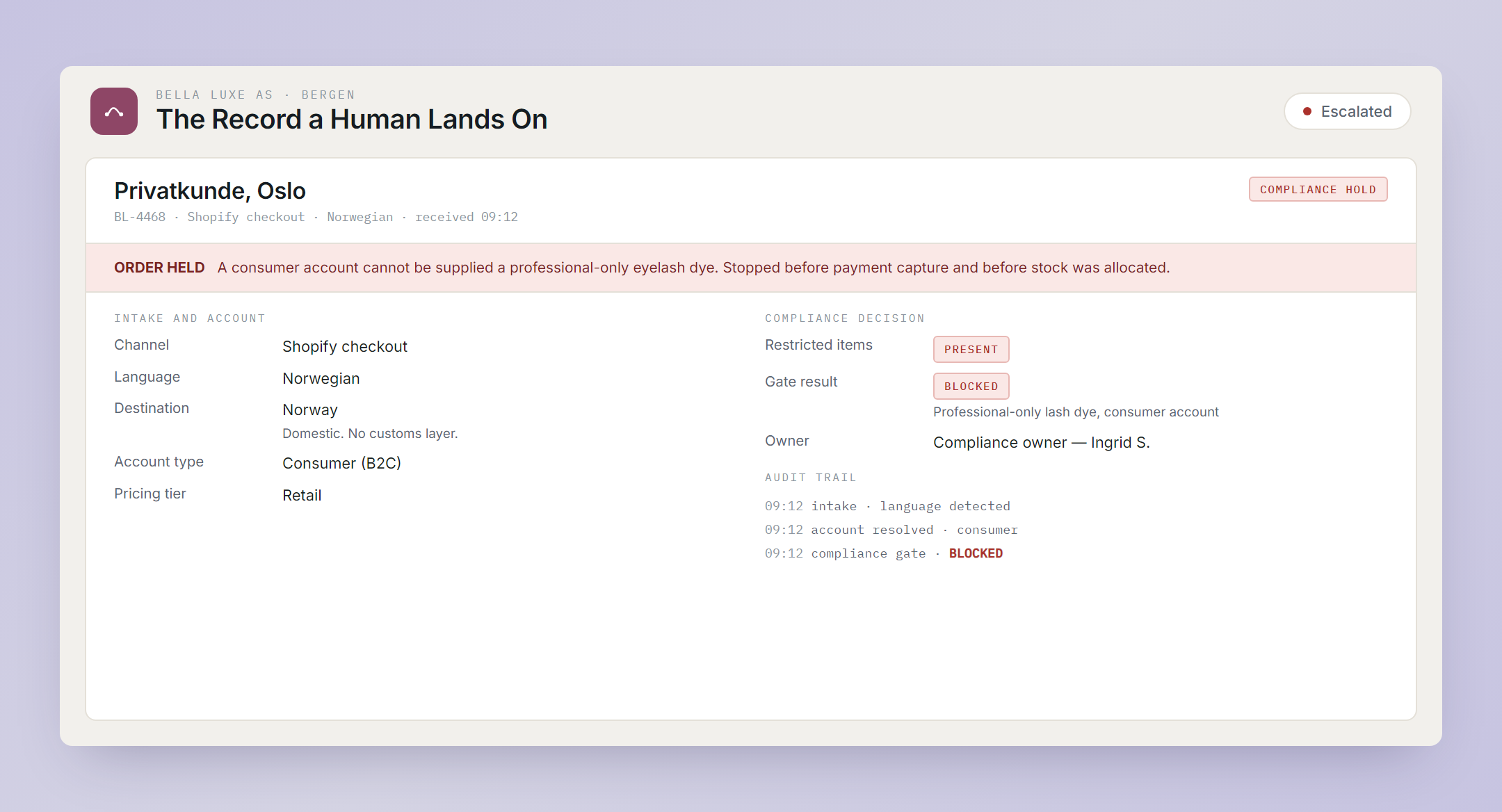
When a consumer account has a professional-only eyelash dye in the basket, the process halts. Not downgraded, not substituted, not quietly fulfilled with a note. The order is held before payment capture and before stock allocation, and it goes to a named compliance owner with the complete record attached.
That rule lives in deterministic application code sitting above the language model, which means a persuasive customer message cannot talk the process into shipping a restricted product, and a model update cannot silently weaken it. The same gate passes the order without friction when the account is a verified professional, because then the supply is lawful.
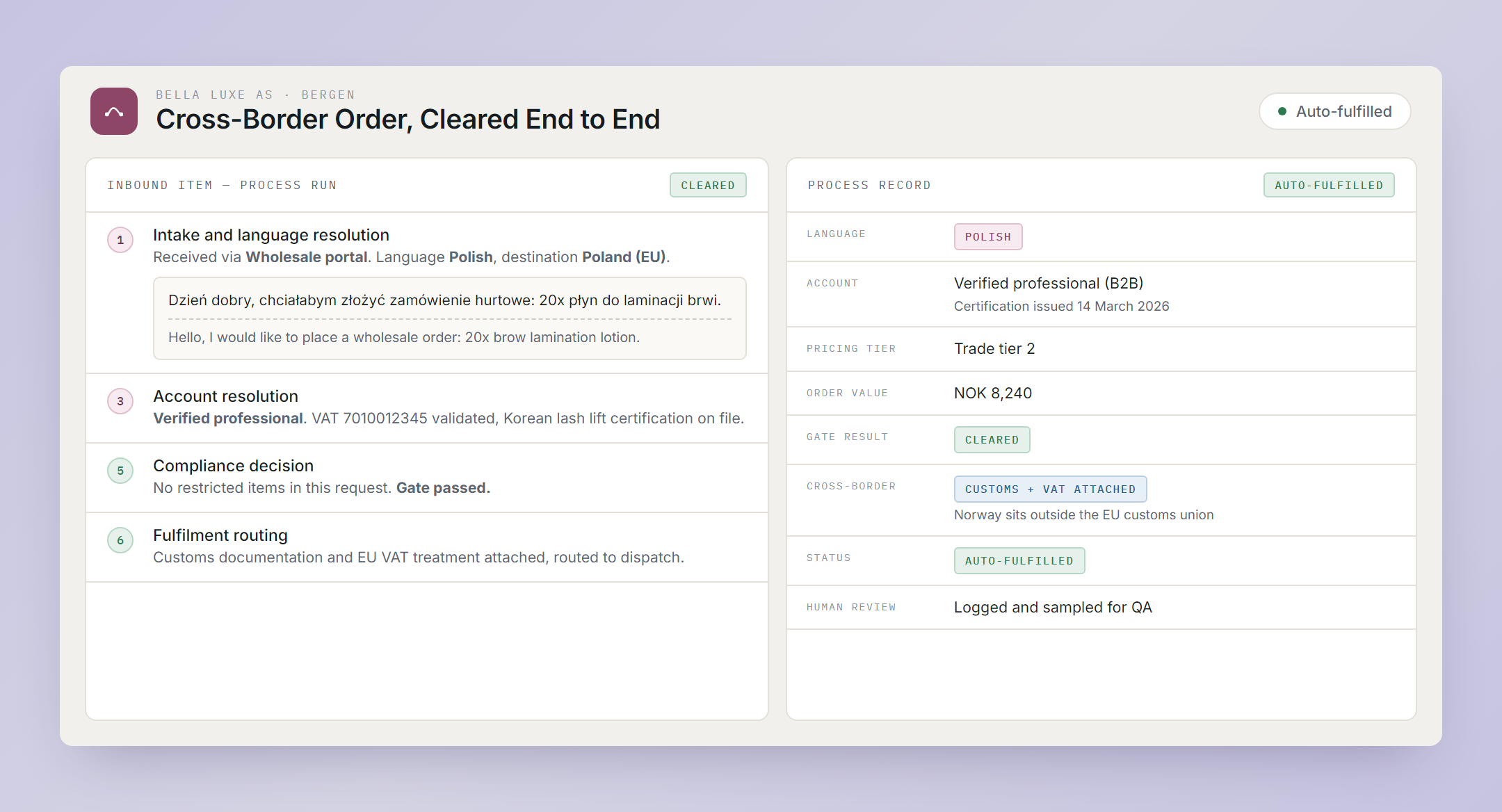
Stating that you run a salon does not unlock trade pricing or restricted stock. Verification draws on the organisation or VAT number and on certification held from Bella Luxe’s own training courses, which neatly connects their education business to their product business. A course graduate becomes an eligible trade buyer automatically.
Norway sits outside the EU customs union, so an order to Bergen and an order to Warsaw are not the same transaction. EU-bound shipments do not leave without customs documentation and the correct VAT treatment recorded against the order. Handling that at the routing stage is what stops it resurfacing later as a held parcel and a support ticket.
.png)

The process runs the same way every time, and every stage adds to a single record that travels with the order.
One entry point for Shopify checkout, the wholesale portal, the contact form and WhatsApp. Market is resolved from language and destination together, because a Swedish message shipping to Norway is a different transaction from a Swedish message shipping to Sweden. The original text is retained for audit.
Separates a new order from a reorder, an account request, a stock question and an order status enquiry. Only order paths continue into fulfilment logic. Everything else is answered or routed without touching inventory.
Establishes consumer or verified professional, using the organisation or VAT number and any certification on file, then assigns the pricing tier that follows from it.
Pulls live order, stock and tier pricing from Shopify, so every downstream decision is made against real data rather than what the customer believes is available.
Checks restricted products against account status and destination. This is the stage with the authority to stop everything, and it is deliberately the least clever part of the system.
Domestic orders go straight to pick and pack. EU-bound orders get customs documentation and VAT treatment attached before dispatch. Anything unresolved carries its full record to a named human owner.

It is automating an entire operational process end to end rather than automating individual tasks inside it. For an online retailer that means one flow carrying an order from first contact through classification, account checks, stock and pricing, compliance and dispatch, with a single record and a named owner at every exit. Connecting two tools is task automation. Replacing the chain of decisions and handoffs between them is process automation.
Connected apps move data. They do not make decisions. The expensive part of most e-commerce operations is not moving an order between systems, it is the judgement in between: is this buyer trade or retail, is the claimed discount valid, can this item lawfully ship to this destination. Process automation puts explicit, auditable decision logic at those points and escalates when it should not decide alone.
It stops and hands over. If language detection or intent classification falls below threshold, if stock or tier pricing conflicts with what was quoted, or if a compliance question is ambiguous, the item routes to a human with the original message and the full decision record attached. A mistranslated or wrongly priced order is worse than a slow one.
The eligibility rule is written as deterministic code outside the language model, so it cannot be reasoned around. In this concept, a professional-only eyelash dye in a consumer basket halts the order before payment capture and routes it to a named compliance owner. Restricted stock and trade pricing stay locked until verification evidence is on file, not merely claimed. Any production build would confirm current requirements per destination market with a qualified regulatory adviser.
This concept is scoped at eight weeks across five phases: a process audit that documents what actually happens today including the informal rules, opportunity mapping and ROI ranking, building the decision points with an adversarial test suite against the compliance gate, a phased rollout starting with domestic orders before cross-border handling, then continuous measurement using override patterns as the tuning signal.
Practical systems that reduce manual work, lower costs, and help teams scale.


.webp)