.svg)
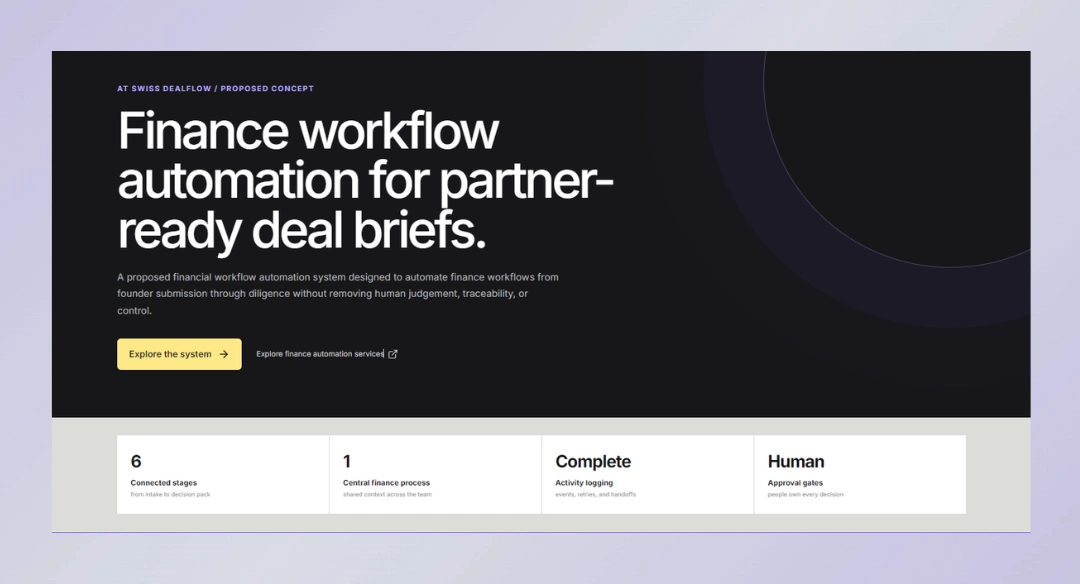
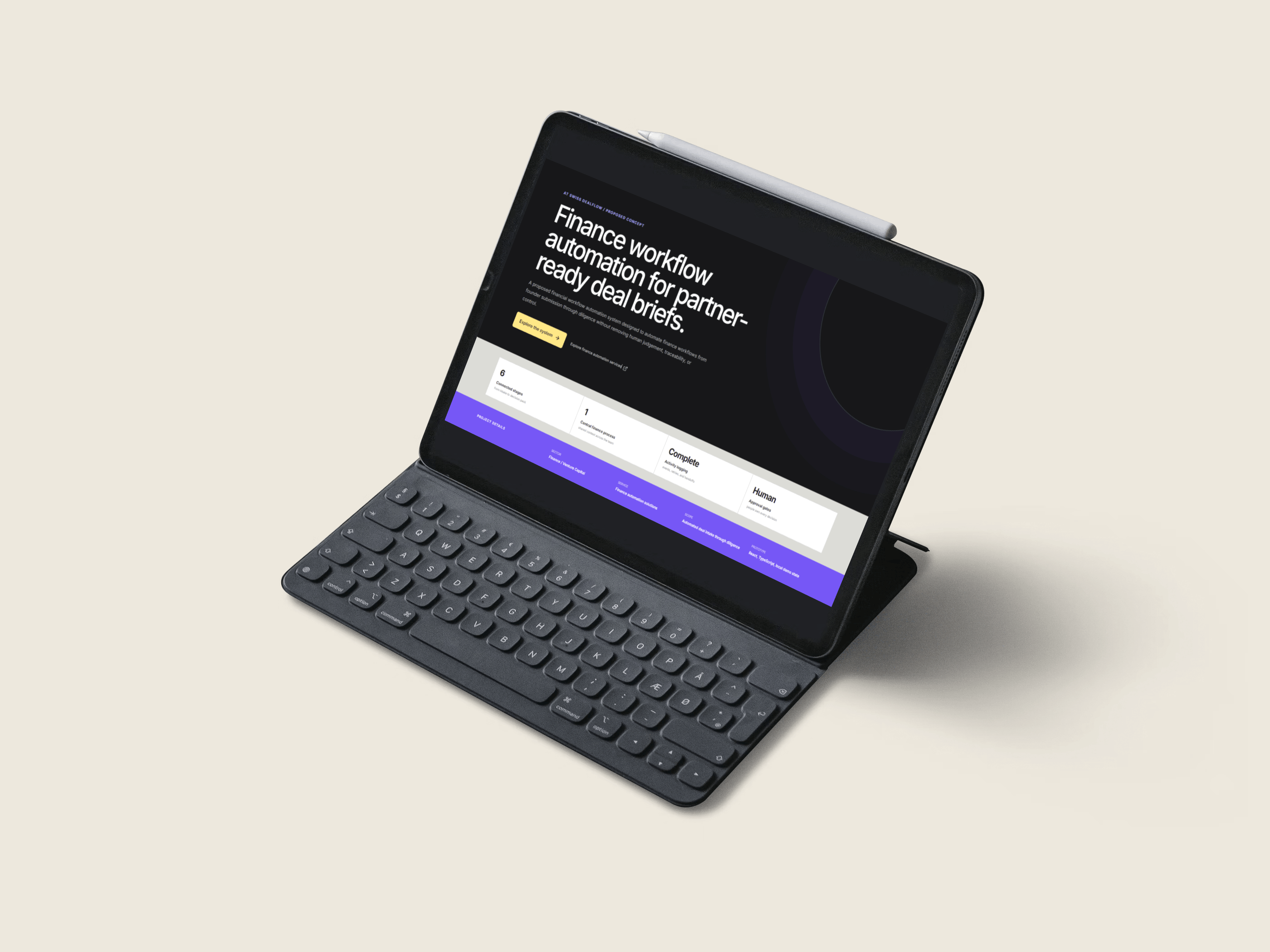
A proposed financial workflow automation system for turning founder submissions into structured, partner- ready deal briefs.
.webp)
Automation prepares the evidence; people make the investment decision.
Good opportunities can arrive through forms, email introductions, shared documents, pitch decks, and internal referrals. Each submission may contain useful information, but the format, completeness, and quality of that information can vary substantially.
Investment teams must repeatedly extract company details, identify missing documents, evaluate thesis alignment, update internal systems, assign follow-ups, and prepare information for partner review. Manual handling makes the process harder to apply consistently and leaves important context distributed across multiple tools.
Finance process automation can organize this preparation, but speed is not the only requirement. Any financial process automation system must preserve evidence, expose uncertainty, document exceptions, and keep people responsible for investment decisions.
The proposed system demonstrates how to automate financial processes around intake, screening, routing, and diligence while maintaining transparent human approval gates.
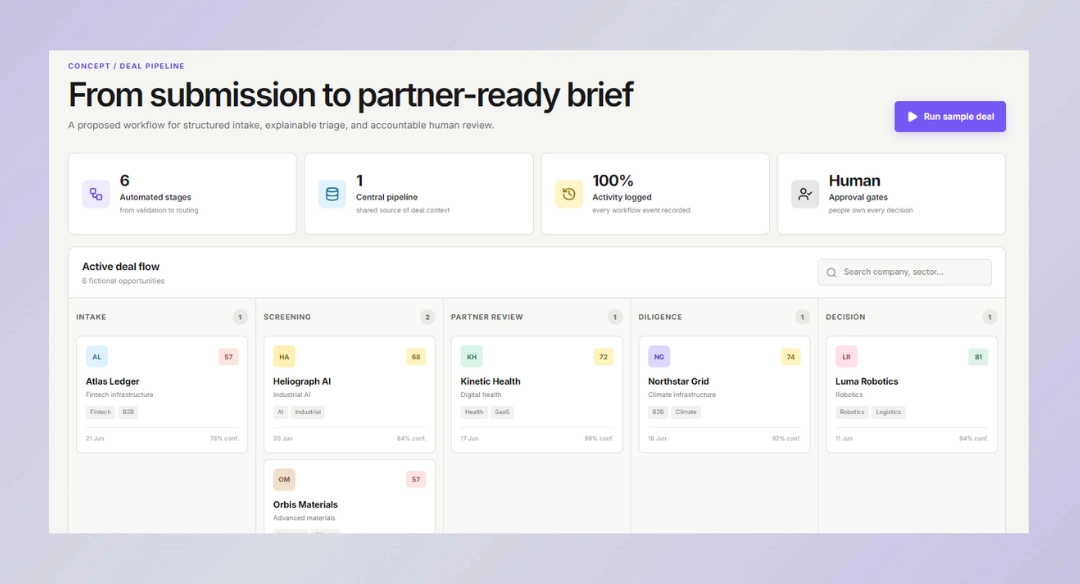
The concept organizes the workflow into connected stages. Each stage produces structured evidence for the next person or process while recording what happened, which information was used, and where human review is required.
Founder intake automation creates a consistent starting point for every opportunity. Structured fields capture the company, sector, location, funding stage, requested investment, and supporting documents.
The automated deal intake process validates required information, checks whether expected files are present, and records the submission in a centralized pipeline.
Basic startup screening automation can organize submissions against documented criteria. When information is incomplete, inconsistent, or outside expected parameters, deal screening automation creates a review task instead of silently advancing the opportunity.
This gives the investment team a cleaner intake queue without preventing founders or reviewers from providing additional context.
Pitch deck automation reduces repetitive document review by identifying relevant company facts and organizing them into a consistent structure.
Pitch deck data extraction can capture information such as the business model, market, team, traction, funding request, customers, and financial assumptions. Every extracted field should retain its source and confidence level so reviewers can distinguish verified information from uncertain results.
Company data enrichment can then add approved public or internal context. If an enrichment provider is unavailable, the workflow records the failure, retries according to policy, and routes unresolved information for human review.
The concept intentionally includes a failed enrichment attempt and a low-confidence result to demonstrate how exceptions would be handled.
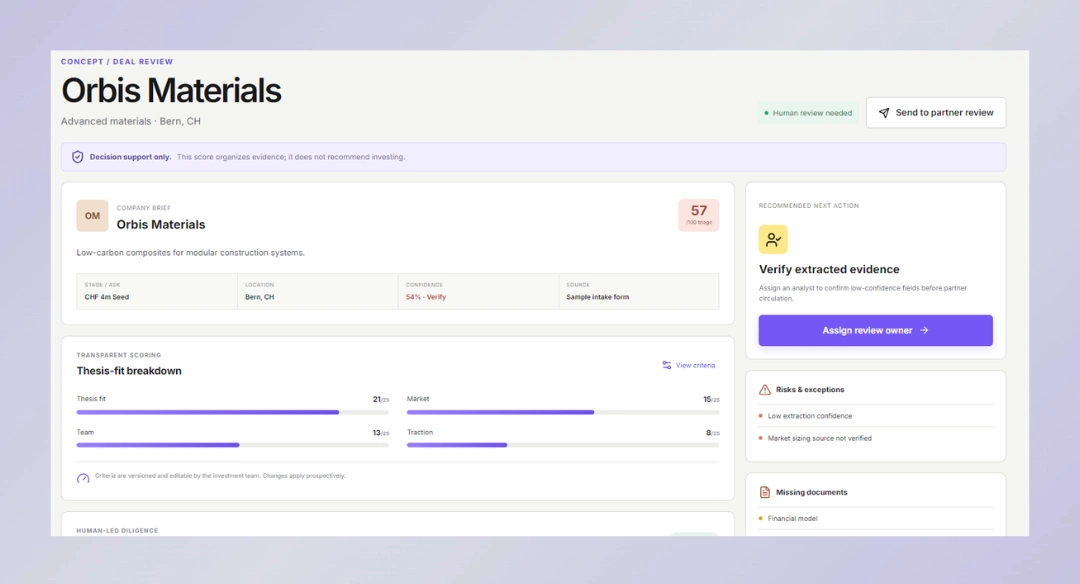
Thesis-fit scoring helps the investment team organize early review criteria without allowing an algorithm to approve or reject an investment.
A versioned investment scoring model can assess areas such as thesis alignment, market relevance, team evidence, and traction. Reviewers can see the individual components, the source information behind them, and the criteria version used.
Scores support triage only. They do not represent an investment recommendation.
Once the evidence is prepared, the partner review workflow presents the company brief, risks, missing information, confidence indicators, and relevant activity history to the appropriate reviewer.
Due diligence automation coordinates tasks, document requests, owners, deadlines, approvals, and evidence without replacing professional judgment.
Financial due diligence automation can help organize financial models, assumptions, supporting records, and reviewer comments. The broader venture capital due diligence process can also include commercial, legal, technical, security, reference, and market assessments.
A configurable venture capital due diligence checklist ensures that relevant work is assigned and tracked consistently. Diligence workflow management records each completed task, outstanding request, exception, and approval.
CRM workflow automation can synchronize approved stage changes and supporting context with an existing CRM. Investment memo automation can then assemble verified information for the investment committee workflow.
The investment team remains responsible for interpreting the evidence and making the final decision.


The system checks required fields, expected documents, file safety, and basic formatting. Missing or inconsistent information is flagged before processing continues.
Relevant company facts are extracted from the fictional sample submission. Each field retains a source reference and confidence indicator.
Approved company and market context is added where available. Failed requests follow a limited retry policy before being assigned for review.
Documented criteria organize the evidence into an explainable score breakdown. Reviewers can inspect each component instead of receiving an unexplained result.
The workflow considers the score, extraction confidence, missing documents, and identified risks. Low-confidence or incomplete submissions are routed to a person for verification.
Verified information, outstanding questions, diligence tasks, risks, and activity history are organized for partner or committee review. Automation stops before the investment decision.

Finance workflow automation connects repeatable tasks, evidence, approvals, notifications, and system updates in a controlled process.
Teams can automate finance workflows involving validation, document extraction, enrichment, routing, reminders, activity logging, and task creation. Decision-sensitive transitions can require named reviewers to inspect the evidence and approve the next action.
Yes. Finance automation solutions can connect with an existing CRM through controlled, permission-based integrations. A production implementation could create records, update approved fields, synchronize stage changes, attach evidence, and log workflow activity without providing unrestricted system access.
Finance automation services can include process discovery, workflow design, integration planning, permissions, exception handling, implementation, testing, monitoring, documentation, and team handover. The final scope depends on the systems, governance requirements, and review policies already used by the organization.
No. The investment scoring model in this case study supports triage and review prioritization only. It organizes documented criteria into a transparent breakdown. Partners and investment committee members retain full responsibility for the final decision.
Practical systems that reduce manual work, lower costs, and help teams scale.


