.svg)
We designed an AI chatbot experience that serves architects, contractors, and distributors who need clear answers about roofing panels, wall systems, coils, materials, warranties, and technical documents wit guided product journey and a cleaner handoff for the sales or technical team.
We can develop a custom manufacturing chatbot that makes the journey easier and keeps your experts in control.
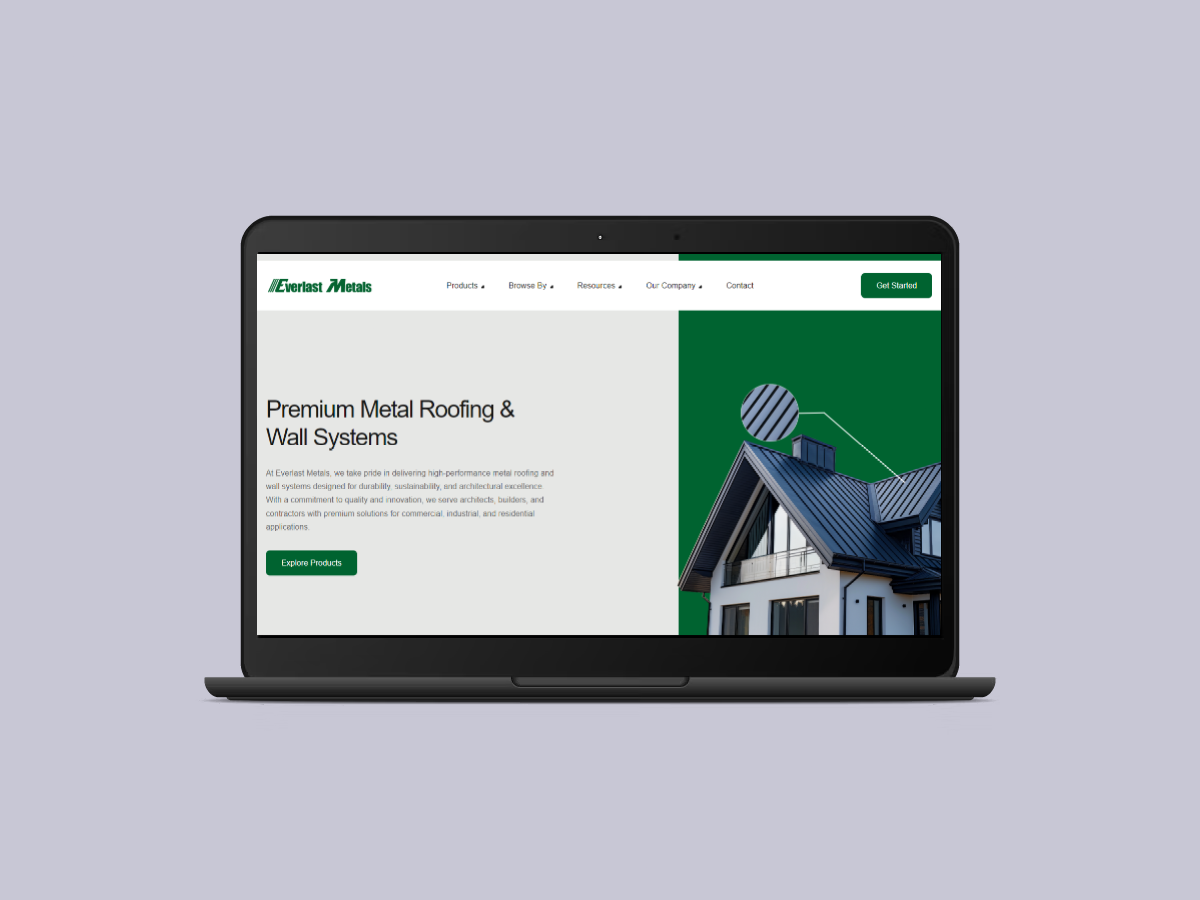
Everlast Metals offers architectural metal roofing panels, wall and soffit systems, coils, sheets, colors, warranties, and technical resources. That gives customers useful choice, but it also creates a detailed buying journey. An architect may care about minimum slope and testing. A contractor may need installation guidance or ventilation details. A distributor may be looking for a specific gauge, width, finish, or fabrication option.
A normal contact form cannot understand those differences. It collects a message, but it does not help the customer find the right product path or tell the sales team which details are still missing. This is a practical opportunity for an AI chatbot for manufacturing: guide the conversation, organize the requirements, and prepare a useful handoff without pretending to replace technical review.
We started with a simple idea: the chatbot should make the first conversation more useful for both the customer and the manufacturing team.
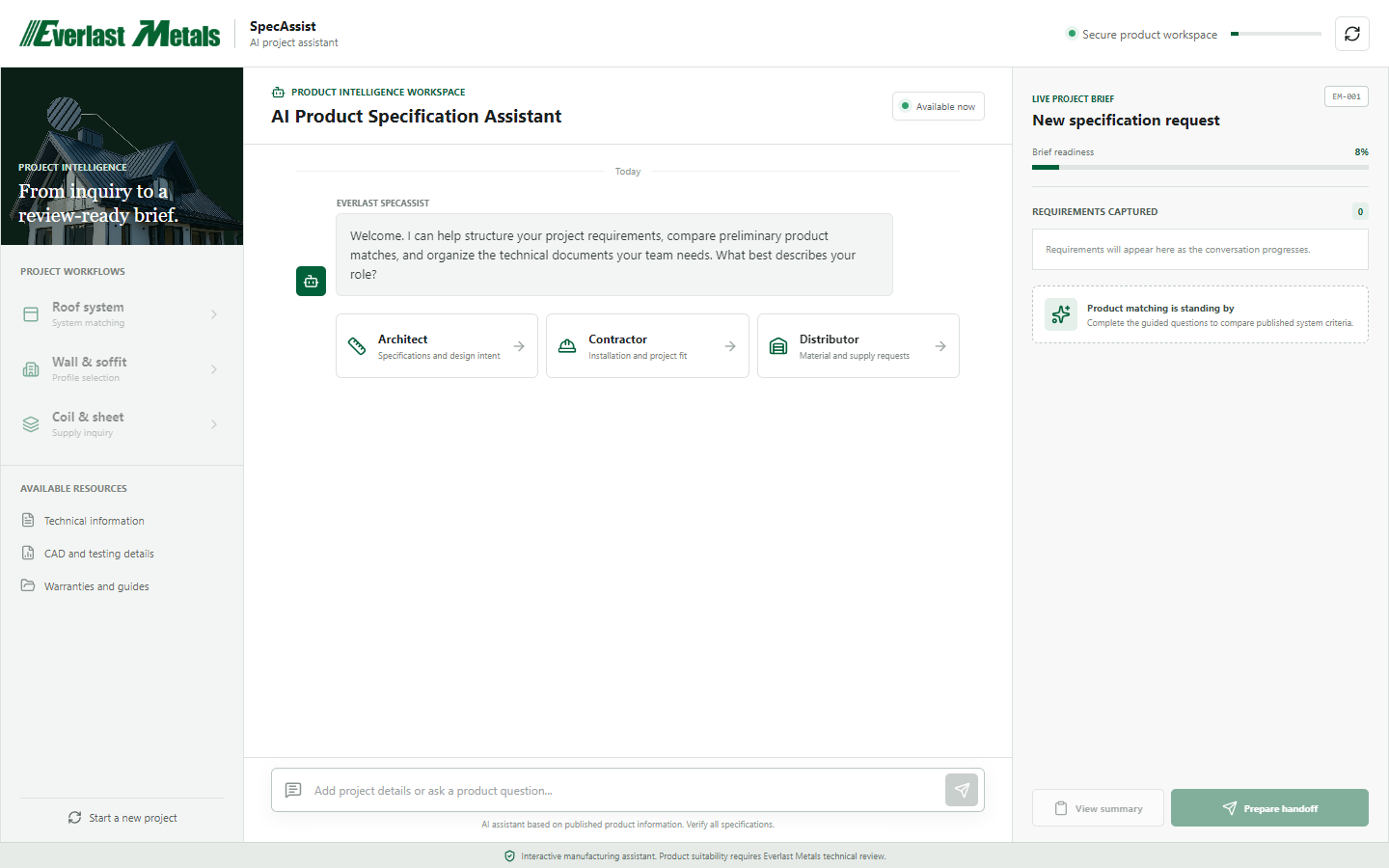
The solution does not open with a blank chat box and expect the user to know what to ask. It first learns whether the visitor is an architect, contractor, or distributor. It then opens the workflow that fits that person, asks a small number of clear questions, and updates a live project brief while the conversation continues.
This approach keeps AI chatbot services for manufacturing companies focused on real work. The system helps people move through a technical product catalog, but it leaves engineering approval, warranty confirmation, pricing, and final product selection with the Everlast Metals team.
A custom AI chatbot for manufacturers should understand the company's products, terminology, documents, and decision rules. A generic website bot may answer basic questions, but it will not know which details change a technical recommendation.
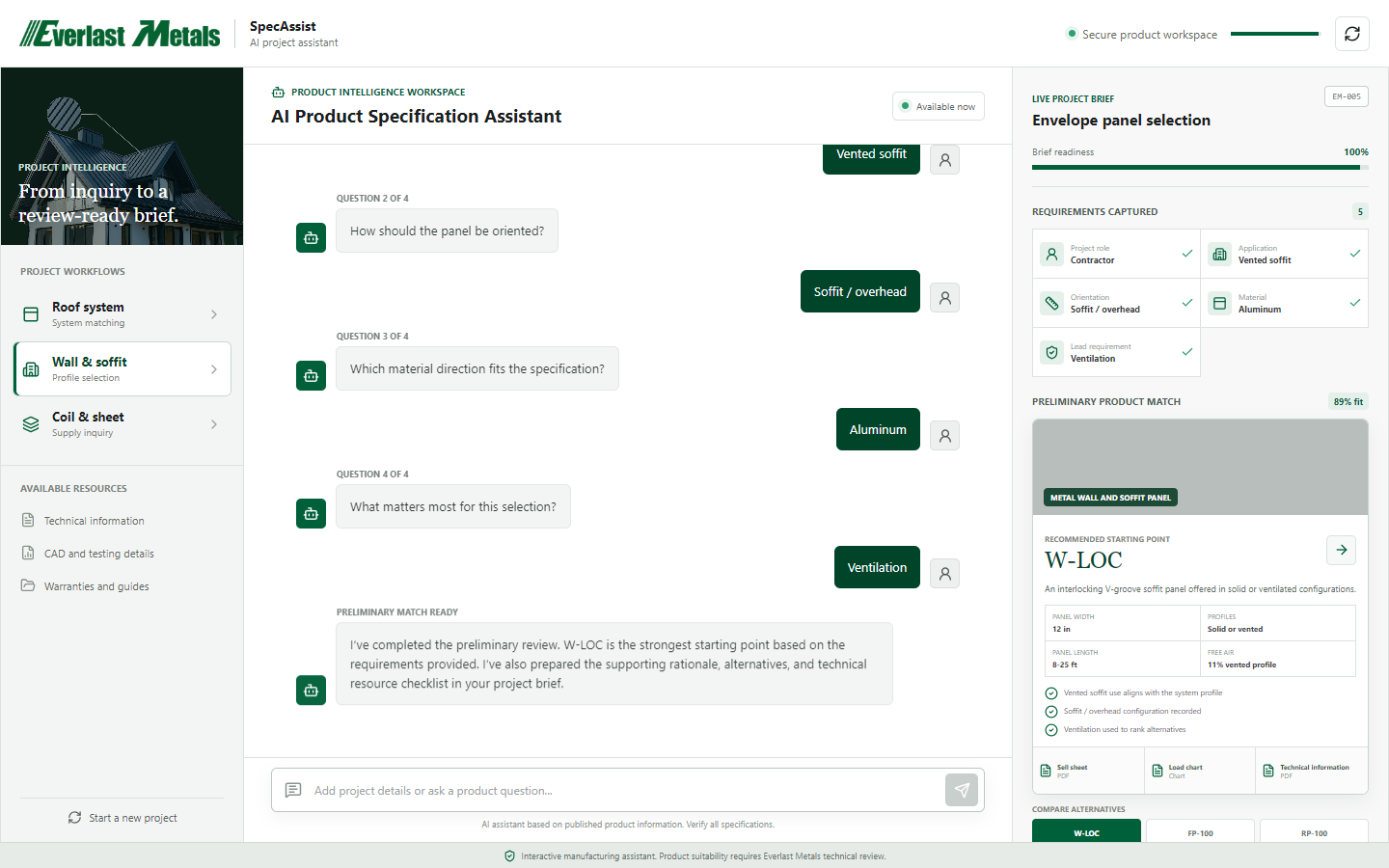
For this project, we mapped published Everlast Metals information into structured product paths. Roof inquiries consider details such as slope, deck condition, seaming approach, material, and performance priority. Wall and soffit inquiries consider application, ventilation, profile, orientation, and material. Coil and sheet inquiries collect format, gauge, width, finish, and fabrication needs.
The result feels closer to a knowledgeable product assistant than a normal FAQ widget.
The main workflow demonstrates an AI chatbot for product selection in a manufacturing setting. It behaves like an AI product recommendation assistant, narrowing the catalog with the details supplied by the visitor instead of showing every option at once.
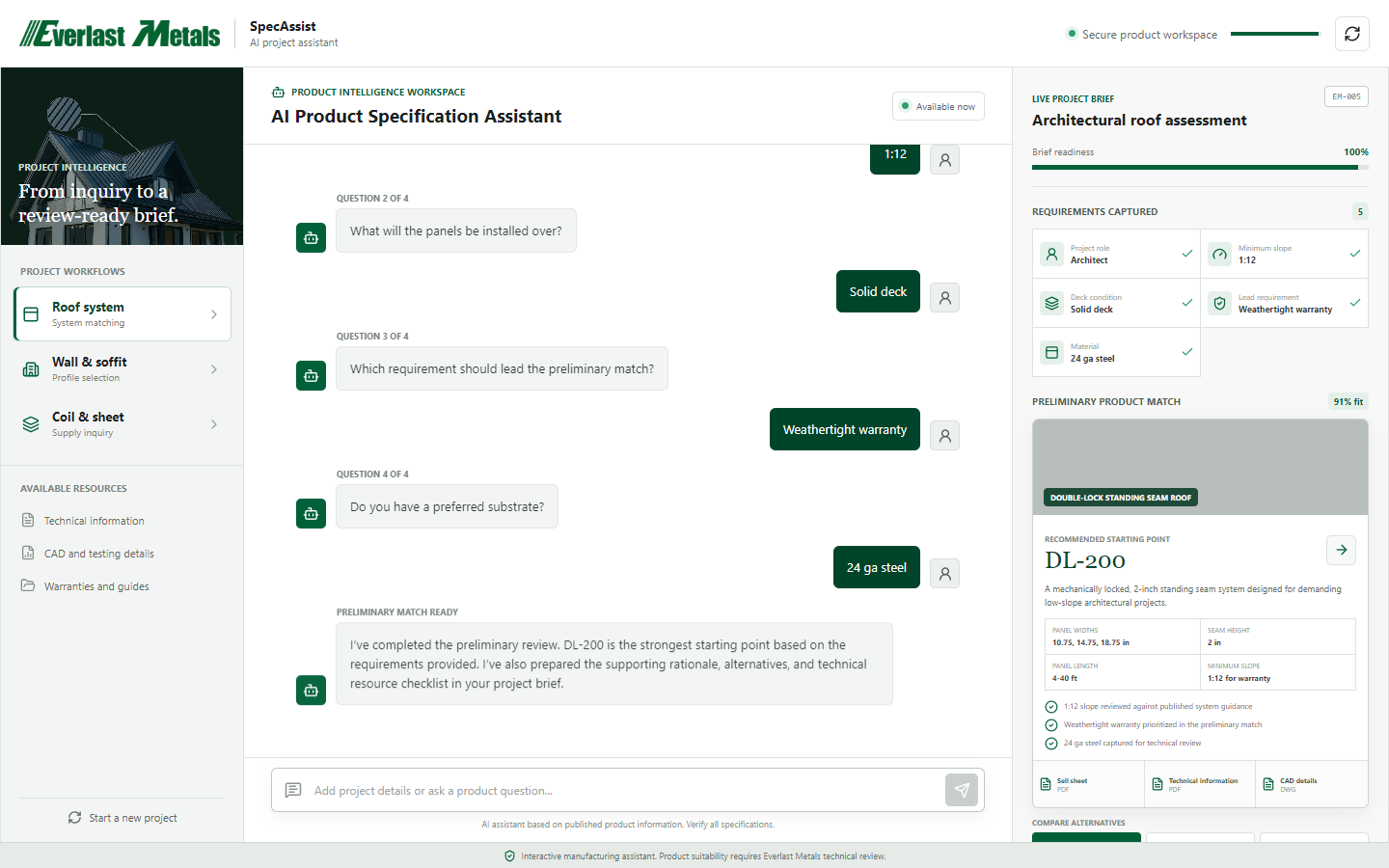
Each recommendation includes a short explanation, important specifications, relevant alternatives, and a reminder that the result is preliminary. This makes the experience useful without presenting the chatbot as an engineer or final decision-maker.
The same structure can support a technical support chatbot for manufacturers. With an approved knowledge base, it becomes an AI chatbot for technical documentation that can help visitors locate installation guides, warranty documents, color charts, CAD details, sell sheets, and product-specific information before the conversation reaches a specialist.
The solution includes three focused manufacturing chatbot use cases. Each one reflects a different customer journey and produces a structured result.
An architect can enter a roof workflow and answer questions about minimum slope, deck condition, material, installation priority, and weathertightness needs. The assistant then presents a preliminary product path, such as DL-200, SSL-175, or DL-150, with the reasons behind the match.
A contractor can describe whether the project needs a vented soffit, flush facade, reveal facade, or equipment screen. The assistant compares that request with options such as W-LOC, FP-100, and RP-100 while keeping orientation and material requirements visible.
A distributor can prepare a clearer supply request by selecting slit coil, flat sheets, cut-to-length material, or custom trim. The workflow records material, gauge, width, finish, and production options before preparing the handoff.
These examples show how an AI sales assistant for manufacturers can improve the start of a conversation without making unsupported promises about availability, lead time, pricing, or engineering suitability.
Conversational AI for manufacturing works best when it reduces effort for the customer and gives the internal team better information.
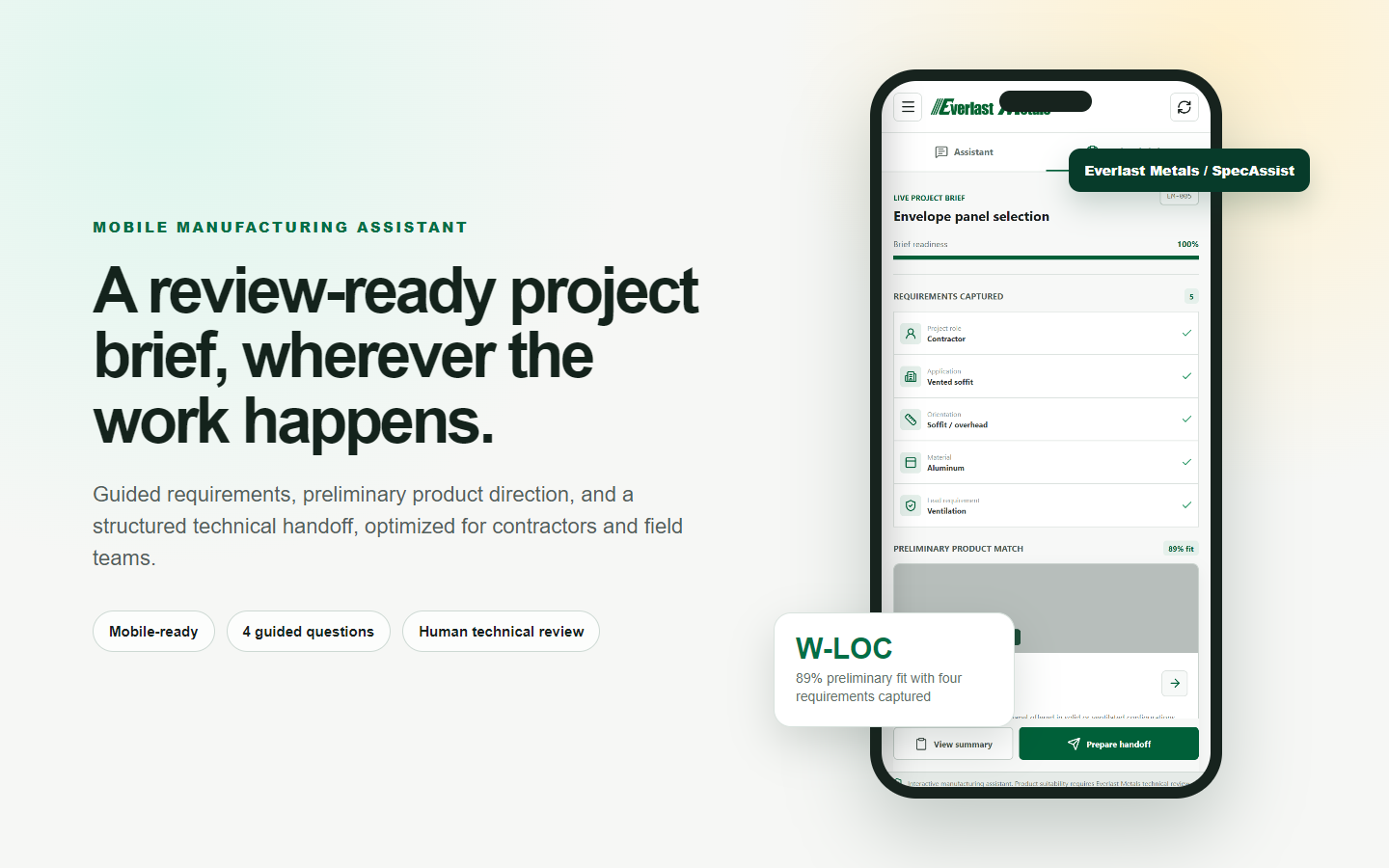
In this solution, every answer updates a live project brief. By the end of the conversation, the user can see the selected requirements, preliminary product match, alternatives, specifications, and document categories in one place. The sales or technical team receives the same organized context instead of a vague contact-form message.
This is a practical form of manufacturing customer service automation. Straightforward discovery can happen at any time, while complicated questions can be escalated to a person with the conversation history attached.
An AI chatbot for manufacturing customer service becomes more valuable when it knows what it can answer, what source supports the answer, and when the customer needs a real person.
AI-powered customer support for manufacturers should not hide uncertainty. Technical products have application limits, testing requirements, warranty conditions, and project-specific risks. A useful assistant must know when to stop and involve a specialist.
The Everlast Metals project labels every result as preliminary. It explains why a product may fit, shows alternatives, and states which decisions still require technical confirmation. That human-in-the-loop design protects the customer experience and makes the assistant easier for sales and engineering teams to trust.
The current experience is an interactive product demonstration. It uses guided conversation logic and published product information to demonstrate the intended customer journey. It does not yet use a live language model, connect to inventory, submit leads, create quotes, or make engineering decisions.
Our manufacturing chatbot development services would turn the project into a production system in controlled stages. The first stage would organize approved product pages, PDFs, guides, warranties, and frequently asked questions into a managed knowledge base. This would create a RAG chatbot for manufacturing knowledge bases that answers questions from approved sources and provides clear citations.
The live assistant could be embedded on the Everlast Metals website, connected to a CRM or shared inbox, and configured to route architects, contractors, distributors, and support requests to the right team. ERP, inventory, order-status, or quoting integrations could be added where secure APIs and business rules are available.
An AI chatbot integration with CRM and ERP systems can move the experience beyond question answering. With permission, the production assistant could create a qualified lead, attach the project brief, assign the correct region or product team, and preserve the conversation for follow-up. This supports automated lead qualification for manufacturers without forcing sales teams to re-enter the same information.
For deeper workflows, the assistant could check approved inventory data, retrieve order status, or start a quote request. These actions would use fixed permissions, validation rules, audit logs, and human approval where required. The chatbot would become part of the manufacturing workflow rather than another isolated website widget.


The solution turns a technical customer conversation into a review-ready project brief in five steps.
The assistant begins by asking whether the visitor is an architect, contractor, or distributor. That choice changes the questions and product path that follow.
The chatbot asks a short series of questions about the application, product format, dimensions, material, installation condition, or performance priority.
The system compares the answers with structured product information. It presents a preliminary match, explains why it may fit, and keeps alternatives available for comparison.
The assistant points the user toward product pages and document categories such as sell sheets, installation guides, technical information, CAD details, color charts, and warranties.
The final brief collects the customer role, requirements, product direction, alternatives, and unresolved questions. A live system could send that information to sales, customer support, or a technical specialist.
The finished assistant demonstrated how a complex manufacturing catalog can become a guided conversation. It gave three different customer types a clear starting point, captured the details that matter, and turned their answers into an organized handoff.
It also established clear boundaries. The assistant can support product discovery, technical-document search, lead qualification, and customer service. It should not issue final specifications, confirm warranties, promise inventory, or replace engineering review.
That distinction provides a practical foundation for a live website chatbot for manufacturing companies: automate the repeated parts of discovery while sending important decisions to the people who know the products best. It also shows how an AI chatbot for building material manufacturers can simplify a large technical catalog without reducing every project to a generic answer.

AI chatbot services for manufacturing companies include the design, development, integration, and support of conversational systems built around manufacturing products and workflows. These chatbots can answer product questions, search approved documents, qualify leads, support product selection, and prepare human handoffs.
An AI chatbot for manufacturing can give customers a clear starting point, ask the right follow-up questions, and provide access to approved technical information. It can also route difficult questions to a sales or technical specialist with the conversation context attached.
A manufacturing chatbot can provide preliminary product recommendations when it uses approved product data and clear decision rules. Final specifications, warranty decisions, engineering approval, pricing, and availability should remain with qualified team members.
Yes. A custom AI chatbot for manufacturers can connect with CRM, ERP, inventory, helpdesk, or order-management systems when secure APIs and permissions are available. The exact integration depends on the company’s existing systems and approval requirements.
A manufacturing AI chatbot can use approved product pages, catalogs, specifications, installation guides, warranties, FAQs, technical documents, support content, and internal process rules. A retrieval-based system can cite those sources so users and employees can verify important answers.
Practical systems that reduce manual work, lower costs, and help teams scale.


