.svg)
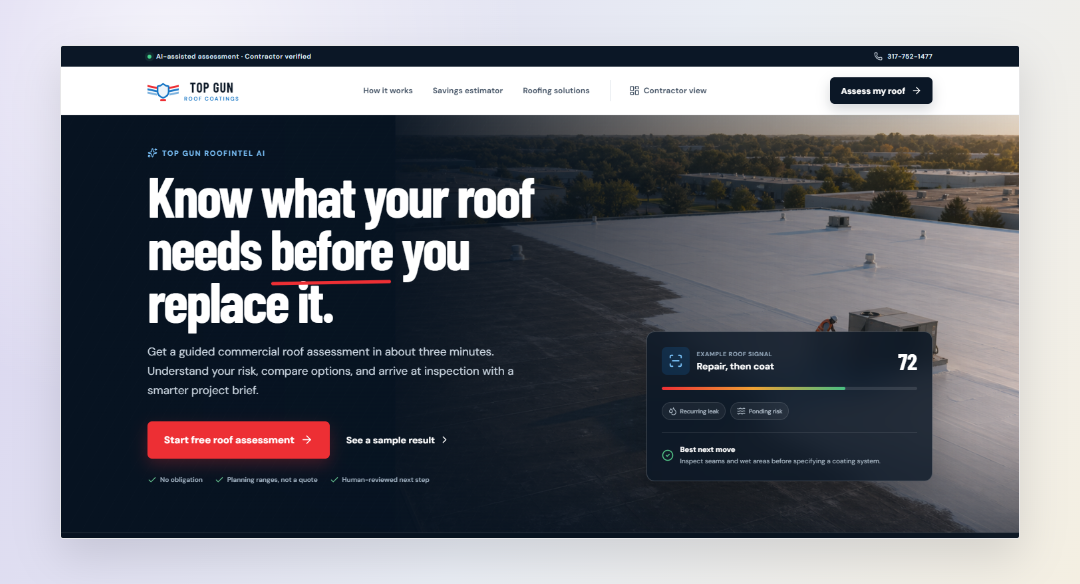
A guided roof-assessment and AI lead qualification tool that helps Top Gun Roof Coatings turn uncertain inquiries into clear, contractor-ready next steps.
Turn one high-friction intake, estimating, or sales process into a focused AI MVP your team can test with realistic inputs.
Commercial roofing leads rarely arrive with a usable scope. A property owner may know there is a recurring leak or ponding water, but not the roof material, condition, restoration fit, or likely next step.
Top Gun Roof Coatings needed a better way to handle early-stage inquiries. A basic contact form captured a name and phone number, but not the evidence that determines whether a lead is ready for coating, repair, inspection, or possible replacement.
The goal was not to replace a roof inspection or generate an automatic quote. It was to make the first conversation more useful while keeping final technical judgment with an experienced contractor.
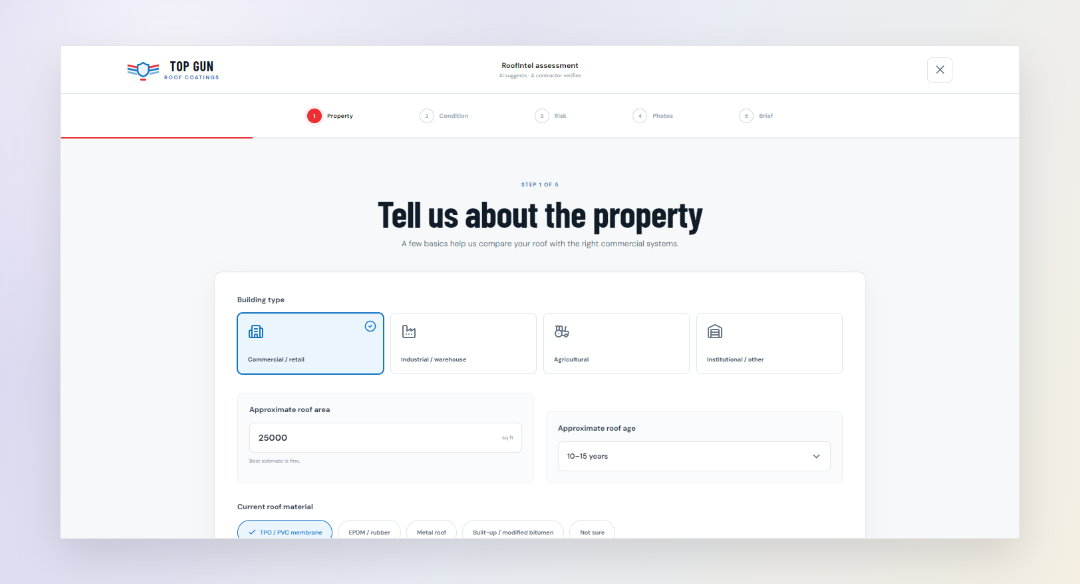
The customer-facing flow starts with information owners can realistically provide: building type, approximate roof area and age, current material, leak history, visible wear, business urgency, and supporting photos. RoofIntel structures those observations into a concise project profile and explains the factors behind its preliminary condition signal.
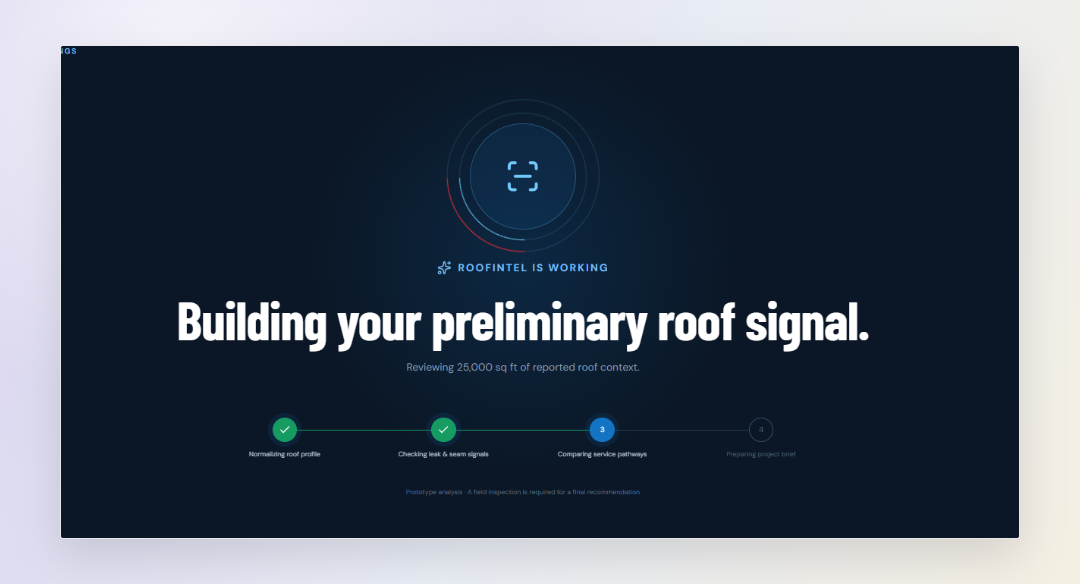
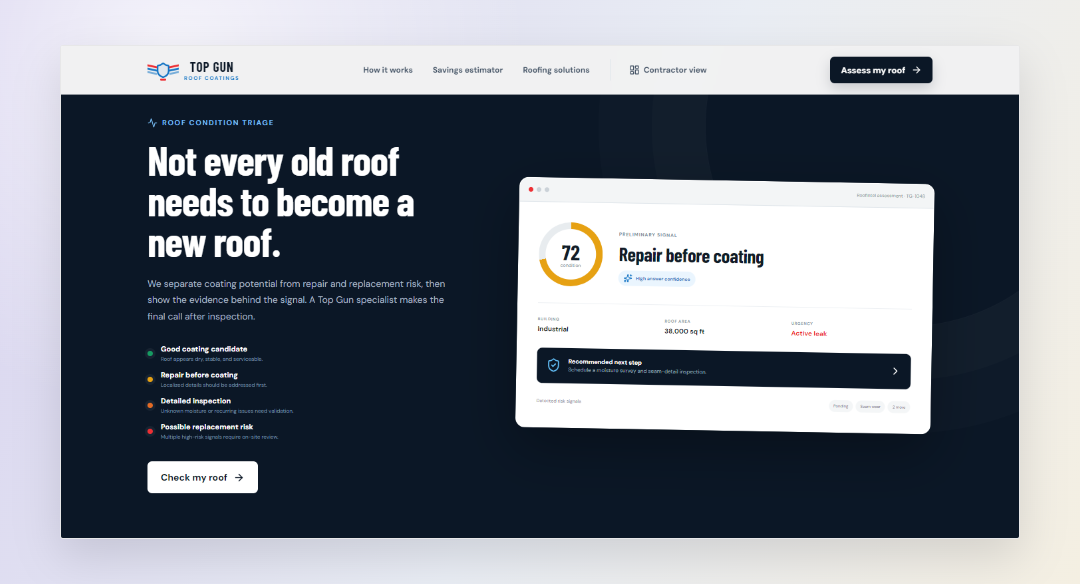
RoofIntel works as an AI lead qualification tool before a salesperson invests time in discovery. It captures active leaks, recurring failures, wet areas, roof age, property size, urgency, and inspection readiness, then routes the opportunity toward coating candidacy, repair before coating, detailed inspection, or possible replacement risk.
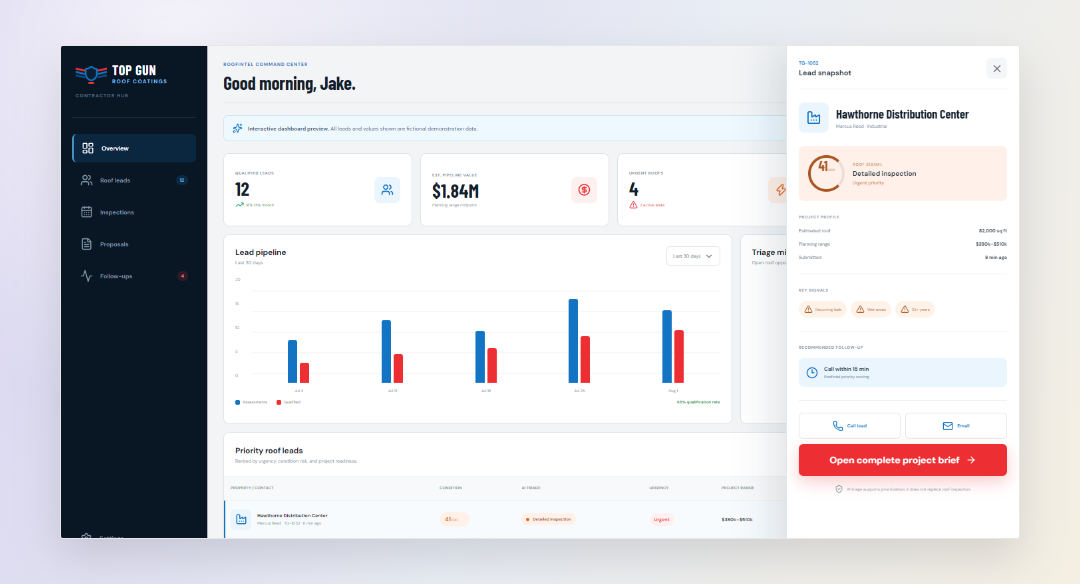
The contractor dashboard turns completed assessments into a prioritized queue. Each opportunity includes condition score, triage status, urgency, roof area, planning range, key signals, and a recommended follow-up action. The score is never shown without the observations that produced it.
The estimator compares broad planning ranges for replacement, targeted repair, and fluid-applied roof coating. It clearly labels the result as illustrative, preserving field measurements, moisture testing, access requirements, system selection, and final pricing for the contractor.
Generic chatbots cannot distinguish an older roof from one that has reached the end of its serviceable life. RoofIntel connects commercial roof assessment, roof condition scoring, lead triage, and fluid-applied roof coating to the actual service paths Top Gun evaluates.


For property owners, the product provides a guided assessment, condition explanation, planning comparison, and clear next step. For Top Gun, it creates structured lead data, ranked follow-up, consistent service routing, and a complete project brief. That two-sided design is the foundation for useful AI automation for construction companies.
The working MVP demonstrated that the workflow can turn a vague inquiry into a structured five-step brief, explain roof condition scoring, compare coating, repair, and replacement without producing a false quote, and rank leads while keeping inspection and final system selection under human control.
The risky questions were whether owners could complete intake without roofing expertise, whether the output could stay explainable, and whether a contractor would receive enough context to prioritize a lead. AI supports triage and planning; a qualified roofing specialist verifies condition and determines scope.
RoofIntel brings guided assessment, explainable scoring, lead qualification, planning ranges, and follow-up into one workflow. Property owners get a clearer next step, while the contractor sees why the lead was prioritized and what should happen next.
Amplence is an AI MVP development company for construction and service businesses. If you want to build an AI MVP for lead qualification, estimating support, inspection preparation, or operations, start with one workflow and one measurable decision.

It typically includes workflow discovery, user journeys, domain rules, interface design, data structure, AI-assisted scoring or generation, evaluation criteria, and a working product focused on one operational decision.
No. AI can organize reported symptoms, photos, roof age, urgency, and known risks, but a qualified contractor must verify condition and determine the final scope.
It compares illustrative planning ranges using roof area, age, and broad service assumptions. The result is not a quote; field measurements, repairs, access, materials, and system requirements still require confirmation.
A prototype tests whether an interaction or technical approach works. An MVP connects that capability to a complete workflow that can be tested with realistic inputs and reviewed by the people who will use it.
Yes. A production phase could connect assessment data to a CRM, inspection calendar, follow-up messaging, photo review, proposal workflows, and analytics after the core workflow is validated.
Practical systems that reduce manual work, lower costs, and help teams scale.