.svg)


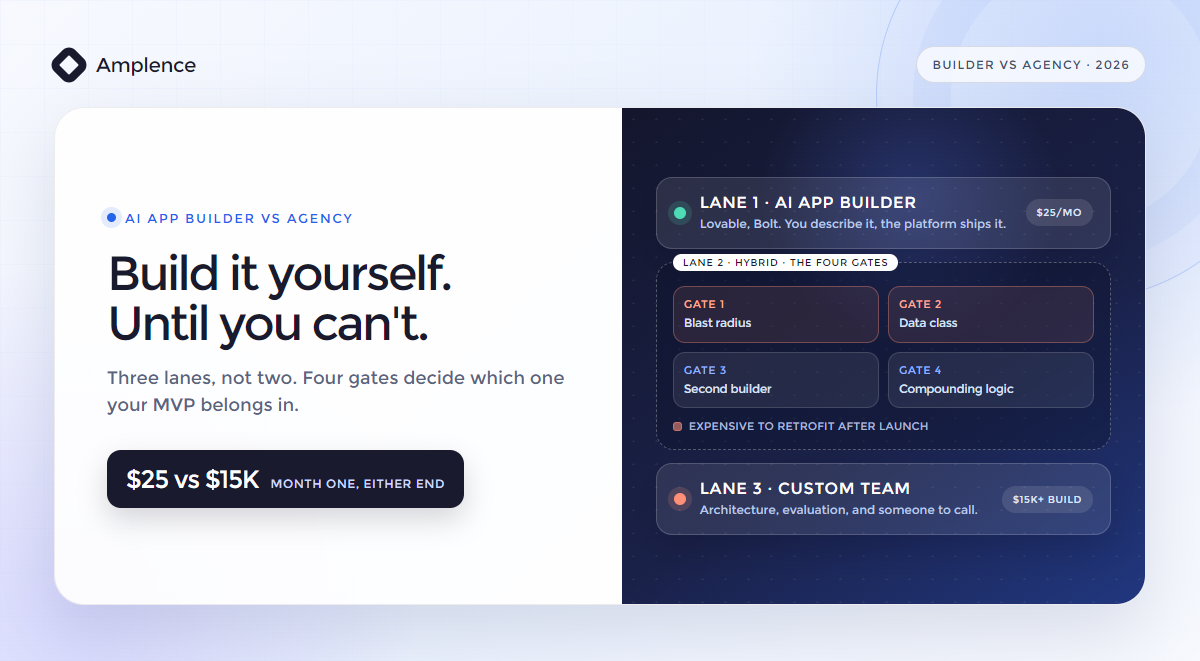
Start in lane one. Leave it on a trigger, not a feeling.
Build it yourself when the app is yours to break. Buy a team when someone else's money, data, or license is on the line. Most founders should start in lane one and switch at a named trigger, not on a feeling. The trigger is almost never "the code got messy". It's the first time a stranger's data lands in your database.
Three years ago this article would have been short. You either hired developers or you didn't ship. That changed. In Y Combinator's Winter 2025 batch, a quarter of the companies had codebases that were roughly 95% AI generated, and those were technical founders who could have written it themselves.
So the question isn't whether AI app builders work. They do. The question is where they stop working for your specific product, and what it costs to find that line the hard way.
This guide compares three lanes, not two. It uses published vendor pricing, checked on 23 August 2026. It works through the billing math that turns a $25 plan into a real monthly number. And it names the point where we'd tell you to skip our AI MVP development service and keep building alone.
What an AI App Builder and a Development Agency Actually Give You
Most comparisons put "AI tools" on one side and "humans" on the other. That framing loses money, because it hides the lane that most successful MVPs actually use.
Notice that Cursor sits in a different lane from Lovable and Bolt. That distinction matters more than the marketing suggests. Lovable and Bolt are app builders: they abstract the code away and hand you a running product. Cursor is a code editor with an agent inside it. It assumes you can read what it wrote and notice when it's wrong.
If you can't read the diff, Cursor doesn't give you control. It gives you the feeling of control at a $20 monthly price.
AI App Builder vs Development Agency: The Honest Comparison
Here is the comparison with the uncomfortable rows left in.
| Decision factor | AI app builder | Hybrid | Custom team |
|---|---|---|---|
| Time to first working screen | Hours | 2 to 5 days | 2 to 4 weeks |
| Realistic month-one spend | $25 to $150 | $200 to $3,000 | $8,000 to $20,000 |
| Realistic first-year spend | $600 to $4,000 | $10,000 to $45,000 | $15,000 to $150,000+ |
| Who owns the deployment | The platform | You | The team |
| Who is accountable when it breaks | You | You | Contracted party |
| What usually breaks first | Auth and data access rules | Integration edge cases | Scope, not code |
| Handles other people's personal data | Only with expert review | Yes, with review | Yes, by design |
| Passes a buyer or investor code review | Rarely | Usually | Usually |
| Exit cost if you leave | Low in files, high in rework | Low | Low |
The row that decides most projects is not cost. It's accountability. When an AI builder ships a data leak at 2am, there is no one to call. That's not a criticism of the tools. It's the deal you accept in exchange for the price.
What Do Lovable, Bolt, and Cursor Cost in 2026?
Published list prices, read from each vendor's own pricing page on 23 August 2026. Recheck them before you budget, because all three have changed their billing units at least once.
| Tool | Free tier | Entry paid plan | Team plan | Billing unit |
|---|---|---|---|---|
| Lovable | 5 build credits per day, capped at 30 per month | Pro from $25 per month for 100 credits | Business from $50 per month | Credits, 0.5 to 1.7 per message |
| Bolt | 300K tokens per day, 1M per month | Pro $25 per month, from 10M tokens | Teams $30 per member per month | Tokens, consumed per generation |
| Cursor | Hobby, limited agent requests | Pro $20 per month | Teams $40 per user per month | Agent requests, then on-demand usage |
Sources: Lovable pricing and Lovable credit documentation, Bolt pricing, Cursor pricing. Cursor also lists Pro+ and Ultra tiers above Pro for heavier agent use.
Three plans at roughly $25 look interchangeable. They are not. Each one meters something different, and that is where the budget goes wrong.
How Credit and Token Billing Actually Works
A credit is not a message. On Lovable, a single default-mode message costs between 0.50 and 1.70 credits depending on how much work it triggers, while plan mode costs 1 credit per message. Bolt meters tokens, so a long conversation about a large file burns allowance faster than ten short prompts. Cursor meters agent requests, then bills on-demand usage in arrears once your included amount runs out.
Use this to estimate before you commit:
Monthly builder cost = base plan + ((build messages per month × average credits per message) − included credits) × top-up rate
Worked example, one founder building daily. Assume 12 build messages per working day across 22 days, so 264 messages per month. Assume 1.0 credit per message as a blended average across simple and complex prompts.
| Line | Value |
|---|---|
| Messages per month | 264 |
| Blended credits per message | 1.0 |
| Credits consumed | 264 |
| Included: Pro plan credits | 100 |
| Included: daily build grant, 5 per day | 150 |
| Shortfall | 14 credits |
| Top-up at $0.30 per credit | $4.20 |
| Total monthly | $29.20 |
That's the good case, and it's genuinely cheap. Now change one assumption. Push the blended average to 1.5 credits per message, which is normal once your app has real files and the model has to read more context on every request. Consumption jumps to 396 credits, the shortfall becomes 146, and the top-up bill is $43.80. Your $25 plan now costs $68.80.
Push it again to 20 messages a day during a launch week and the same plan lands near $150 for the month.
None of that is a hidden fee. It's published, and unused monthly plan credits do roll over while your subscription stays active, though Lovable's pricing page notes they expire after two months unused. The point is that the sticker price describes the floor, not the spend. We ask every founder who comes to us mid-build for their last three invoices, and the gap between what they expected and what they paid is usually two to three times. Log your actual message count for one week before you plan a year.
What Does It Cost to Leave?
This is the question almost no comparison answers, and it's the one that decides whether lane one was cheap or expensive.
Start with the good news. Your code is yours. Lovable's documentation is explicit: you can download the codebase as a zip or sync it to GitHub or GitLab and do what you like with it. There is no ransom on the files.
The cost isn't the export. It's these three things.
1. The door only opens outward. Lovable's own FAQ states that "currently there is no way to start a Lovable project from already existing code on for example GitHub". So the moment a human edits that repo properly, the chat-driven workflow you paid for is over. You can leave. You can't come back with what you built while you were gone.
2. Hosting and database move with you, or they don't. An exported project still expects the platform's backend conventions. Someone has to re-point auth, storage, and environment configuration at infrastructure you control. That's a task, not a click. Some pieces of an AI MVP tech stack are cheap to swap later and some are not, which is worth knowing before you pick one.
3. The second engineer has to read it. This is the real bill. A developer inheriting a generated codebase spends their first days deciding what to trust. The 2025 Stack Overflow Developer Survey found 66% of developers name "AI solutions that are almost right, but not quite" as their top frustration, and 45% say debugging AI-generated code takes more time than writing it fresh.
| What you hand over | Typically survives review | What gets rewritten | Planning estimate to harden |
|---|---|---|---|
| Single-user tool, no login, your data only | 80% to 95% | Config and deployment | $1,000 to $4,000 |
| Multi-user app, login, customer records | 40% to 60% | Auth, access rules, data layer | $6,000 to $18,000 |
| Payments, integrations, or an agent loop | 20% to 40% | Most of the backend | $15,000 to $40,000 |
Those percentages are Amplence planning estimates from our own handover work, not measured industry averages. Treat them as a way to argue with your own optimism, not as a quote.
Read the middle row again, because it's where most founders actually sit. Six thousand dollars of rework on an app you built for $300 is still a good trade. Eighteen thousand dollars of rework on the same app is not, and the difference between those two numbers is decided in week one, by whether anyone thought about access rules before the first customer signed up.
Where AI Builders Break: What the Production Data Says
The honest version of this section is not "AI code is bad". It's that AI code is now reliably correct and unreliably safe, and those two things have stopped improving together.
| Source | Finding | What it measures | How to read it |
|---|---|---|---|
| Veracode, Spring 2026 | Syntax correctness above 95%, security pass rate around 55% | 150+ models on curated coding tasksBenchmark | Lab conditions. Treat it as your ceiling |
| Matt Palmer, CVE-2025-48757 | 170 of 1,645 scanned Lovable apps exposed data, 303 endpoints | Live apps built on one platformField data | The closest thing here to a real-world sample |
| GitClear, 2026 | Duplicated code blocks up 81% since 2023, refactoring down sharply | Commit history across large reposTrend | The direction is clear, the cause is not proven |
| Stack Overflow, 2025 | Trust in AI accuracy at 29%, down 11 points year on year | 49,000+ developer responsesSelf-reported | Measures how developers feel, which moves fast |
| DORA, 2025 | 90% AI adoption, only 24% report high trust | Industry survey with delivery metricsSurvey | The best evidence that process beats tooling |
| METR, 2025 | Experienced developers 19% slower with AI while believing they were 20% faster | 16 developers, 246 real tasksSmall sample | Read the authors' own caveat below before quoting it |
Sources: Veracode Spring 2026 GenAI code security update, Matt Palmer's CVE-2025-48757 disclosure, GitClear's 2026 maintainability research, Stack Overflow 2025 Developer Survey, DORA 2025 State of AI-assisted Software Development, METR's 2025 developer productivity trial.
Two of those deserve a caveat, and leaving it out would be dishonest.
The METR trial is the most quoted result in this debate and the most misused. It studied 16 experienced maintainers working in repositories they already knew well, which is close to the opposite of a founder building something new. METR itself published an update in February 2026 saying the design suffers from selection bias, because developers who most valued AI declined to participate. Their words: the true speedup "could be much higher among the developers and tasks which are selected out". Cite it as evidence that the productivity feeling is unreliable, not as proof that AI slows people down.
The Veracode finding is the one that should change your plan. Across two years of model releases, security pass rates have stayed near 55% while syntax correctness climbed past 95%. Models got much better at producing code that runs, and did not get better at producing code that holds. Your builder will not warn you about the gap, because from inside the chat everything looks like it worked.
The Lovable disclosure shows what that gap looks like in production. Security researcher Matt Palmer crawled 1,645 apps built on the platform and found 303 insecure endpoints across 170 of them, all traceable to missing database row-level security. Roughly one in ten public apps was serving other people's records to anyone who asked. The vendor's guidance was to configure the policies yourself.
That's the same class of failure we cover in why most AI MVPs never reach production: the demo was never wrong, the assumptions around it were.
The Four Gates: A Test That Picks Your Lane
Forget feature lists. Four questions decide your lane, and failing any one of them moves you up. Answer them about the version you'll have in six months, not the one you're sketching today.
- Blast radiusWho pays if the app is confidently wrong?If the answer is only you, lane one is fine. If a customer loses money, misses a deadline, or acts on bad advice, you need a reviewer.
- Data classWhose records sit in your database?Your own notes are one thing. Other people's names, payments, health, or legal details are another. Personal data means lane two at minimum.
- Second builderWill anyone other than you touch this within six months?A hire, a contractor, an acquirer's technical reviewer. If yes, the code has to be readable by someone who wasn't in the chat.
- Compounding logicDoes the value come from rules that get more tangled every week?Pricing engines, matching, scheduling, tool-using agents. Prompt-driven building degrades fast once the logic branches.
Score it honestly. Every gate you fail costs more later than it does now, and the order matters: data class and blast radius are architectural, so retrofitting them means rebuilding the parts everything else sits on.
| # | Gate | Pass means | Fail means | Cost to fix later |
|---|---|---|---|---|
| 1 | Blast radius | Only you absorb a wrong answer | A user acts on it | Expensive |
| 2 | Data class | Your own data only | Personal, payment, or health records | Expensive |
| 3 | Second builder | You're the only maintainer | Someone inherits it | Moderate |
| 4 | Compounding logic | One workflow, stable rules | Branching rules, tools, agents | Moderate |
When we built RoofIntel for a commercial roofing contractor, gate one failed on day one. A roof recommendation influences a real repair decision worth real money, so the MVP was designed to triage and explain rather than diagnose, with a contractor verifying before anything reached a customer. That constraint came out of the gate test, not out of the code.
When You Should Not Hire Us
We build AI MVPs. Here are four shapes where paying us would be a poor use of your money, and we'd say so on the call.
- You're still testing demand. If you don't yet know that people want this, you don't need engineers. You need a landing page, ten conversations, and something clickable. Lovable does that for the price of a lunch.
- The tool is for you and three colleagues. Internal tools with no external users fail every gate in the direction that favors building it yourself. Our guide to building a custom AI tool without hiring a dev team covers this route properly.
- Your budget is under $8,000 and your scope isn't. A serious team cannot deliver a multi-role product for that. Anyone who says yes is planning to cut something you'll only discover at handover.
- You want the code, not the thinking. If you already have architecture, evaluation criteria, and a plan, hire a contractor by the hour. You'd be paying agency rates for a decision you already made.
We would rather lose the project than take a budget that can only end in a bad review. That's not generosity. A stalled build costs us more in reputation than the invoice is worth.
The Hybrid Lane: Build the Demo Yourself, Buy the Production Layer
This is where most of our best projects start, and it's the answer we give more often than either extreme.
Build version one yourself in Lovable or Bolt. Show it to users. Learn what the product actually is, which nobody knows on day one. Then buy the specific thing you can't do, instead of buying a rebuild.
- Buy the data layer. Access rules, tenant isolation, and a schema that survives your second feature. This is the fix that stops being cheap the moment you have customers.
- Buy the evaluation set. Twenty to fifty real cases with expected outputs, so you can tell whether a prompt change helped or quietly broke something.
- Buy the deployment path. Environments, secrets, backups, and a way to roll back. An hour of this beats a weekend of panic.
- Keep the interface. Whatever you built that users liked, keep it. Rewriting working screens is the most common waste in a handover.
Set the trigger before you need it. Ours is simple: the first time a person who isn't you stores data in your app, book the review. Not the rebuild. The review.
Not sure which lane you're in?
Send us what you've already built in Lovable, Bolt, or Cursor. We'll run the four gates against it and tell you what actually needs hardening, including when the answer is nothing.
Book a free MVP review ↗Which Should You Pick?
The verdict, by who you are.
Solo founder testing demand
Lane one. Use Lovable or Bolt, spend under $50 a month, and treat the app as a research instrument rather than a product. Keep other people's data out of it until you have proof anyone wants the thing. If demand shows up, you'll have a working prototype and a much better brief than you could have written in month one.
Funded startup with a launch date
Lane two, and start it earlier than feels necessary. Build fast with Cursor in a real repository, and put one senior engineer on architecture and review from week one. The failure mode here is not bad code. It's a demo that impressed the board and cannot take payments.
Operating business automating an internal workflow
Lane one or two, depending on the data. An internal tool touching only your own records is a genuinely good fit for an app builder. The moment it touches customer records, staff records, or anything an auditor would ask about, you've failed gate two and need a reviewer.
Regulated or data-sensitive product
Lane three. Health, finance, legal, children's data, or anything with a licensing regime behind it. Not because AI builders write worse code, but because the work is mostly not code. It's controls, audit trails, human review points, and the ability to prove what your system did and why.
Frequently Asked Questions
Can I build a real MVP entirely with Lovable or Bolt?
Yes, for a real class of products. Single-user tools, internal dashboards, landing pages with logic, and demos for user interviews all ship fine. The limit isn't complexity, it's exposure. Once strangers create accounts and store data, you need someone who can verify access rules, and neither platform does that for you.
Is Cursor an alternative to hiring a developer?
No. Cursor is an alternative to typing, for someone who can already read code. It's the strongest option in this comparison for a technical founder and the weakest for a non-technical one, because its output lands in a repository you're expected to review.
Which is cheaper over twelve months, an AI builder or an agency?
The builder, almost always, on direct spend. Roughly $600 to $4,000 against $15,000 and up. The comparison only becomes close when you add rework, and rework depends entirely on how many of the four gates you failed while building.
What actually happens to my app if I stop paying?
On Lovable, your account reverts to the free plan and you keep your code, which you can download as a zip or push to GitHub. Remaining credits stay usable until the billing period ends. The app itself stops being maintainable through chat long before you cancel, which is the constraint that matters more.
How do I know when to bring in a team?
Use the trigger, not a feeling. The first external user who stores data, the first payment, the first integration with a system you don't control, or the first time you can't explain what a piece of your app does. Any one of those is the moment to buy a review.
Do agencies use these tools too?
The good ones use them constantly, inside a process. That's the actual difference. DORA's 2025 research found AI acts as an amplifier of whatever a team already has, so the same tool that speeds up a disciplined team also helps an undisciplined one ship problems faster. Ask any agency you're evaluating which parts of their process AI is not allowed to touch. A vague answer tells you a lot.