.svg)


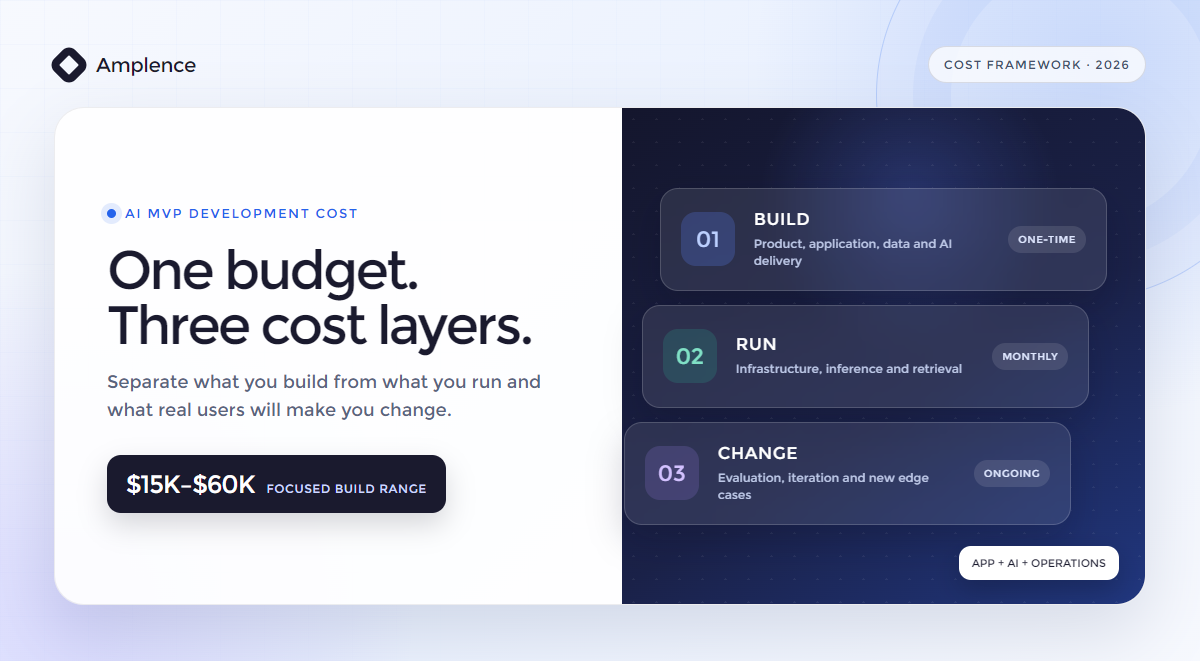
Separate the build quote from the monthly run rate.
A focused, API-based AI MVP usually belongs in a $15,000-$60,000 build budget. Multi-role SaaS products, tool-using agents, regulated data, or custom model work can move the cost toward $40,000-$150,000+. Those are Amplence planning ranges, not market averages or fixed quotes. Your real budget has three separate ledgers: Build, Run, and Change.
Search for AI MVP development cost and you will find estimates from under $10,000 to more than $300,000. The disagreement is not only about agency rates. Many articles compare a thin AI prototype with an enterprise product as if they were the same deliverable.
They also mix the normal application with the AI system around it. Authentication, dashboards, billing, databases, integrations, retrieval, evaluations, model calls, and monitoring disappear into one large number.
That is not enough to make a budget decision.
This guide separates the app layer from the AI layer, the one-time build from the monthly run cost, and initial delivery from the work that starts after real users arrive. If you are already evaluating a project, our AI MVP development team uses the same separation during scoping.
How Much Does AI MVP Development Cost in 2026?
Here is the useful answer, with the scope attached.
| Product stage | What is actually included | Indicative build budget | Typical calendar time |
|---|---|---|---|
| AI prototype | One technical test, sample or synthetic data, little production hardening | $5,000-$15,000 | 2-4 weeks |
| Lean AI MVP | One core workflow, managed model API, basic app, real users | $15,000-$35,000 | 4-8 weeks |
| RAG or document AI MVP | Data ingestion, retrieval, citations, evaluation set, user-facing app | $25,000-$60,000 | 6-10 weeks |
| AI SaaS or controlled agent MVP | Accounts, billing, admin, multiple roles, tool calls, integrations | $40,000-$100,000 | 8-16 weeks |
| Regulated or custom AI system | Sensitive data, formal controls, human review, complex integrations or model work | $75,000-$150,000+ | 12-24+ weeks |
How to read this table: These are Amplence's 2026 planning ranges for a professionally built first version. They are not a claim about the average market price. A final estimate still depends on the workflow, data, user roles, integrations, reliability target, and delivery team.
The first row is also a warning. A prototype can prove that an approach is technically possible, but it may not be a usable MVP. If you are unsure where that boundary sits, our guide to what an AI MVP actually includes separates a technical demo from a product that real users can test.
Why Do AI MVP Cost Estimates Range From $5K to $300K+?
Current agency guides genuinely publish numbers this far apart. Ideas2IT's broad MVP guide places simple products around $5,000-$15,000 and complex products around $50,000-$150,000. IPH's AI-specific guide prices an API-driven AI MVP at $15,000-$30,000 and a custom AI MVP at $100,000-$300,000+. Softude's broader enterprise AI guide puts first-year budgets at $80,000-$300,000 and enterprise systems above that.
Those ranges are not directly comparable. They change at least five variables at once:
- Prototype or real product: A single model call behind a basic screen is different from a live application with accounts, permissions, billing, logs, and support.
- Existing data or data project: Clean documents are cheaper to use than scanned files, inconsistent records, or unlabeled examples that need preparation.
- One response or an agent loop: One model request has one usage profile. A tool-using workflow may call the model several times, retry failed steps, and run a separate validator.
- General or regulated environment: Sensitive workflows need stronger access control, auditability, security review, and human approval.
- Delivery rate: The same scope costs very different amounts at different blended team rates.
Take a 550-hour project as a simple example. At $35 per hour, labor is $19,250. At $75 per hour, it is $41,250. At $150 per hour, it is $82,500. Same hours. Same scope. Very different quote.
This is why a price without an architecture, estimated effort, assumptions, and exclusions tells you very little.
What Are You Actually Paying For?
We use three ledgers when budgeting an AI MVP: Build, Run, and Change. This is an Amplence planning model, not an industry standard.
| Ledger | What it covers | Cost behavior |
|---|---|---|
| Build | Product discovery, UX, frontend, backend, data, AI integration, evaluations, QA, deployment | Mostly one-time |
| Run | Hosting, database, storage, model inference, retrieval, monitoring, third-party services | Recurring and usage-based |
| Change | User-driven iterations, prompt and retrieval improvements, model migrations, new edge cases, support | Recurring or milestone-based |
Your first-year budget is therefore:
The Change budget should not be a random percentage. Estimate it from a real post-launch plan. How often will you review failures? Who will update the evaluation set? How many product iterations can you fund after the first user feedback?
This is one place AI MVP development pricing differs from a conventional fixed-feature build. The AI can behave correctly in testing and still encounter new language, documents, edge cases, and user strategies after launch. That feedback is part of the MVP's job, but responding to it still costs time.
How Does the Build Cost Split Between the App and the AI?
The model call is usually a small part of the engineering work. The product around it is what makes the result useful, testable, secure, and measurable.
| Build layer | Work included | What makes it more expensive |
|---|---|---|
| Product and scope | User journey, hypothesis, success metric, acceptance criteria, architecture | Multiple audiences, unclear workflow, untested assumptions |
| UX and interface | Core screens, states, onboarding, responsive behavior, accessibility | Mobile plus web, complex dashboards, many edge cases |
| Application layer | Frontend, backend, authentication, database, roles, billing, admin | Multi-tenancy, granular permissions, real-time features |
| Integrations | CRM, payment, email, storage, external APIs, internal systems | Weak APIs, legacy systems, bidirectional sync, rate limits |
| AI orchestration | Prompts, structured outputs, model routing, tool calling, fallbacks | Multiple models, long context, agents, retry paths |
| Data and retrieval | Parsing, cleaning, chunking, embeddings, vector search, citations | Scanned files, changing sources, poor metadata, tenant isolation |
| Evaluation and controls | Test set, task-success scoring, hallucination checks, human review | High-stakes outputs, many edge cases, formal approval requirements |
| Quality and launch | Functional QA, AI-output QA, security checks, deployment, logs, documentation | Compliance, performance targets, production support requirements |
A vendor quote that says only “AI integration” is too vague. Ask whether it includes a representative evaluation set, structured output validation, usage metering, failure handling, and a way to inspect bad results. If it does not, you may be buying a demo wrapped in an app.
How Much Does an AI MVP Cost to Run Each Month?
Monthly AI MVP cost is not one percentage of the build. It is a sum of fixed plans, metered usage, and human operating work.
| Run-cost category | Practical calculation |
|---|---|
| App hosting | Base plan + compute + bandwidth + request overages |
| Database and authentication | Plan + compute tier + storage + active-user or bandwidth overages |
| Model inference | Input tokens + cached input + output tokens, multiplied by model calls |
| Retrieval | Embedding or ingestion + vector storage + search operations + retrieved tokens |
| Tools | Search, OCR, transcription, email, SMS, maps, identity checks, or other APIs |
| Monitoring and evaluations | Logs, traces, error events, grader-model usage, and human review time |
| Maintenance | Agreed support hours, incidents, model migrations, and planned improvements |
For one common managed stack, Vercel Pro starts at $20 per month and Supabase Pro is $25 per month, before relevant overages or add-ons. A separate vector database may charge for storage and read/write operations; Pinecone documents its serverless billing as usage-based across storage and operations.
These base plans are not your total run rate. The user behavior inside the product matters more.
How Do You Calculate AI Inference Cost Per User?
Use this formula:
Do not skip model calls per task. A visible user action may trigger a planner, retrieval step, tool call, retry, safety check, and final formatter. One task is not always one model request.
Worked example: 1,000 active users
Assume a document-support AI MVP with:
That produces:
OpenAI's official pricing, checked on August 7, 2026, lists GPT-5.6 Terra short-context standard rates at $2 per million input tokens and $12 per million output tokens.
| Calculation | Cost |
|---|---|
| 52M input tokens x $2/M | $104 |
| 13M output tokens x $12/M | $156 |
| Monthly model inference | $260 |
| Model cost per active user | $0.26 |
| Model cost per user task | $0.013 |
Now add retrieval and baseline app infrastructure.
This example assumes one OpenAI File Search call per user task. The official tool pricing is $2.50 per 1,000 calls, so 20,000 calls cost $50. Five GB of file-search storage produces four billable GB after the first free GB. At $0.10 per GB per day for a 30-day month, that adds $12.
| Example monthly run item | Cost |
|---|---|
| Model inference | $260 |
| File Search tool calls | $50 |
| File Search storage | $12 |
| Vercel Pro base plan | $20 |
| Supabase Pro base plan | $25 |
| Subtotal | $367/month |
| Subtotal per active user | $0.367 |
| Subtotal per user task | $0.01835 |
This is an illustrative workload, not a forecast for every product. It excludes monitoring, email, payment fees, human review, support, taxes, regional processing uplifts, and usage overages. It also assumes the 2,000 input tokens already include retrieved context.
The useful lesson is not that every AI MVP costs $0.367 per user. It is that you can audit the number.
Model choice can change the inference line by 25x
Using the same 26,000 calls and token volumes with other current OpenAI short-context standard rates:
| Model | Input/output price per 1M tokens | Monthly inference | Per active user |
|---|---|---|---|
| GPT-5.6 Luna | $0.20 / $1.20 | $26 | $0.026 |
| GPT-5.6 Terra | $2 / $12 | $260 | $0.26 |
| GPT-5.6 Sol | $5 / $30 | $650 | $0.65 |
This is not a quality comparison or a model recommendation. A cheaper model is only cheaper if it passes your evaluation set. The practical approach is often routing: use the lowest-cost model that meets the acceptance criteria for each task, and reserve a stronger model for the cases that need it.
Provider prices change. Keep the formula and replace the rates. Better still, log the input, cached input, output, tool calls, and model used for every task so your product can calculate the actual cost per customer and plan.
Which Factors Increase the Cost to Build an AI MVP Most?
1. More than one core workflow
“Upload a document and receive a cited summary” is one workflow. Adding collaboration, approvals, automated outreach, CRM updates, and team reporting creates several products inside the same release.
Scope the first version around the one journey that tests the business hypothesis. Our step-by-step AI MVP build guide covers how to define that minimum journey before selecting tools.
2. Unprepared or inaccessible data
RAG does not turn a folder of inconsistent files into a reliable knowledge system automatically. Parsing, deduplication, metadata, permissions, chunking, re-indexing, and retrieval evaluation all require work.
If access to representative data is still uncertain, start with discovery or a prototype. Do not sign a production-MVP quote based on an imagined data set.
3. Multi-tenancy and permissions
One internal workspace is simpler than a SaaS product where every customer has separate users, documents, usage limits, and billing. Tenant isolation affects the database, retrieval layer, admin controls, logging, and testing.
4. Tool-using or agentic behavior
An agent that reads a record, searches a knowledge base, updates a CRM, drafts an email, and requests approval has more failure paths than a single response generator. Each tool needs a schema, permissions, error handling, retries, idempotency, audit logs, and test cases.
It also increases model calls per task, which affects both latency and AI inference cost. We work that loop through turn by turn, including what prefix caching does to it, in our AI agent cost article.
5. Reliability and human-review requirements
A marketing draft can tolerate a user editing the answer. A health, finance, legal, or safety-related recommendation may need citations, confidence rules, restricted actions, audit trails, and mandatory professional review.
Do not budget high-stakes reliability as a final QA task. It changes the architecture from the beginning.
6. Integrations and external dependencies
Well-documented APIs reduce uncertainty. Legacy systems, limited sandboxes, unclear ownership, data mapping, and third-party rate limits increase it. Each integration also becomes an operating dependency after launch.
How Can You Reduce AI MVP Cost Without Underbuilding It?
Prove the workflow before polishing the product
Test the riskiest assumption first. If a manual concierge test, landing page, or clickable prototype can answer the demand question, use it. You may not need a software build yet.
Start with a managed model API
Training or self-hosting a model adds data, infrastructure, deployment, and monitoring responsibilities. For most early products, a managed API is the faster way to test whether the product creates value. Revisit the model strategy once usage and quality data justify it.
Measure cost per successful task
Cost per request can reward a system that produces cheap but unusable output. Track cost per successful task instead:
This connects unit economics to quality.
Control model calls and output length
Set retry limits, tool-call limits, token caps, and timeouts. Keep context relevant. A product should never allow an uncontrolled agent loop to decide its own budget.
Cache and batch when the workload allows it
OpenAI's prompt-caching documentation explains that cached input is priced below uncached input for supported models, although current GPT-5.6 cache writes carry a separate charge. For work that does not need an immediate response, the OpenAI Batch API documents a 50% cost reduction with asynchronous processing.
Caching and batching are optimizations, not substitutes for good architecture. Apply them only after measuring the real workload.
Use normal automation when AI adds no value
If the process follows stable rules, ordinary workflow automation may be cheaper, faster, and easier to test. Saying “AI” should not create the budget. Uncertainty should.
What Should a Complete AI MVP Quote Include?
A serious proposal should let you answer these questions:
A complete AI MVP quote should make these answers clear
- What exact user and workflow does version one support?
- Which features belong to the app layer, AI layer, and data layer?
- Which model, context pattern, and retrieval approach does the estimate assume?
- What representative data is available, and who prepares it?
- How will output quality be measured before launch?
- Are usage metering, logs, fallbacks, and human review included?
- Which integrations and user roles are in scope?
- Who owns the infrastructure, accounts, source code, and documentation?
- What monthly third-party costs are expected at the forecast usage?
- What is excluded, and how are scope changes priced?
- What post-launch support and iteration are included?
Be cautious when a vendor gives one fixed number before understanding the workflow or data. Also be cautious when every technical decision points toward the vendor's preferred tool.
Our guide to red flags when hiring an AI development agency provides a fuller evaluation checklist. Use it whether you speak with Amplence or anyone else.
How Can You Estimate Your Budget Before an Agency Call?
Bring these ten inputs:
- One sentence describing the core user outcome
- The single end-to-end workflow for version one
- Required user roles and permissions
- Data sources, file types, quality, and approximate volume
- External systems and APIs to connect
- Expected monthly active users
- AI tasks per user per month
- Expected model calls per task
- Quality, latency, privacy, and human-review requirements
- The decision the MVP must help you make
You may not know the token counts yet. That is fine. A short technical spike can measure them using representative tasks. What matters is refusing to hide usage behind a generic “API fees” line.
When Should You Not Build an AI MVP Yet?
Do not commission a full AI MVP when:
The cheapest version is sometimes no build at all. That is a good outcome if it prevents you from validating the wrong thing. Here is how to validate an AI startup idea before any of this becomes a budget question.
Frequently Asked Questions
How much does AI MVP development cost in 2026?
A focused API-based AI MVP commonly fits an Amplence planning range of $15,000-$60,000. AI SaaS, controlled agents, regulated products, and custom model work can move toward $40,000-$150,000+. Scope, data, integrations, reliability, team rate, and post-launch requirements determine the actual quote.
What is the cheapest way to build an AI MVP?
Start with one workflow, one user type, a managed model API, and the smallest app needed for real testing. Avoid custom model work, multiple platforms, broad integrations, and autonomous agent loops until the first version proves they are necessary.
How much does an AI MVP cost to run per month?
There is no defensible flat percentage. Add hosting, database, storage, inference, retrieval, monitoring, third-party APIs, and support. Then calculate model usage from users, tasks per user, model calls per task, input tokens, output tokens, and current provider rates.
Is RAG more expensive than a basic LLM integration?
Usually, because RAG adds document parsing, chunking, embeddings, storage, retrieval, permissions, citations, re-indexing, and evaluation. It is worth that work when the product must answer from private or changing information. Do not add RAG only because it sounds more advanced.
Why do two agencies quote such different AI MVP prices?
They may assume different scopes, delivery rates, team structures, data readiness, reliability standards, and post-launch responsibilities. Compare the estimated effort and included layers, not only the total.
Should ongoing AI API cost affect my product pricing?
Yes. Measure cost per active user and cost per successful task. Add usage limits or tiered pricing before launch if heavy users could cost more to serve than their subscription revenue.
A Better AI MVP Budget Starts With the Right Split
The headline build quote is only one part of AI MVP development cost. A reliable budget separates the application from the AI, the build from the run rate, and launch from the changes real users will demand.
Start with one workflow. Show the assumptions. Calculate cost per user. Measure successful outcomes, not just API calls.
Plan the app, AI, data, and operating assumptions together.
Get a focused AI MVP scope that separates delivery work from the run rate and the iteration work real users will create.
Discuss your AI MVP ↗