.svg)


You have a product idea with AI at its core. The question that keeps you up is not whether it is clever. It is whether anyone will actually use it and pay for it and how fast you can find out. That is exactly what an AI MVP is built to answer.
In this guide we cover what an AI MVP is, how AI MVP development differs from ordinary MVP software development, how long it takes, and how founders in healthcare, finance, e-commerce, manufacturing, law, and construction are shipping AI MVPs in 2 to 14 weeks.
Quick Answer: What Is an AI MVP?
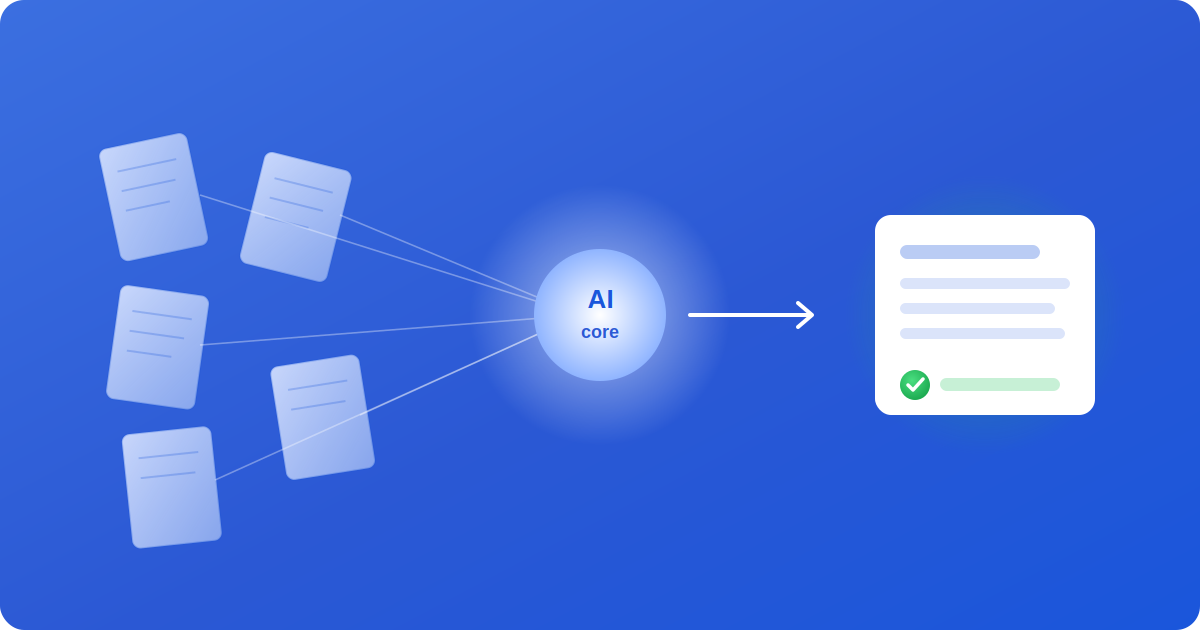
An AI MVP (minimum viable product) is the smallest working version of an AI-powered product that real users can test on real infrastructure. It ships one core AI workflow generation, classification, retrieval, or analysis that is wrapped in enough auth, data, and error handling to produce a trustworthy signal about demand.
A focused AI MVP typically takes 2 to 4 weeks; a production-grade one with integrations takes 4 to 8 weeks, and a regulated build takes 8 to 14 weeks.
The AI MVP Timeline: Idea to Launch in 2 to 14 Weeks
A realistic build path for an AI-native minimum viable product
Hypothesis
Define the test
Days 1 to 3
Ruthless Scope
One core workflow
Days 3 to 7
Build the AI Layer
RAG, routing, chains
Week 1 to 5
Deploy Live
Real URL, real users
Week 4 to 7
Measure and Decide
Scale, pivot or kill
Week 2 to 14
What Is an MVP in Software Development?
Before the AI part, the fundamentals. In software development, an MVP is the leanest version of a product that still delivers real value to a real user.
The point of MVP development is not to impress anyone with features. It is to answer one question as cheaply as possible: does this solve a problem people will pay to fix?
The discipline of MVP development for startups is mostly the discipline of leaving things out. No admin panel unless it is critical. No multi-tier pricing.
No elaborate onboarding. Every screen should answer a product question rather than simply adding another feature. That is true of any startup MVP development effort, and it becomes even more important when AI enters the picture.
What Is an AI MVP? (And What Is an MVP in AI)
An AI MVP applies the same lean logic to a product whose core value lives in an intelligence layer.
When people ask what is an MVP in AI, the honest answer is that it is a standard MVP with one hard twist: the thing that makes it valuable, the model behavior that is genuinely difficult to get right on the first pass.
That difficulty is why AI MVP development is its own discipline. A generic MVP development process assumes the hard part is building features.
In custom MVP development AI projects, the hard part is making the AI produce consistent, trustworthy output against messy real-world inputs. Get that wrong and you ship a demo that dazzles on the happy path and collapses the moment a real user phrases a request differently than your script assumed.
The Two Ways AI MVPs Fail Before Launch
Over-engineered A team treats it like enterprise software. Three months and a heavy budget later, there is a beautiful microservices diagram and zero validated users.
Under-built A founder wires a GPT wrapper to a landing page. It works in the demo and falls apart on real data and real edge cases, creating a false signal that looks like validation but is not.
Is It a Prototype, a PoC or an MVP?
Three different artifacts, three different questions. A proof of concept asks whether the model can hit your accuracy bar on your data. A prototype asks whether anyone wants the thing, and its AI can be completely faked. An MVP asks whether it holds up at real cost and volume, and it is the first one you do not throw away.
Most teams need two of the three, and picking the wrong one costs weeks answering a question you could already answer. We work through how to tell which you need, including when to skip the proof of concept entirely, in AI PoC vs prototype vs MVP.
How Long Does It Take to Build an AI MVP?
The honest answer: between 2 and 14 weeks, depending on scope. Anyone quoting a single number without asking about your workflow, data, and compliance needs is guessing. Here is how the MVP development timeline actually breaks down.
Timeline at a Glance
Validation MVP One workflow, sample data, and a single role.
Production MVP RAG on your data, auth, roles, guardrails, scale-ready code.
Regulated MVP Healthcare, finance, and legal work with human-in-the-loop review and audit trails.
What Moves the Timeline
- Number of workflows: One core flow ships fast. Every additional workflow adds days to weeks.
- Data integrations: Static sample data is quick. Live plan systems, CRMs, and ERPs add discovery and testing times.
- User roles: A single-role tool is lighter than a multi-role product with permissions.
- AI complexity: A single prompt chain is fast. A multi-model pipeline with RAG and confidence scoring takes longer.
- Compliance: Regulated industries need privacy, access controls, audit logging, and legal review before any claim.
AI MVP Timeline by Tier
The same three tiers set the timeline, and scope drives all of it. A focused validation build on sample data ships in weeks. A production build on your live data takes longer, because integrations and guardrails have to be tested against real records. The money side of each tier, build cost and monthly running cost as two separate ledgers, lives in our AI MVP development cost guide, so this page stays on scope and time.
AI MVP Timeline by Tier
Indicative ranges by scope. Costs are in the separate cost guide.
Validation MVP
Prove the demand
2 to 4 wks
- One core AI workflow
- Synthetic or sample data
- Single user role
- Live deploy, real users
- Lightest LLM setup
Best for
Pre-seed founders testing an idea
Production MVP
Validate and scale-ready
4 to 8 wks
- Core flow + edge cases
- RAG pipeline on your data
- Auth, database, roles
- Error handling + guardrails
- Extensible codebase you own
Best for
Seed startups raising on traction
Regulated MVP
Compliance in the loop
8 to 14 wks
- Healthcare, finance, legal
- Human-in-the-loop review
- Privacy-by-design
- Audit logs, access controls
- Live data integrations
Best for
Teams in regulated industries
What You’ll Build It On
Most AI MVPs in 2026 run on the same short list: a Next.js frontend, Postgres and auth on Supabase, retrieval on pgvector, Stripe for payments, and a hosted model API. It is a deliberately boring stack, and that is the point. It gets you to a live URL fast without painting you into a corner.
The choice that actually deserves your attention is not which of those you pick. It is your data model, because it is the only one that is expensive to change later. We break down the full stack, the condition that makes each piece wrong, and what each swap costs in our guide to the AI MVP tech stack.
The principle behind an AI MVP builder approach is that version two extends version one. You should own clean, documented source code that your next developer or our team can pick up without a rewrite.
The Build Process in Brief
The build runs as one loop: write the hypothesis, scope to a single workflow, build the AI layer against real inputs, then launch, measure and decide. We keep the detailed version in one place, our step-by-step guide to building an AI MVP, which expands that loop into seven stages with the deliverable and the decision at each one. This page stays on what an AI MVP is and how long it takes.
What About an MVP AI Agent?
A growing share of AI MVPs are agentic. An MVP AI agent does not just answer a prompt; it takes a task, breaks it into steps, calls tools or data sources, and produces a structured result.
The MVP discipline is identical: pick one agent workflow with clear value, wrap it in real infrastructure, and keep a human in the loop wherever a decision carries real consequences. We covered a shipped example of exactly this pattern in manufacturing below.
AI MVP Use Cases by Industry
The strongest AI MVP ideas share a shape: one clear user, one clear workflow, and one measurable problem. Here is how that plays out across the six industries Amplence builds for.
- Healthcare: Evidence-led plan comparison and clinical decision-support tools that organize information and hand off to a licensed professional, never replacing one.
- Finance: Turning founder submissions or deal documents into structured, partner-ready briefs, plus risk-scoring tools with confidence thresholds.
- E-commerce: AI product descriptions, semantic search, and support assistants that measurably lift conversion and reduce ticket volume.
- Manufacturing: Agents that turn complex product requests into clear requirements, product-fit matches, and engineer-ready handoffs.
- Law Firms: Document review and clause retrieval with citations back to source, keeping a lawyer as the verifier of record.
- Construction: Bid analysis, spec extraction, and site-report summarization from piles of unstructured documents.
AI MVP Use Cases by Industry
One clear workflow, one measurable problem, per vertical
Healthcare
Evidence-led plan comparison with advisor-ready briefs and human-in-the-loop review.
E-commerce
AI product descriptions, smart search and support assistants that lift conversion.
Manufacturing
Turn complex product requests into requirements and engineer-ready handoffs.
Law Firms
Document review and clause retrieval with citations back to source, human-verified.
Finance
Turn founder or deal submissions into structured, partner-ready briefs and risk scoring.
Construction
Bid analysis, spec extraction and site-report summarization from unstructured documents.
Case Study: A Healthcare AI MVP in 2 Months
Theory is cheap, so here is a shipped example. For Find The Plan, a Medicare guidance concept, we asked a single practical question: what is the smallest useful AI product that could make plan selection clearer? Reading several plan rulebooks at once is exactly the kind of problem a scoped AI MVP is built for.
What We Built (and Why It Worked)
-
Five guided preference inputs replaced an open-ended questionnaire, with no name, diagnosis, or contact data collected.
-
A RAG pipeline retrieved the exact plan clauses matching each priority, so every recommendation cited its evidence.
-
An evidence inspector turned the AI from a black box into a reviewable decision-support tool.
-
The product never announced a winner. It produced an advisor-ready brief for a licensed professional to finish.
The result was a focused, privacy-by-design concept that proved the core experience was useful and trusted before a dollar went into a full build. Read the full healthcare AI MVP case study for the complete workflow and stack.
Is AI MVP Development the Right Starting Point for You?
An AI MVP is a strong fit if your product has AI at its core, you want real users testing it before a full build, and you need something in people's hands within weeks.
It is the wrong tool if you have already proven the concept and just need the full product or if you are really trying to automate internal operations; that is a workflow or business process automation conversation.
Good Fit vs. Not Yet
Good fit
- AI-core idea
- Pre-validation
- Need live users in weeks
- Want scale-ready code from day one
Not yet
- The concept is already proven
- Internal ops automation
- You only want a clickable mockup rather than working software
Free Strategy Call
Bring the idea. We'll build your AI MVP.
Book a 20-minute call, and we'll figure out the smallest useful version of your product, scoped, priced, and shippable in weeks, not months.
Frequently Asked Questions
1: What is an AI MVP?
An AI MVP is the smallest working version of an AI product that real users can test on real infrastructure.
It ships one core AI workflow with generation, classification, retrieval, or analysis with enough authentication, data handling, and error handling to generate trustworthy feedback about whether people want the product.
2: What is an MVP in AI versus a regular MVP?
A regular MVP test is required for any product. An MVP in AI does the same, but the core value lives in a model layer that is hard to get right on the first pass, so the build focuses on making the AI produce consistent, trustworthy output against messy real inputs, not just on shipping features.
3: How long does AI MVP development take?
Typically 2 to 14 weeks, rising to 12 to 24 weeks or more once live regulated data is involved. A focused validation MVP with one workflow and sample data ships in 2 to 4 weeks.
A production MVP with RAG on your data, auth, and guardrails takes 4 to 8 weeks. A regulated MVP in healthcare, finance, or legal runs 8 to 14 weeks when it works from synthetic, de-identified, or limited data. Once it handles live regulated records the range moves to 12 to 24 weeks or more, and our guide to healthcare AI MVP development sets out what drives the difference.
4: How much does AI MVP development cost?
Scope drives cost the same way it drives the timeline: the number of workflows, integrations, user roles, AI complexity and compliance needs. We separate what an AI MVP costs to build from what it costs to run, with worked numbers, in our AI MVP development cost guide.
5: What is an AI MVP builder or an MVP AI agent?
An AI MVP builder is an approach (or partner) that ships a lean but properly built first version where version two extends version one without a rewrite.
An MVP AI agent is an agentic MVP that takes a task, breaks it into steps, calls tools or data, and returns a structured result that is built with the same scope-one-workflow discipline.
6: Can you build an AI MVP with RAG?
Yes. A RAG (retrieval-augmented generation) pipeline is used when the product must reference private documents, policies, past cases, or customer data.
It retrieves relevant context from approved sources before generating answers, which also makes the AI's reasoning inspectable, as in our healthcare MVP, where every recommendation cited its evidence.
7: What industries is AI MVP development good for?
Any vertical with a clear, document-heavy or decision-support workflow. We build AI MVPs for healthcare, finance, e-commerce, manufacturing, law firms, and construction, each around one clear user, one workflow, and one measurable problem to validate.