.svg)


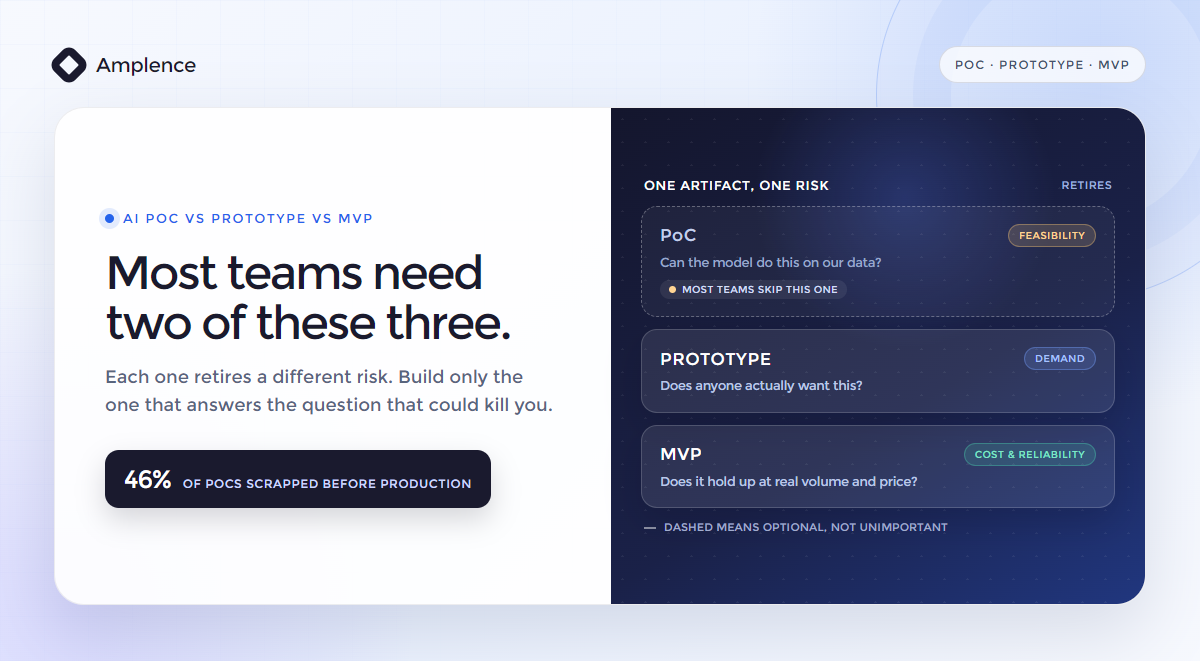
Build the one that answers the question that could kill you.
Build a PoC only when you genuinely don't know if the model can hit your accuracy bar on your data. Build a prototype when you don't know if anyone wants it. Build an MVP when both are settled enough to charge for. Most AI projects using a hosted model on a common task should skip straight past the PoC.
Three artifacts, three different questions. Almost every guide to this topic explains the definitions and stops there, which leaves you exactly where you started: holding three options and no way to choose.
The choice isn't really about the artifacts. It's about which risk is most likely to kill your project, because each artifact exists to retire exactly one of them. Pick the wrong one and you spend six weeks answering a question you already knew the answer to.
AI changes this in one specific way, and it's the reason a generic PoC-vs-MVP article won't help you. We build these for a living, so this is the version with the AI part left in. If you'd rather talk it through, that's what our AI MVP development work is.
AI PoC vs Prototype vs MVP: The Short Answer
Here's the whole decision on one screen.
| PoC | Prototype | MVP | |
|---|---|---|---|
| Risk it retires | Feasibility | Demand | Cost and reliability |
| Question | Can the model do this on our data? | Does anyone want this? | Does it hold up with real users? |
| Audience | Your own team | A handful of target users | Paying or committed users |
| Real data? | Yes, a representative sample | No, faked is fine | Yes, all of it |
| Real infrastructure? | No | No | Yes |
| Success looks like | A measured number beating a threshold you set first | Users completing the task without help | Cost per successful task you can live with |
| Typical length | 1 to 3 weeks | 1 to 2 weeks | 4 to 10 weeks |
| Throwaway? | Yes, entirely | Yes, entirely | No, this is the product |
Lengths are Amplence estimates from projects we've delivered, not an industry benchmark.
What Each One Actually Proves
The definitions only matter to the extent they change what you build.
A proof of concept is a script. No interface, no login, no database. It takes a representative slice of your real data, runs the model against it, and produces a number. Nobody outside your team ever sees it. Its only job is to answer a technical question that you cannot answer by reasoning about it.
A prototype is a facade. It looks real and does nothing. The AI response can be hardcoded, or a person can type it from another room. Its only job is to find out whether anyone changes their behavior when the thing appears to exist.
An MVP is the smallest thing you would let a stranger pay for. Real auth, real data, real error handling, real infrastructure. It's the first artifact you don't throw away. We cover what goes into one in our guide to what an AI MVP is.
The contrast that matters: a PoC and a prototype are both disposable, but they're disposable for opposite reasons. The PoC is real logic with a fake product around it. The prototype is a real product with fake logic inside it.
Why AI Changes the Answer
In conventional software, the PoC stage is usually a formality. Can we build a booking system with a calendar and payments? Yes. Somebody built one this morning. Feasibility risk is close to zero, which is why most software teams go straight to a prototype and most PoC-vs-MVP advice treats the PoC as an optional first box to tick.
AI breaks that assumption, because the answer genuinely depends on your data.
Nobody can tell you in advance whether a model will classify your support tickets correctly, extract fields from your scanned invoices, or summarize your contracts without inventing a clause. The model's published benchmarks tell you it's capable in general. They tell you nothing about your messy, domain-specific, badly-scanned reality.
That's a real, unbounded risk, and it's the one thing you cannot design your way around. It is also why the PoC stage earns its place in AI when it rarely does elsewhere.
| Conventional software | AI feature | |
|---|---|---|
| Can it be built? | Almost always yes | Depends on your data |
| Who answers that? | An architect, in a meeting | A measurement, on a sample |
| Failure mode | Runs late | Never reaches the bar at all |
| Cost of finding out late | Weeks | The whole project |
The trap is applying this correctly. AI makes feasibility risk real. It does not make it universal.
When You Actually Need an AI PoC
Four conditions. If none of them describes you, keep reading to the next section.
- Your data is unusual. Rare languages, heavy domain jargon, poor scans, handwriting, or a label set with only a few dozen examples per class.
- Your accuracy bar is high and non-negotiable. Anything where being wrong five percent of the time is a regulatory, financial or safety problem rather than an annoyance.
- The task is genuinely novel. Not classification, extraction, summarization, drafting or translation, which are settled. Something a frontier model has no obvious analogue for.
- You have a hard latency or cost ceiling. Sub-second responses, or a unit cost so thin that only a small model could work, which puts capability back in question.
One condition is enough. Two makes a PoC clearly worth it.
Notice what's not on the list: "the client asked for one," "it's how we always start," and "we need something to show the board." Those are real reasons people run PoCs. None of them is a feasibility question, and a PoC is an expensive way to answer a different one.
When to Skip the PoC (Which Is Most of the Time)
Here's the unprofitable part, and it costs us work to say it.
If you're calling a hosted frontier model to classify text, pull named fields out of documents, summarize, translate, or draft from a template plus retrieved context, the feasibility question is largely closed. Those capabilities are settled in 2026. Running a six-week study to confirm the model can summarize is not de-risking, it's a delay you paid for.
A PoC is also the easiest thing in this industry to sell. It's small, it's fixed-scope, it sounds prudent, and it commits the client to nothing while committing them to a supplier. Every article in this category is written by somebody who sells them, which is roughly why none of them ever tells you to skip one.
The honest substitute, in most cases, is a two-day spike. One engineer, a hundred real examples, an afternoon of prompt iteration, and a spreadsheet with a number in it. If the number is nowhere near your bar, you've learned the same thing a PoC would have told you, six weeks earlier and for a fraction of the cost. If it's close, you've earned the right to run a proper PoC on the specific part that's shaky.
Ask any agency proposing a PoC what specific technical question it answers, and what result would make them tell you to stop. If they can't answer both, you're buying a demo.
One exception, because we recommend it ourselves. In our guide to hiring an AI automation agency we tell you to require a paid trial sprint before committing to a large contract. That's a different thing wearing the same word. A trial sprint tests the agency: do they communicate, ship something in a fortnight, and handle your data responsibly. A proof of concept tests the model. Buy the first one routinely. Buy the second one only when one of the four conditions above applies, and be clear with your supplier which of the two you're actually paying for.
What "PoC Passed" Has to Mean
A proof of concept without a number agreed in advance is not a proof of anything. It's a demo, and demos always succeed, because whoever built it chose the examples.
Four things get written down before the work starts.
- The metric. Not "accuracy" in the abstract. Precision, recall, exact-match rate, or task success rate, named explicitly, because they fail in different directions.
- The threshold. A number. "Correct on 92% of the held-out set." Set it before you see any results, or you'll rationalize whatever you get.
- The dataset. A real sample, chosen before you start, including the awkward ten percent. Held out and never used for prompt tuning.
- The kill condition. What result makes you stop. If no result would make you stop, you're not testing anything and you can save the money.
That fourth one is the one everybody omits, and it's the one that makes the other three mean something. A PoC where every outcome leads to "great, let's proceed to build" is a procurement ritual.
For what a real threshold looks like once it's live, our Amazon Appeal Wizard build holds an 87% success rate across more than 2,000 generated appeals. That number is the kind of thing a PoC exists to predict, and the kind of thing you should be able to state before anyone writes production code.
The AI Prototype: What It's For and What It Isn't
A prototype answers a question about people, not models. Which means the AI inside it can be completely fake, and usually should be.
Hardcode the outputs. Or run it Wizard-of-Oz style, where a person answers in real time and the user believes it's the system. Both are faster than building anything, and both answer the actual question: does a user's behavior change when this appears to exist?
What a prototype is not: a small version of the product. The moment you find yourself adding a database so the prototype can remember things, you've stopped prototyping and started building an MVP without deciding to. If that's where you are, the seven-step build guide is the place to decide it properly.
The useful signal from a prototype isn't praise. People are generous in usability sessions. The signal is whether they finish the task without help, come back unprompted, or give you something they'd rather not give away: an email address, a calendar slot, a deposit.
The AI MVP: Where Cost and Reliability Get Real
An MVP is where the questions stop being about capability and start being about economics.
Your PoC proved the model can hit the bar on a curated sample. Your MVP finds out what happens at a thousand users, on data nobody cleaned, when the model is wrong at three in the morning and nobody is watching. Those are different problems, and passing the first tells you very little about the second.
This is the stage where unit cost becomes the thing that kills you, which is why we work through it properly in the AI MVP cost breakdown, and where what you build on starts to matter, which is the AI MVP tech stack.
It's also the first stage where throwing the code away is expensive. Which brings us to the failure mode.
The Trap: When the PoC Becomes the Product
The most common and most expensive mistake in this whole sequence.
The PoC works. Everyone is delighted. Somebody asks how long it would take to "just add a login and put it in front of customers," and because the demo already exists, that sounds like a small step. It isn't. The PoC was built to be thrown away: no error handling, no retries, no evaluation set, hardcoded paths, one happy path through curated data.
Six months later that throwaway script is load-bearing, nobody can change it safely, and the shortcuts have become the architecture. We covered this failure mode and five others in why most AI MVPs never reach production, along with a teardown of the statistics that circulate about this stage, which vary wildly depending on which one you pick and what it measures.
The one figure that actually measures this particular gap comes from S&P Global's 2025 survey of more than 1,000 respondents across North America and Europe: the average organization scrapped 46% of its proof of concepts before production. Treat the more alarming numbers you'll see quoted around PoCs with suspicion until you've checked what they measure.
The fix is a sentence in the PoC brief: this code will be deleted. Say it out loud at the start, when it's free, rather than discovering it eighteen months in.
Which One You Need: A 10-Minute Decision
Answer these in order and stop at the first yes.
- Write the single sentence that would make you cancel this project. Whichever artifact tests that sentence fastest is the one to build. Most of the work is in being honest about the sentence.
- Is that sentence about the model being good enough on your data? Run the two-day spike first. Escalate to a full PoC only if the spike lands close to your bar rather than nowhere near it.
- Is it about whether anyone wants this? Build the prototype and fake the AI entirely. Do not build any backend.
- Is it about cost, reliability or retention at real volume? You're past both earlier stages. Build the MVP.
If you genuinely can't write that cancellation sentence, that's the finding. It means nobody has defined what success looks like, and no artifact fixes that.
Not sure which one you are actually buying?
Send us the one sentence that would kill your project and we'll tell you which of the three answers it, including when the answer is that you don't need us yet. Bring that sentence.
Book a 20-minute scoping call ↗Frequently Asked Questions
What is the difference between an AI PoC and an MVP?
A PoC answers whether the model can perform the task on your data at an acceptable level, and only your team ever sees it. An MVP is a working product real users can pay for, and it answers whether the thing is wanted, reliable and affordable at volume. A PoC is thrown away by design. An MVP is the first version of the product you keep.
Do I really need a proof of concept for an AI project?
Usually not. If you're using a hosted model for classification, extraction, summarization or drafting, feasibility is largely settled and a PoC mostly buys delay. You need one when your data is unusual, your accuracy bar is high and non-negotiable, the task is genuinely novel, or you have a hard latency or cost ceiling.
How long should an AI PoC take?
One to three weeks in our experience, and a two-day spike answers the question outright more often than people expect. If a proposed PoC runs longer than a month, ask what specific question needs that much time, because the answer is often that it has quietly become an MVP.
What should an AI PoC deliver?
A number and a recommendation, not a demo. Specifically: the metric you agreed, measured on a held-out sample you agreed, compared against the threshold you set before starting, plus a plain statement of whether to proceed, adjust or stop.
Can I go straight to an MVP and skip both?
Often yes, and it's the right call when the capability is proven and demand is already evidenced by waiting lists, letters of intent or an existing manual process people pay for today. The risk is that you find out about a feasibility problem after committing to a full build rather than before.
Is an AI prototype the same as a demo?
No, though they look identical. A demo is built to persuade someone, and it succeeds by definition because the person showing it picks the examples. A prototype is built to learn something, which means it has to be able to fail. If nothing a user does could change your plan, you built a demo.