.svg)


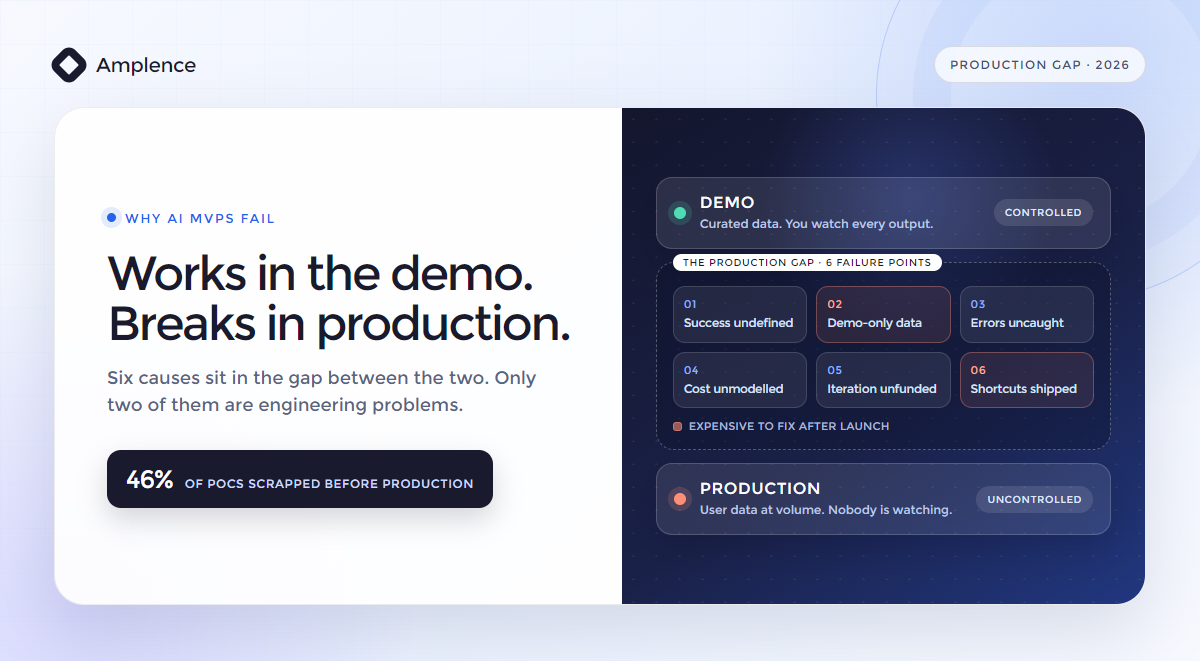
The famous number is real. It just measures something else.
The 80% figure is real, but it measures AI projects failing, not AI MVPs reaching production. The number that actually fits is 46%, the share of proof-of-concepts the average organization scrapped before production in 2025. Six causes explain most of it. Only two are engineering problems.
The demo went well. It always does.
Someone uploads a document, the model returns something impressive, the room nods. Six weeks later the same system is sitting in a branch nobody has merged, and the conversation has quietly moved from "when do we launch" to "what would it take to launch."
That's the gap this article is about. Not model quality, which is fine. The distance between a thing that works when you're watching and a thing that works when you're not.
You've probably seen the stat that frames this. Maybe as 80%, maybe 88%, maybe 95%. It shows up in every AI pitch deck and most agency blogs, almost always with no source attached.
So we read the studies. All of them are real. None of them say what the headlines say. They measure four different things across four different populations, and blending them is how a genuinely useful finding turns into noise.
This guide does two jobs. First, what each number actually measures, because that decides which one applies to you. Then the six causes that stall AI MVPs before production, ranked by what each costs to fix after launch.
Only two of the six are engineering problems. That's the most useful thing on this page.
The six causes, at a glance
Cost to fix after launchWhat the 80% AI Failure Rate Actually Measures
Here's every figure in circulation, traced to its primary source.
| Source | Figure | What it actually measures | Method |
|---|---|---|---|
| RAND, 2024 | 80%+ of AI projects fail | AI projects failing, roughly twice the rate of non-AI IT projectsQualitative | Qualitative. 65 data scientists and engineers, each with 5+ years building AI models |
| Capgemini, 2023 | 88% of pilots never reach production | Pilot to production conversionSurvey | Survey |
| S&P Global, 2025 | 46% of proof-of-concepts scrapped before production | PoC to production conversionClosest fit to this question | Survey, 1,000+ respondents, North America and Europe |
| Gartner, Jul 2024 | 30%+ of GenAI projects abandoned after PoC | A prediction, not a measurementPrediction, not measurement | Analyst forecast |
| Gartner, Jun 2025 | 40%+ of agentic AI projects canceled by 2027 | A prediction, not a measurementPrediction, not measurement | Analyst forecast |
| MIT NANDA, Aug 2025 | 95% of GenAI pilots show no P&L impact | Profit and loss impact, not productionNot peer reviewed | 150 interviews, 350 surveys, 300 cases. Not peer reviewed. |
Three things follow.
So the honest version is closer to roughly half of AI proofs of concept die before production. Still bad. Still worth fixing. Not 95%.
One more finding from RAND deserves more attention than the headline number ever got. Among its industry interviewees, 84% named leadership-driven issues as the primary cause of failure. Not data. Not models. Leadership misunderstanding or miscommunicating what problem needed solving in the first place.
That reframes the whole question. If you're scoping a build right now, it's the first thing worth pressure-testing, and it's where every AI MVP development engagement should start. If you're earlier than that and still working out what you're building, start with what an AI MVP actually is before you worry about production.
Why AI MVPs Fail Between Demo and Production
The gap isn't model quality. Models are good enough for most MVP use cases and improve every quarter.
The gap is conditions. A demo runs under conditions you control. Production runs under conditions your users control.
Every cause below is the same mistake in a different costume: a decision that was safe to defer during the demo and expensive to defer past launch.
RAND's five root causes are worth naming here, because four of them are not technical at all:
- Leadership misunderstands or miscommunicates the problem to be solved
- Inadequate or poor-quality data
- Teams chase the latest technology instead of the actual problem
- Underinvestment in deployment infrastructure
- The problem is beyond what current AI can reliably do
Only causes 2 and 4 are things an engineer can fix alone. The rest get decided in rooms where no engineer is present.
Cause 1: Nobody Defined What "Working" Means
"Looks good" was never converted into a number. So you can't answer the only question that matters: is this better or worse than last week?
You end up shipping on instinct, or not shipping at all. Gartner named unclear business value among its top reasons GenAI projects get abandoned after proof of concept, and this is what that looks like from the inside. It also maps directly to RAND's leading root cause, the one 84% of their industry interviewees pointed at.
Then hold the set still. Change your examples every time you change your prompt and you've measured nothing.
The Amazon Appeal Wizard build is a useful reference. An 87% client-reported reinstatement rate across 2,000+ appeals is only a claim you can make because somebody decided in advance what a successful appeal was, then counted.
Cause 2: The Demo Ran on Data You Won't Have in Production
Poor data quality is RAND's second root cause and the first item on Gartner's abandonment list. It's also the most expensive cause here to discover late, because fixing it usually means re-architecting retrieval rather than tweaking a prompt.
And if you can't get access to representative data yet, that's a finding, not a delay. It means you aren't ready to commission a production build. Run a discovery phase instead of signing a fixed-scope quote against data nobody has seen. Our step-by-step AI MVP build guide covers where that check belongs in the sequence.
Cause 3: Right Often Enough to Demo, Wrong Often Enough to Hurt
The failure isn't the 10%. Every AI system is wrong sometimes. The failure is that the system treats its confident answers and its shaky answers identically, so nothing catches the shaky ones before a customer does.
On CollageDepot, that's what makes 65% auto-resolution safe rather than reckless. The other 35% goes to a person with order data and history pre-loaded, so the handoff costs seconds instead of minutes.
The engineering behind this is genuinely its own subject, and we've written it up properly in our guide to building production-ready AI agents, covering validation gates, retries and rollback. This page is about recognizing you need it. That one is about building it.
Cause 4: The Unit Economics Only Work at Demo Volume
Cost was the top obstacle in the S&P Global survey and appeared in both of Gartner's abandonment predictions. Inference scales with users and, unlike hosting, it never plateaus. A workflow costing half a cent per task is invisible at 50 users and a real line item at 50,000.
The version that actually kills products is quieter. Your heaviest users cost more to serve than they pay you, and nobody notices until they're your best customers.
We break down the full build and run numbers, including per-user token math you can rerun, in our AI MVP development cost guide.
Cause 5: No Budget Survived the Launch
Almost nobody writes about this one. It kills more MVPs than bad code.
An AI MVP's entire job is to generate surprises. Real users phrase things you didn't anticipate, upload formats you didn't plan for, and find the edges your test set missed. Responding to that isn't scope creep. It's the deliverable.
MIT's report found the same thing from the other direction. The teams getting value weren't the ones with better models. They were the ones whose systems adapted to real workflows. Adaptation costs money.
If a vendor's proposal ends at delivery with no iteration budget and no named owner for post-launch quality, treat that as a warning. It's one of several patterns worth checking against our red flags when hiring an AI development agency.
And if you can only afford the build with nothing after it, build something smaller. A narrow MVP you can afford to iterate beats a broad one you have to abandon.
Cause 6: The Prototype's Shortcuts Became the Architecture
The failure is silent. Nobody wrote the shortcuts down, the demo went well, and the prototype got promoted to production by momentum instead of decision. RAND calls this underinvestment in deployment infrastructure. It's why "we just need to productionise it" turns into a rebuild.
That list is also the honest answer when somebody asks how far the demo is from production. Without it everyone guesses, and everyone guesses low.
How to Move an AI Pilot Into Production: The Production Gap Score
Score each question 0, 1 or 2. The right column tells you what it costs to fix after launch, which is how you sequence the work.
| # | Question | 0 points | 1 point | 2 points | Cost to fix later |
|---|---|---|---|---|---|
| 1 | Is success defined as a number? | No target | Vague goal | Written threshold you'd ship at | Cheap |
| 2 | Is your test data representative? | Curated demo set | Some real data | Real sample including the messy tail | Expensive |
| 3 | Are weak answers caught before users see them? | Model always acts | Ad hoc spot checks | Scored and routed below threshold | Moderate |
| 4 | Do you know cost per successful task? | Never measured | Know the API bill | Know cost per successful task | Cheap |
| 5 | Is post-launch iteration funded? | No budget | Informal intent | 90 days funded, owner named | Moderate |
| 6 | Are the prototype's shortcuts written down? | Unknown | Partly known | Written list with replacement plan | Expensive |
Fix the expensive column first. Questions 2 and 6 are the ones that turn into re-architecture.
What This Won't Fix
Four honest limits, and the fourth is RAND's.
- Most dead AI MVPs died of indifference, not engineering. Nobody wanted the thing. Every fix here makes a wanted product more likely to survive contact with production. None of them make an unwanted product wanted. Validate demand first, cheaply, before any of this matters.
- Under about 20 real users, most of this is premature. You can't measure a success rate across eight sessions. Ship the narrow thing, watch what breaks, then come back to this list. Hardening a product nobody has used is a sophisticated way of avoiding launch.
- If the process is deterministic, none of it applies. If the decision can be written as rules, you don't have an AI MVP. You have an automation project. It's cheaper, it's testable, and our workflow automation services page is a more useful place to be than this one.
- Sometimes the problem is genuinely too hard. RAND's fifth root cause is teams applying AI to problems beyond what the technology can currently do reliably. No amount of prompt work, evaluation or infrastructure fixes that. It's rarer than the other five, but when it's your situation, the correct move is to stop, and the sooner the better.
Score your MVP with us
Send us what you've built and we'll run the six questions against it, tell you which gap is closest to costing you a rebuild, and give you the honest answer on whether it's ready for real users. Twenty-minute call. If the answer is "you're not ready to build yet," we'll say that.
Book a production readiness call ↗Frequently Asked Questions
Why do most AI MVPs fail to reach production?
Rarely because of model quality. RAND's 2024 study found the causes were mostly organizational, and 84% of its industry interviewees named leadership-driven issues as the primary cause. Of the six causes on this page, only two are engineering problems.
Is the 80% AI failure statistic accurate?
It's real but widely misapplied. RAND's 80%+ measures AI projects failing, drawn from 65 qualitative interviews, not MVPs reaching production. For pilot-to-production specifically, S&P Global's 2025 survey of 1,000+ respondents is the better figure: the average organization scrapped 46% of proof-of-concepts.
What's the difference between an AI pilot and a production AI system?
A pilot runs under conditions you control, with curated data and someone watching every output. Production runs on user-supplied data at volume with nobody watching. The gap is error handling, monitoring and escalation, not model capability.
How long should an AI MVP run before deciding to scale or kill it?
Long enough to hit a real sample of user behavior, which usually means weeks of live traffic rather than a fixed date. Decide against the success threshold you set before launch. If you never set one, that's the finding.
What's the most common reason AI pilots get canceled?
Cost and unclear business value dominate the analyst data. Gartner cited escalating costs and unclear value in both its 2024 and 2025 predictions, and cost was the top obstacle in S&P Global's 2025 survey.
Can you fix a failing AI MVP, or should you restart?
Usually fix. Questions 1, 3, 4 and 5 on the score are repairable in place. A zero on question 2 is the exception. If the system was built against unrepresentative data, retrieval and evaluation often need rebuilding, and patching costs more than restarting.