.svg)


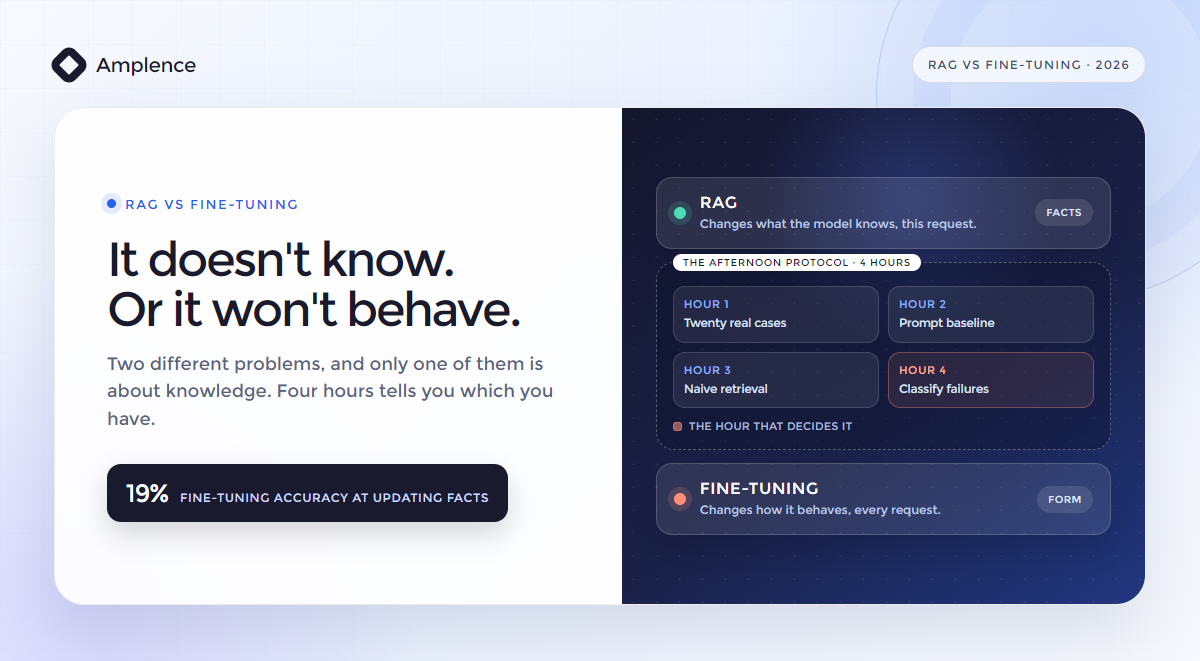
RAG fixes what the model doesn’t know. Fine-tuning fixes how it behaves.
RAG fixes what the model doesn't know. Fine-tuning fixes how the model behaves. Almost every founder asking this question has a knowledge problem, so the answer is RAG, and often not even that. Run four one-hour blocks against twenty real cases and your failure modes will tell you which one you need. Cost will not decide it. At MVP scale the two land within a few dollars a month of each other.
Teams lose weeks to this decision. They read that fine-tuning makes a model "learn your business", budget for it, and discover four months later that the model still can't answer a question about a policy written last Tuesday.
That's not a tooling failure. It's a category error. The two techniques solve different problems, and only one of them is about knowledge.
We hear this question on roughly half our scoping calls, usually phrased as "we're deciding between RAG and fine-tuning." Almost every time, the honest response is that they haven't got a decision yet. They've got twenty test cases they haven't written and a prompt nobody has taken seriously. That sounds dismissive. It isn't. It's the fastest path to shipping, and it costs nothing.
This guide uses published API rates checked on 25 August 2026, peer-reviewed results on what fine-tuning can and can't teach, and a protocol you can finish between lunch and dinner. If your product needs retrieval systems built from your own documents, the same protocol is how we scope it.
What Do RAG and Fine-Tuning Actually Do?
Strip away the marketing and there are two different interventions.
That distinction does the work. A model with your handbook in its context can quote your refund window. A model fine-tuned on your handbook has, at best, absorbed a statistical impression of it.
Here's the version we use on calls. Fine-tuning is like sending someone on a training course. They come back with better habits, a house style, and a feel for how you do things. They don't come back knowing what's in the email you sent this morning. RAG is handing them the email before they answer. You can do both, and most mature products eventually do, but if what you actually need is for them to read today's email, no amount of training will substitute.
The other thing worth knowing early: your data doesn't move. Fine-tuning bakes it into a model checkpoint, so a policy change means retraining and re-evaluating. Retrieval reads the current document at query time, which means correcting a mistake is an edit, not a project. For a product still finding its shape, that difference compounds fast.
RAG vs Fine-Tuning: The Honest Comparison
Here is the comparison with the rows that usually get left out.
| Decision factor | RAG | Fine-tuning |
|---|---|---|
| What it changes | What the model knows right now | How the model behaves every time |
| Time to first working version | Hours | Days to weeks |
| Updating your data | Re-index the changed document | Retrain the whole model |
| Can cite its sources | Yes, natively | No |
| Handles data written today | Yes | Only after another training run |
| Per-token cost | Base rate on more input tokens | 1.5x to 2x base rate, permanently |
| Fixes tone, format, and structure | Weakly, through prompting | Strongly |
| Access control per user | Enforceable at retrieval | Not possible |
| Biggest failure mode | Retrieval returns the wrong passage | Model confidently invents a plausible answer |
| Available on every major provider | Yes | No |
That last row surprises people. Anthropic's published pricing lists no fine-tuning tier for Claude at all. If your stack is on Claude, fine-tuning isn't a decision you get to make without changing provider.
What Does Each One Cost in 2026?
Published list rates, read from each vendor's own pricing page on 25 August 2026. Recheck before you budget.
| Model | Standard input / output | Fine-tuned input / output | Training | Premium |
|---|---|---|---|---|
| gpt-4.1 | $2.00 / $8.00 | $3.00 / $12.00 | $25.00 per 1M | 1.5x |
| gpt-4.1-mini | $0.40 / $1.60 | $0.80 / $3.20 | $5.00 per 1M | 2x |
| gpt-4.1-nano | $0.10 / $0.40 | $0.20 / $0.80 | $1.50 per 1M | 2x |
| gpt-4o-mini | $0.15 / $0.60 | $0.30 / $1.20 | $3.00 per 1M | 2x |
Sources: OpenAI API pricing and Anthropic pricing, both checked 25 August 2026. All figures are per million tokens. Embeddings for retrieval run $0.02 per million tokens on text-embedding-3-small.
Read the premium column twice. Fine-tuning does not charge you once. It charges you 1.5x to 2x on every token for the life of the product, and it applies to output tokens, which already cost four times what input costs. A chatty product pays that tax harder than a terse one.
RAG's cost works the other way. It adds input tokens per call, and input is the cheap side. It is also the side that caching discounts: OpenAI prices cached input at 75% off on the gpt-4.1 family, and Anthropic prices a cache hit at 0.1x base input.
A worked example at 20,000 tasks a month
Assume a support-answer feature on gpt-4.1-mini. Each task sends 800 prompt tokens and returns 300. RAG adds 2,500 retrieved tokens per call.
| Approach | Input cost | Output cost | Monthly | One-off |
|---|---|---|---|---|
| Prompt only, no retrieval | $6.40 | $9.60 | $16.00 | none |
| RAG | $26.40 | $9.60 | $36.00 | $0.10 embeddings |
| Fine-tuned | $12.80 | $19.20 | $32.00 | $10.00 per training run |
What does diverge is the retraining bill. Every behavior change means another training run and another evaluation pass, and when the provider retires that model version you pay it again. RAG's equivalent is re-indexing one document, which costs cents. Our breakdown of what an AI MVP actually costs to run separates these ongoing ledgers properly.
What the Research Says About Teaching a Model Facts
This is where the decision usually gets made, and it isn't close.
| Source | Finding | What it tested | How to read it |
|---|---|---|---|
| Ovadia et al., EMNLP 2024 | RAG scored 0.875 and 0.876 on new-knowledge tasks against 0.504 and 0.511 for fine-tuning | Two open models, MMLU plus a current-events set | Peer reviewed, open modelsPeer reviewed |
| Wu, Wu and Zou, 2024 | Commercial fine-tuning APIs averaged 37% accuracy injecting new facts and 19% updating existing ones | GPT-4o, GPT-4o mini, GPT-3.5, Gemini 1.5 Pro and Flash | Directly tests the APIs you would useTests the real APIs |
| Balaguer et al., Microsoft, 2024 | Fine-tuning added over 6 points of accuracy, RAG added 5, and the two were cumulative | Agriculture question set with location-specific answers | Shows the combination worksSingle domain |
| Barnett et al., 2024 | Seven distinct failure points, five of which sit outside the model | Three production RAG systems | The canonical failure taxonomyField study |
Sources: Fine-Tuning or Retrieval? Comparing Knowledge Injection in LLMs, FineTuneBench, RAG vs Fine-tuning: Pipelines, Tradeoffs, and a Case Study on Agriculture, Seven Failure Points When Engineering a Retrieval Augmented Generation System.
The FineTuneBench number is the one to keep. Those researchers tested the actual commercial APIs a founder would reach for, and found that fine-tuning updated existing knowledge correctly 19% of the time. Their Gemini results were worse: the paper concludes those APIs were unable to learn new knowledge at all.
Fine-tuning is not a memory. Stop treating it like one.
The Afternoon Protocol: Four Hours to a Decision
You do not need a spike, a vendor call, or a week. You need twenty real cases and four hours. Block them out, in this order.
- Build the evaluation setTwenty real cases, with the answer you'd acceptPull them from actual user questions, support tickets, or your own backlog. No synthetic examples. This hour decides everything after it, so don't shorten it.
- Baseline with a plain promptNo retrieval, no training, just a careful promptSend all twenty through and score each pass or fail. Then write one sentence per failure describing what went wrong. Those sentences are the raw material for hour four.
- Add naive retrieval by handPaste the relevant document straight into the promptNo vector database, no chunking strategy, no infrastructure. You're testing whether the information helps at all, not building a pipeline.
- Classify the failuresSort every failure sentence into the seven buckets belowThe shape of the pile is your answer. Count the rows, don't weigh the arguments.
Hour four is the whole point. You're not asking "did it get better". You're asking "what kind of wrong was it", because the kind of wrong maps directly onto the fix.
Why twenty cases? Because it's enough to see a pattern and few enough that you'll actually finish. Five hides the pattern. A hundred turns hour one into a week and the project dies there. Twenty is the number we use internally, and we've never needed more to make this particular call.
One rule for hour three: don't build anything. The temptation to stand up a vector database before you know whether retrieval helps is strong, and it's where most of these afternoons turn into fortnights. Copy and paste the document. If the answers get better with the information sitting in the prompt, retrieval is worth engineering. If they don't, you've saved yourself a sprint and learned something more valuable than any benchmark would have told you. Our step-by-step guide to building an AI MVP puts this same test before the architecture decision for the same reason.
What Your Failure Modes Are Telling You
The seven failure points below come from Barnett et al.'s study of three production RAG systems. The right-hand column is ours.
| # | Failure point | What you see | The actual fix |
|---|---|---|---|
| 1 | Missing content | The answer isn't in your documents at all | Write the document. Neither technique invents facts |
| 2 | Missed the top-ranked documents | The answer exists but retrieval ranked it too low | Better retrieval, not fine-tuning |
| 3 | Not in context | Retrieved but dropped during consolidation | Chunking and context assembly |
| 4 | Not extracted | The answer is in the context and the model missed it | Prompt, or a stronger model |
| 5 | Wrong format | You asked for a table, it wrote prose | Fine-tuning territory |
| 6 | Incorrect specificity | Too vague or too detailed for the user | Fine-tuning territory |
| 7 | Incomplete | Correct as far as it goes, but leaves things out | Prompt, or chunk boundaries |
Count your pile. Five of the seven are not fine-tuning problems. If most of your failures land in rows one to four or row seven, buying a training run will change nothing except your monthly bill.
If your pile is genuinely stacked in rows five and six, you have found the real case for fine-tuning, and you should read on.
When Do You Actually Need Fine-Tuning?
There is a real case. It is narrower than the marketing, and it looks like this.
- You need a rigid output shape on every call. A specific JSON structure, a clinical note format, a legal clause template. You have tried prompting and it holds ninety percent of the time, which is not enough.
- You need a voice you cannot describe. Tone that your editors recognize instantly but nobody can write down as an instruction. Examples teach this better than adjectives do.
- You are compressing a long prompt. If your system prompt has grown to three thousand tokens of rules, fine-tuning can bake them in and cut latency and cost per call.
- You need a small model to punch above its weight. Fine-tuning a nano-class model on a narrow task can match a much larger model at a fraction of the price.
- Your task is classification or extraction, not conversation. Fixed label sets and fixed fields are exactly what supervised training is for.
Notice what's absent from that list. None of it is about knowledge. Every item is about form, and form is what training teaches well.
You also need the data. A few hundred clean, consistent examples minimum, and consistency matters more than volume. Contradictory examples teach a model to be inconsistent, reliably. We've seen a team assemble twelve hundred examples from three different authors who each had their own idea of a good answer, then wonder why the fine-tuned model couldn't pick a lane. It had learned exactly what it was shown.
There's a timing argument too, and it cuts against fine-tuning early. Base models keep improving, and every improvement is free if you're prompting and expensive if you've trained. A fine-tune pins you to one checkpoint. When something better ships six months later, you don't just switch: you rebuild your training set, retrain, and re-evaluate before you can take the upgrade. For an MVP that's still changing weekly, that's a bad trade. For a stable, narrow, high-volume task, it's often worth it.
When Is Neither One Your Problem?
The unprofitable part of the answer, and the one we give most often on scoping calls.
- Your corpus is small enough to just paste in. Work out the break-even. RAG adds roughly 2,500 retrieved tokens per call at $0.40 per million, so about $0.001 per call. Cached input on the same model costs $0.10 per million. Divide and you get 10,000 tokens: if your entire knowledge base fits under that, caching the whole thing in the prompt is cheaper and simpler than any retrieval pipeline you could build. Claude 4.6 and later carry a full million-token context at standard rates, so the ceiling is generous.
- Your documents are a mess. Retrieval over inconsistent, duplicated, undated files returns inconsistent, duplicated, undated answers. Fix the corpus first. This is unglamorous and it is usually the highest-return work available.
- Your prompt has never been seriously written. We have watched a careful prompt with four worked examples close a gap that a team had already budgeted a fine-tuning project to fix.
- The task needs reasoning you haven't got. If the model cannot follow the logic, more context and more training both fail. Change the model or decompose the task.
That last one is worth money to hear early. Our guide to choosing an AI MVP tech stack covers when a model swap beats an architecture change.
Can You Use Both?
Yes, and for mature products it's often the right end state. The Microsoft agriculture study found the gains were cumulative: fine-tuning contributed over six points of accuracy, retrieval added five more on top.
Read those numbers carefully before you plan around them. Six points and five points are real improvements, and they are not the order of magnitude that the word "learn your business" suggests. If your evaluation set is failing half the time, an eleven-point combined lift doesn't get you to a shippable product. Something more basic is wrong, and you'll find it in hour four.
The sequencing matters too.
- Get retrieval right first. Fine-tuning on top of a retrieval layer that returns the wrong passages just teaches the model to be confidently wrong in your house style.
- Fine-tune the behavior, not the facts. Train on how to use retrieved context well: citing it, admitting when it is thin, refusing when it is absent.
- Keep the evaluation set from hour one. It is the only thing that will tell you whether the second intervention helped or quietly undid the first.
- Budget for both retraining and re-indexing. They are separate ongoing costs on separate schedules.
When we built Find The Plan, a plan-comparison MVP, retrieval was the whole architecture: every recommendation had to show the evidence behind it and hand off to a licensed advisor. A fine-tuned model could have produced fluent recommendations. It could not have shown its sources, and in that domain a recommendation without sources is not a product.
Not sure which pile your failures land in?
Send us twenty of your real cases. We'll run the protocol, classify the failure modes, and tell you which intervention your product actually needs, including when the answer is a better prompt.
Book a free scoping call ↗Which Should You Pick?
The verdict, by what you are building.
A document question-answering MVP
RAG, without hesitation. Your users will ask about things written after the model's training cut-off, they will expect citations, and access control has to be enforceable per user. All three are retrieval properties and none of them survive fine-tuning.
An internal tool over a small, stable handbook
Probably neither. Run the break-even above. Under ten thousand tokens, cache the corpus in the prompt and ship this week. You can add retrieval later when the corpus grows, and that migration is easy.
A structured extraction or classification feature
Fine-tuning is a genuine contender here, and it may be the cheaper answer because it lets you drop to a smaller model. Baseline with a prompt first, because current models are better at this than they were when the fine-tuning advice was written.
A support or operations agent
Retrieval first, then behavior. Get the agent grounded in real records, add permissions and approval points, and only then consider training the response style. Our AI agent development work sequences it that way for a reason: an agent that acts on a wrong retrieval is worse than one that answers slowly.
Frequently Asked Questions
Is RAG always cheaper than fine-tuning?
No, and the belief that it is causes bad decisions. At 20,000 tasks a month on gpt-4.1-mini the two land within four dollars of each other. Fine-tuning is more expensive over time because of retraining, not because of the per-token premium. Pick on capability and let the cost fall where it falls.
How much data do I need to fine-tune?
A few hundred consistent examples is a realistic floor for a narrow task. Consistency beats volume: fifty examples that agree with each other teach more than five hundred that contradict. If you cannot produce that set, you have your answer already.
Can fine-tuning teach a model my company's information?
Poorly, and the published evidence is blunt about it. FineTuneBench measured commercial fine-tuning APIs at 37% accuracy for injecting new information and 19% for updating existing knowledge. Use retrieval for facts.
Do I still need RAG if the model has a million-token context window?
Sometimes not. If your whole corpus fits comfortably and you can cache it, skip retrieval. Beyond that, retrieval still wins on cost, on per-user access control, and on answer quality, because a focused passage beats a haystack.
What is RAFT, and do I need it?
Retrieval-augmented fine-tuning trains a model to work well with retrieved context, including ignoring irrelevant passages. It is a real technique and a poor first move. Get retrieval working, measure it, then consider it.
How long does a RAG pipeline take to build for an MVP?
A naive one that proves the value takes an afternoon. A production one with chunking, evaluation, monitoring, and access control is a two to four week piece of work. Do not confuse the two when you plan, because the first one is what the demo runs on and the second one is what your users get.