.svg)


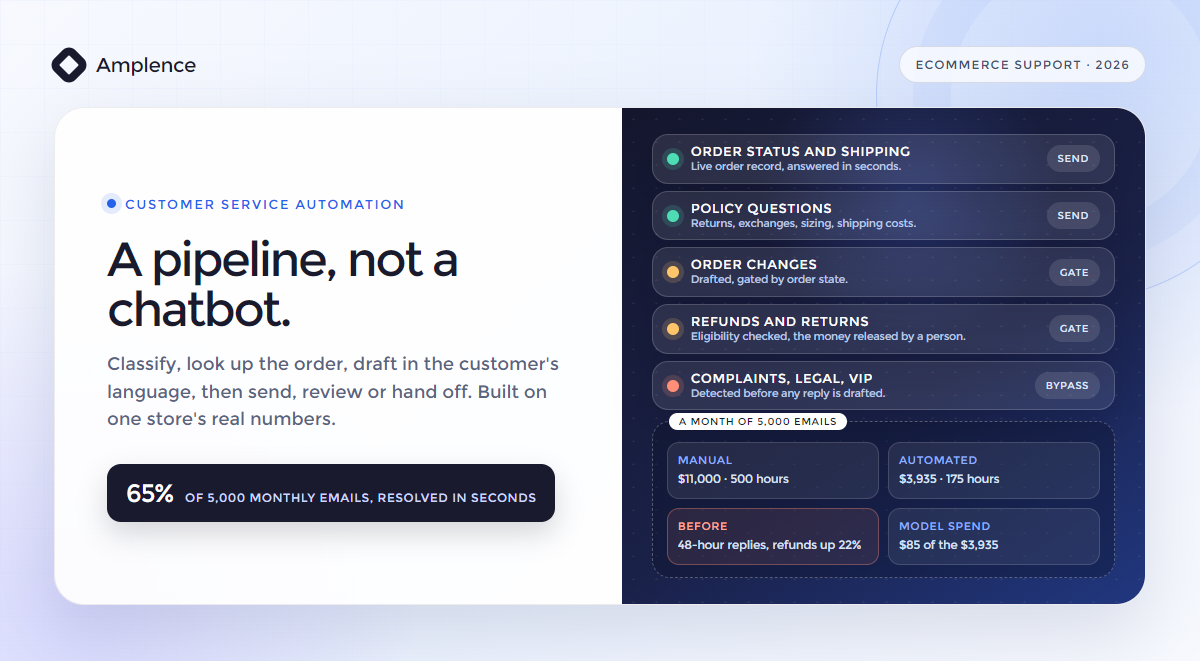
Every guide you'll find on this topic is written by a help-desk vendor, and every one of them ends at the same place: buy the platform. This one is written by the people who built a support pipeline for an online store handling more than 5,000 customer emails a month in four languages. It's built on the numbers that system produced, not on a vendor's benchmark, so you can check them. Where we use an assumption, we tell you. Where we quote a figure, it's either published in the case study or derived from it in arithmetic you can run yourself.
The guide covers what ecommerce customer service automation actually is and what the five kinds of ticket each need. It shows you what one store's numbers look like and the arithmetic on a month of email. Then it covers how the pipeline is built, which actions you should never automate without a person, what happens across languages, and what to ask whoever builds yours.
A pipeline, not a chatbot. Classify, look up the order, draft, then send, review or hand off.
Ecommerce support automation is a pipeline, not a chatbot: classify every inbound message, pull the live order record, draft the reply in the customer's language, send the safe ones and route the rest to a person with the context attached. Done properly on a real store it resolved 65% of 5,000 monthly emails in under a minute, against a 48-hour backlog before. On our cluster's constants that takes the cost of a ticket from $2.20 to $0.79 and gives you back 325 hours a month. Refunds, cancellations and anything that changes an order stay gated, because the arithmetic says so.
What ecommerce customer service automation actually is
Strip the vendor language away and there are five kinds of ticket in your inbox. They don't automate equally, and the honest guide is one that tells you which is which.
| Ticket type | What the system does | What stays with a person | The control |
|---|---|---|---|
| Order status and shipping ("where is my order", tracking, delivery window) | Pulls the live order and tracking record and answers with it | Nothing, unless the shipment is stalled past a threshold | Send, sampled weekly |
| Policy questions (returns window, exchanges, sizing, shipping costs) | Answers from your approved policy text | Nothing, if the policy is written down | Send, sampled weekly |
| Order changes (address, cancel, add an item) | Drafts the change and checks the order state | Approving anything after dispatch or picking | Gated by order state |
| Refunds and returns (start a return, issue a refund, replace a damaged item) | Confirms eligibility against policy and drafts the outcome | Issuing the money | Gated, capped |
| Complaints, chargebacks, legal language, VIP accounts | Detects them before any reply is drafted | The whole conversation | Bypass to a person |
What one store's numbers actually look like
CollageDepot is an online art-print store with customers in four languages, and if you run a store of any size you'll recognise the before picture. The case study records response times past 48 hours, a 22% rise in refund requests that tracked with the slow responses, and 70% of the support team's day going on the same repetitive questions about order status, shipping and return policies. That last figure is the one you should notice. Most of the work wasn't hard. It was the same lookup, done by hand, five thousand times a month.
After the pipeline, the published figures are 5,000-plus emails a month, 65% resolved automatically, replies in under 60 seconds, in English, Spanish, French and German. The escalation logic scores every inbound email for sentiment, urgency and complexity before a reply is drafted. Anything that crosses a threshold goes to a person with the classification and the order context already attached: a chargeback threat, a multi-issue complaint with legal language, a VIP account with a high-value order problem. The thresholds live in a dashboard the support team adjusts themselves, which is what you should expect from yours.
Those are the measured numbers this guide is built on. Everything derived from them below uses the same constants as the rest of our agent cluster, so you can trace every figure back.
The arithmetic on a month of email
Take the published volume and the constants we use across the agent cost article: six minutes of a $22 loaded hour to handle a ticket by hand, and 1.7 cents of model spend for the classify-enrich-draft run. Swap in your own rates and the shape holds.
| Manual | Automated at 65% | |
|---|---|---|
| Tickets handled by a person | 5,000 | 1,750 |
| Hours of support time | 500 | 175 |
| People, full time | 2.8 | 1.0 |
| Model spend | $0 | $85 |
| Monthly cost | $11,000 | $3,935 |
| Cost per ticket | $2.20 | $0.79 |
There's a second reading that matters more to you than the first. Suppose you don't trust the system to send unsupervised yet, and you have a person review every auto-drafted reply before it goes. Now each of those replies costs you a two-minute review instead of six minutes of handling. If half the automated replies are reviewed before sending, the monthly cost is $5,121, which is still 53% below manual. If a quarter are, it's $4,528. The tiered design is cheaper than manual at every setting of the dial: resolve the safe ones, draft the uncertain ones for review, step aside on the rest. That's why you can start cautious and loosen the thresholds as the numbers earn it.
How the pipeline is built
Every good build of this converges on the same six stages, whether it runs in n8n like CollageDepot's or in custom code. What separates a system from a chatbot is stage two, and it's the stage you should ask to see.
- Ingest and acknowledgeWhere does the message arrive?Email, contact form, chat, marketplace messages. Every arrival is acknowledged in the customer's language within seconds, with a reference, so nobody waits in silence.
- Classify before anything elseWhat is this, and is it safe to automate?Language, intent, order reference, sentiment, urgency, complexity, each with a confidence. This step decides the tier, and it runs before any reply exists.
- Enrich from the storeWhat does the order record actually say?A live call to Shopify or your platform for status, fulfilment, tracking, carrier, delivery window and line items. The reply is written from this, not from the customer's description.
- Draft in the customer's languageWhat would your best agent write?A reply that uses the name, the order, the actual answer and the relevant policy, in the language the customer wrote in, in your brand voice.
- Send, review or hand offWhich tier is this?Safe classes send. Uncertain ones wait for a person's approval. Anything gated by order state or money, or flagged by sentiment, goes to a person with the whole packet.
- Log and learnWhat did the person change?Every override is a labelled example. Escalation reasons are counted weekly, and the most common one is the next improvement.
The dashboard is not optional. Your team needs to see volume, resolution by category and language, sentiment trends and the live escalation queue. They need to move the thresholds without a developer. That's the difference between automation your team owns and automation your team fights. If you want the front-of-store version, a chat assistant on the site rather than an email pipeline behind it, our chatbot and assistant service builds it on the same six stages.
Why the order lookup is the whole game
The case study says it plainly: the live Shopify enrichment is the main reason the system reaches 65%. It's worth you understanding why, because it's the part most chatbots skip.
A reply written without the order record is a template. "Your order is on its way" is true of every order and useful to none, and you've received one. A reply written with the record says the parcel left the warehouse on Tuesday with a named carrier, is due Thursday, and here's the tracking link. That's a resolved ticket. The customer doesn't reply, doesn't call, doesn't open a chargeback. The difference between the two isn't the language model. It's the API call your builder gave the model the result of.
This is also why the pipeline needs to be honest about what it couldn't look up. An order reference that doesn't match. A shipment with no tracking event for six days. A customer email that doesn't match the account on the order. Each of those is a signal to stop drafting and hand off to you, with the reason attached.
Refunds, cancellations and the actions that stay gated
Here's where vendor guides go quiet, so we'll be specific with you. The guardrails article sets one rule for every action an agent can take: gate it when the agent's error rate times the cost of a mistake is more than the cost of a two-minute review, which is $0.73 at the same loaded rate. Apply that to your inbox with a system measured at 95% on each class.
An order-status reply that's wrong costs you one human follow-up, about $3.67, so its expected loss is 18 cents and it sends. A return-policy answer is the same. An address change before dispatch costs you about $15 when it's wrong, because a mistake means a redelivery, and it crosses the line at 75 cents: gate it. A refund on a typical order, $40, has an expected loss of $2 and you gate it without discussion. Cancelling an order that's already been picked, $60, the same.
So the pipeline draws the line exactly where the ticket table above did. It answers about money and it prepares the action, but a person releases it, and the release is capped per action and per day. That's not caution for its own sake. It's the arithmetic, and it moves in your favour as the measured error rate on each class comes down.
The 22% figure from the case study shows you what the other side of that line costs. On an illustrative store doing 4,000 orders a month at $60 with a 5% baseline refund rate, a 22% rise in refund requests is 44 extra refunds, $2,640 a month, before anyone's time is counted. The entire automated support bill in the table above is $3,935. Slow replies aren't a service problem. They're a margin problem, and you can see it in your refund column.
Four languages, one pipeline
Multilingual support is where manual ecommerce service breaks first, because you have to cover each language on every shift. The pipeline detects language in stage two and drafts in it in stage four, so your fourth language costs the same as your first: nothing. CollageDepot runs English, Spanish, French and German through one workflow, and the dashboard reports resolution by language. That's how you find out your German policy text is out of date before your German customers tell you.
The order-process version of the same idea is the Bella Luxe concept, designed for a Norwegian beauty-supply retailer selling to salons and consumers across seven European markets in five languages through four channels. There, language and market resolution is the first stage of a six-stage process that runs through account verification, stock and tier pricing, a compliance gate that can halt a restricted product before payment capture, and customs paperwork for EU-bound shipments. It's a concept rather than a measured deployment, and it's the shape you outgrow a support pipeline into: once the inbox is handled, the same stages run the order.
If you sell into the EU, one more thing belongs in stage one. Since 2 August 2026, Article 50 of the EU AI Act requires an AI system that interacts directly with people to be designed so they're told they're dealing with AI. The acknowledgement message is the natural place for it, and your builder should know the rule exists.
The 35% that reach a person
Resolution rate is the number everyone quotes you. The handoff is the number that decides whether your team likes the system. At 5,000 emails a month, 35% is 1,750 handoffs, around 80 a working day. Each one arrives at your team either as a bare forward or as a packet.
The packet is the classification, the confidence scores, the order record the system pulled, the reply it drafted, the reason it stopped, and the one decision it needs. The handoff article works through the design and the staffing arithmetic; the short version for ecommerce is that email handoffs are asynchronous by nature, so one person's day covers what four would need on standby for live chat, and the customer has already been told when to expect a reply.
Two rules from that article matter most here. "I want a person" always works, first time, in every language. And every handoff carries a reason code. A weekly count of those codes is how you find the missing policy document, the product the classifier can't place, or the carrier whose tracking feed is broken.
What honest numbers look like
Ask any vendor for their resolution rate and you'll get a number. Ask what it measures and you'll get a different one. Containment counts every conversation the bot ended, including the customer who gave up. Resolution counts problems actually solved. They get quoted interchangeably, and only one of them removes work from your team. Our cost-per-resolution article goes through the difference and the questions to ask.
The gap between the two is why Gartner's numbers on this look contradictory. Its 2024 survey of 5,728 customers found only 14% of customer service issues fully resolved in self-service. Its March 2025 prediction is that agentic AI will autonomously resolve 80% of common customer service issues by 2029, with a 30% reduction in operational costs. Both can be true. The first measures deflection bots answering from what they were told. The second describes systems that look things up and act. The 65% in this guide sits between them, and unlike the prediction, it's measured.
Four numbers tell you whether yours is real: the auto-resolution rate by category, the re-contact rate on auto-resolved tickets, the time to first response, and the weekly escalation reasons. If a vendor can only give you the first, you're looking at containment.
What to require from whoever builds it
Whether that's us or anyone else, this is what you should see written down before the system touches your inbox, and you can check every line without reading code.
- The five ticket types mapped to send, review or hand off, with the reason for each.
- Classification before drafting, with language, intent, sentiment, urgency and confidence visible on every ticket.
- Live order enrichment from your store platform, and the order record visible inside every drafted reply.
- A refund and cancellation gate with per-action and per-day caps, released by a named person.
- A required-match rule: no order details sent to an email address that isn't on the order.
- The customer acknowledgement, in their language, with a reply time you can keep and the AI disclosure where the law needs it.
- A dashboard your team owns: volume, resolution by category and language, sentiment, the escalation queue, and thresholds they can move.
- Weekly reason-code counts and a monthly review of overrides as training data.
Frequently Asked Questions
How much of ecommerce customer service can be automated?
On a real store with live order enrichment, 65% of email volume resolved automatically, and the remaining 35% reached a person with context attached. The share you get depends on your ticket mix: order status and policy questions automate almost completely, order changes and refunds are gated, and complaints go straight to a person.
Does this replace the support team?
It changes what your team does. In the case study, 70% of the team's day had gone on repetitive lookups. After the pipeline, 175 hours a month of human handling remained out of 500, and that time goes on the tickets that need judgement. The dashboard and the thresholds stay with the team, not the developer.
Can it issue refunds automatically?
It can determine eligibility, draft the outcome and prepare the refund. Issuing it stays with a person, capped per action and per day, because a $40 mistake at any realistic error rate costs more than a two-minute review. You can loosen that rule as your measured error rate on that class comes down.
What does it cost to run?
On our cluster's constants, model spend for 5,000 emails is about $85 a month. The cost that matters is the human tier: $3,850 for the 1,750 tickets that reach a person, against $11,000 for all of them by hand. What you pay for the build depends on your platform, channels and languages, not on the AI.
Will it work with Shopify, WooCommerce or a marketplace?
Any platform with an order API works for enrichment, and Shopify is the one in the case study, so if you run Shopify you are on the proven path. Marketplaces are harder because their messaging rules restrict what you can send and how fast. The classification and drafting still apply, but you'll often keep the send step manual.
Want this run on your own inbox?
Send us a month of ticket volume by type and we'll show you what resolves, what gets gated, and what the monthly bill looks like on your numbers, whether we build it or not.
Book a free support automation review ↗Sources: Amplence, CollageDepot case study and AI automation for e-commerce; Gartner, survey of 5,728 customers on self-service resolution (19 August 2024); Gartner, agentic AI prediction (5 March 2025); EU AI Act, Article 50.